What Is Digital Signal Processing? A Student's Guide
What Is Digital Signal Processing? A Student's Guide

Digital signal processing (DSP) is the mathematical and algorithmic manipulation of digitized signals to analyze, modify, and improve them for applications ranging from noise cancellation to audio compression. DSP converts real-world analog signals into discrete numerical data, applies algorithms like the Fourier transform or digital filtering, and produces a transformed output. For anyone studying audio production or sound engineering, DSP is the engine behind nearly every effect, plugin, and enhancement you hear. Understanding how it works gives you direct control over sound quality, not just a surface-level feel for the knobs.
What is digital signal processing and how does it work?
Digital signal processing is defined as the use of computational algorithms to manipulate signals that have been converted from analog to digital form. DSP digitizes real-world analog signals using analog-to-digital converters (ADCs), processes them as sequences of discrete numbers, and can convert the result back to analog via digital-to-analog converters (DACs). This three-stage pipeline, capture, process, output, is the foundation of every DSP system from a smartphone microphone to a professional studio plugin.
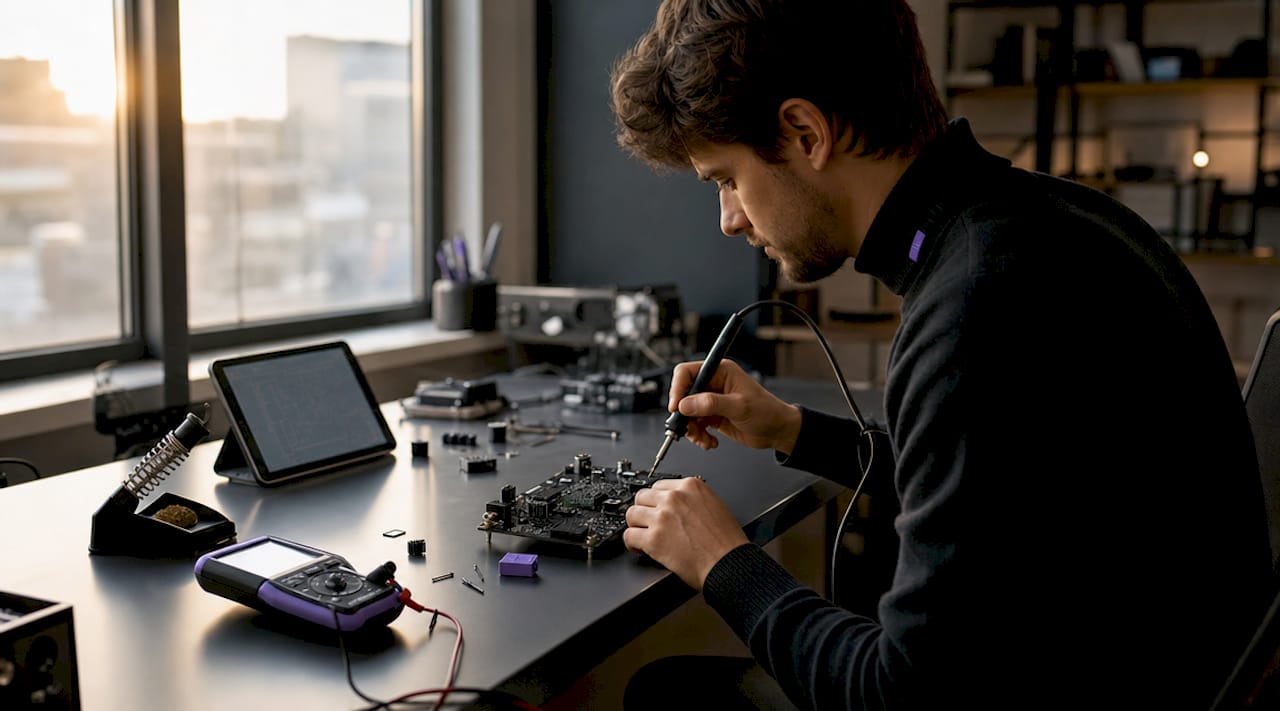
The conversion from analog to digital is not trivial. A continuous sound wave must be sampled at a precise rate, and the Nyquist-Shannon sampling theorem states that the sampling frequency must exceed twice the highest frequency in the signal to prevent aliasing. In practice, engineers use sampling rates 2.5 to 5 times higher than the signal's maximum frequency, combined with anti-aliasing filters applied before digitization. Skipping this step introduces phantom frequencies that corrupt the signal permanently.
Once digitized, the signal enters the processing stage. Here is the typical workflow:
- Anti-aliasing filtering: A low-pass filter removes frequencies above the Nyquist limit before the ADC captures the signal.
- Analog-to-digital conversion: The ADC samples the filtered signal at a fixed rate and assigns each sample a numerical value based on bit depth.
- Algorithm application: Mathematical operations such as convolution, filtering, or spectral analysis transform the raw sample data.
- Frequency domain analysis: The Fast Fourier Transform (FFT) converts the time-domain signal into its frequency components, revealing content that is invisible in the raw waveform.
- Output conversion: The processed digital signal passes through a DAC to produce an analog output, or it is stored and transmitted as digital data.
Pro Tip: When working with FFT analysis, always apply a windowing function such as Hann or Blackman to your signal before transforming it. Without windowing, spectral leakage smears energy across adjacent frequency bins and makes your frequency analysis unreliable.
Understanding DSP concepts through vector spaces and Fourier analysis is the most direct path to mastering this workflow. The math is not decorative. It is the mechanism.
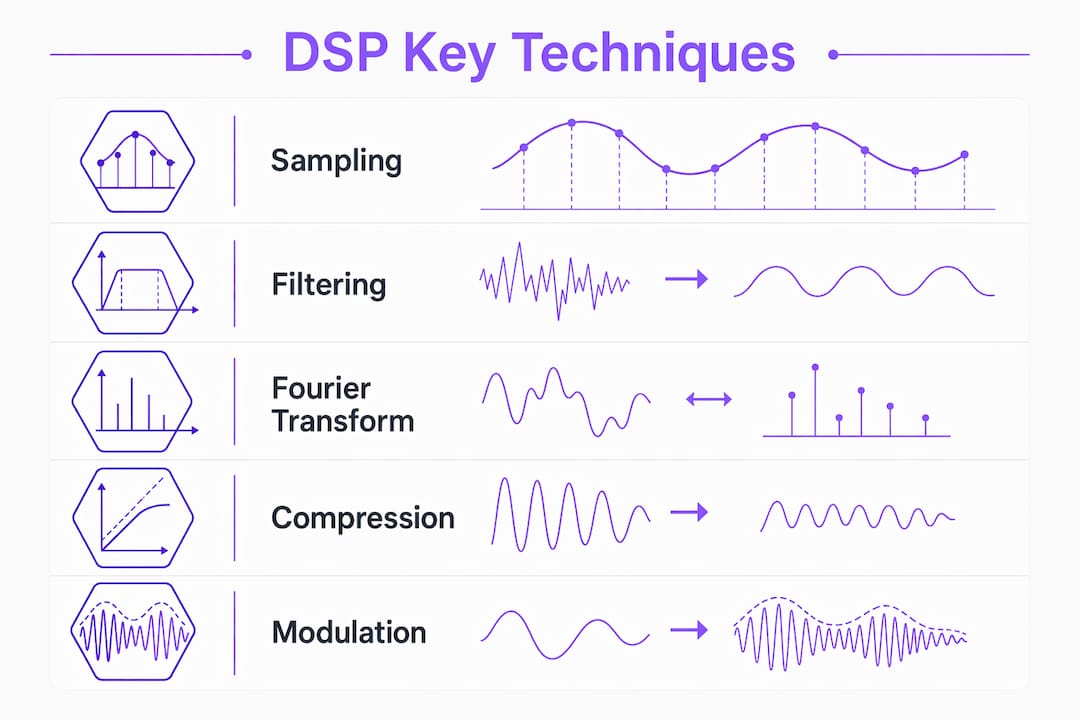
Applications of digital signal processing in audio and beyond
DSP is the technology behind the audio effects you use every day. In audio, DSP enables equalization, noise cancellation, echo cancellation, room correction, and hearing aid improvements by mathematically manipulating digitized sound. Each of these applications represents a different algorithm solving a different problem with the same underlying framework.
The most common audio applications include:
- Equalization (EQ): Digital filters boost or cut specific frequency bands. A parametric EQ in a DAW like Ableton Live or Logic Pro X is a direct implementation of IIR or FIR filter design.
- Noise reduction: Algorithms analyze the spectral profile of background noise and subtract it from the signal. Adobe Audition and iZotope RX both use DSP-based spectral subtraction for this purpose.
- Convolution reverb: Convolution combines an input signal with an impulse response captured from a real space, such as Carnegie Hall or a cathedral, to place audio convincingly inside that environment.
- Adaptive noise cancellation: Noise-cancelling headphones from Sony and Bose use adaptive filters that continuously update their coefficients to track and cancel ambient noise in real time.
- Room correction: Systems like Dirac Live and Audyssey use DSP to measure a room's acoustic response and apply inverse filters that flatten the frequency response at the listening position.
- Dynamic range compression: Compressors and limiters in plugins like FabFilter Pro-C 2 apply gain reduction algorithms that respond to signal level, controlling dynamics with sample-accurate precision.
DSP extends well beyond audio. Telecommunications systems use DSP for channel coding and error correction. Medical imaging devices like MRI scanners apply DSP to reconstruct images from raw sensor data. Radar and sonar systems rely on DSP to detect and locate objects from reflected signals. The same core techniques, filtering, convolution, and Fourier analysis, appear across all of these fields.
AI-driven audio enhancement is the newest frontier. Tools that use machine learning for source separation or AI-powered noise reduction are built on top of DSP pipelines, not instead of them. The neural network outputs a set of filter coefficients or a mask that the DSP engine then applies to the signal.
Pro Tip: If you want to hear DSP in action without any software, compare the sound of a phone call with and without the speakerphone mode. The difference in clarity is almost entirely the result of echo cancellation and noise suppression algorithms running in real time.
How does digital processing compare to analog processing?
The core difference between digital and analog signal processing is programmability. Analog processing uses fixed hardware circuits, resistors, capacitors, and operational amplifiers, where the processing behavior is determined by the physical components. DSP operates in software and hardware using repeated algorithmic manipulations, which means the same physical chip can implement a reverb, a compressor, or a noise gate by loading different code.
| Feature | Digital signal processing | Analog processing |
|---|---|---|
| Flexibility | Parameters adjustable in software without hardware changes | Fixed by physical circuit design |
| Precision | Determined by bit depth and sampling rate | Subject to component tolerances and drift |
| Noise floor | Quantization noise from bit depth limits | Thermal noise inherent in all components |
| Latency | Introduces processing delay, especially with lookahead | Near-zero latency, signal flows continuously |
| Error correction | Supports error detection and data compression | No native error correction capability |
| Replicability | Identical behavior across every instance | Slight variation between units due to component tolerances |
Analog processing still holds an advantage in latency-critical applications. A hardware analog compressor responds to a transient with essentially zero delay. A digital compressor running in a plugin introduces at minimum a few samples of latency, and lookahead designs add more. For live performance monitoring, this difference is audible and matters. Many engineers use analog hardware on the signal chain for this reason, even when the rest of their workflow is entirely digital.
The other trade-off is quantization noise. Every ADC assigns a finite numerical value to each sample, and the rounding error produces a noise floor that scales with bit depth. At 24-bit resolution, this noise floor sits around 144 dB below full scale, which is inaudible in any practical context. At 16-bit, it sits around 96 dB, still below the threshold of most listening environments.
What are the key digital signal processing techniques that shape sound quality?
The quality of any DSP-based audio system depends on the specific techniques used and how well they are implemented. Two filter types define most of what you hear in digital audio.
FIR vs. IIR filters are the central choice in audio DSP design. FIR filters offer linear phase response and unconditional stability but require more computational resources and introduce higher latency because they process a longer window of samples. IIR filters are computationally efficient and can model analog filter behavior closely, but they can introduce phase distortion and, if poorly designed, become unstable. A linear-phase EQ in a mastering plugin uses FIR design. A vintage-modeled analog EQ emulation typically uses IIR design to capture the phase behavior of the original hardware.
- Sampling rate and bit depth directly set the ceiling on sound fidelity. A 44.1 kHz sampling rate captures frequencies up to 22.05 kHz, covering the full range of human hearing. A 96 kHz rate extends the ceiling to 48 kHz, which matters for processing headroom rather than direct audibility. Higher bit depth increases dynamic range and reduces quantization noise.
- Convolution is the mathematical operation that makes impulse response-based effects possible. When you load a guitar cabinet impulse response into a plugin like Two Notes Wall of Sound or Neural DSP Archetype, the plugin convolves your dry signal with the impulse response to produce the cabinet sound.
- Windowing and spectral leakage affect any FFT-based analysis or processing. Without a proper windowing function, FFT settings produce spectral leakage that makes frequency components appear broader and less defined than they are. This is not just an academic concern. It affects the accuracy of dynamic EQ, spectral compressors, and any plugin that makes decisions based on frequency content.
- Latency and CPU constraints are the practical ceiling on algorithm complexity. Real-time DSP must balance algorithm complexity and causality to meet strict processing deadlines without audible delay. A plugin that uses heavy convolution or machine learning inference must complete its calculations within the audio buffer period, typically 64 to 512 samples, or it causes dropouts.
Pro Tip: When comparing FIR and IIR filter behavior in a DAW, bypass the plugin and listen to the phase shift introduced by IIR designs on transient-heavy material like drums. The smearing is subtle but cumulative across a full mix.
Filter design in audio DSP balances stopband attenuation, phase response, latency, and computational load simultaneously. No single filter type wins on all four dimensions, which is why experienced engineers choose the right tool for each specific task.
Key takeaways
Digital signal processing is the foundational technology behind every modern audio effect, and mastering its core principles, filtering, sampling, and convolution, gives you direct, informed control over sound quality.
| Point | Details |
|---|---|
| DSP defined | DSP converts analog signals to digital data and applies algorithms to analyze or transform them. |
| Nyquist-Shannon theorem | Sampling rate must exceed twice the signal's highest frequency to prevent aliasing artifacts. |
| FIR vs. IIR filters | FIR filters offer linear phase and stability; IIR filters are efficient but can introduce phase distortion. |
| Latency trade-off | Digital processing introduces delay that analog circuits avoid, which matters in live monitoring contexts. |
| Convolution reverb | Convolution applies a real-space impulse response to audio, placing it convincingly in a physical environment. |
Why most learners misunderstand DSP before they ever use it
Most students approach DSP as a collection of formulas to memorize rather than a set of physical intuitions to build. That framing makes the subject harder than it needs to be and leads to the most common practical mistakes I see.
The biggest one is ignoring windowing. Engineers spend hours chasing a resonance that their spectrum analyzer shows, not realizing the peak is a spectral leakage artifact from an improperly configured FFT window. The signal is fine. The analysis is broken. Getting comfortable with windowing functions early saves enormous time later.
The second misconception is that higher sampling rates always produce better sound. They produce more processing headroom and reduce aliasing in nonlinear processes like saturation and distortion. For a clean signal chain with no nonlinear processing, 44.1 kHz and 96 kHz are perceptually identical. The choice of sampling rate is a workflow and processing decision, not a fidelity statement.
What I find genuinely exciting about DSP right now is the convergence with machine learning. AI audio tools are not replacing DSP. They are being trained to generate DSP parameters, filter coefficients, gain curves, and spectral masks that a traditional algorithm would have computed through rules. Understanding AI audio enhancement becomes much clearer once you understand the DSP layer underneath it. The neural network is the brain. DSP is still the hands.
Start with the fundamentals: sampling theory, filter design, and the FFT. Build intuition through experimentation in a DAW or a free tool like GNU Octave or MATLAB Online. The concepts compound quickly once the core framework clicks.
— Kai
Hear the difference with Vector-dsp

Vector-dsp builds professional audio plugins grounded in the same DSP principles covered in this guide. The ToneLab plugin applies precision filter design and real-time processing to deliver audio effects with low latency and meticulous control over sound character. Every algorithm in the Vector-dsp lineup is designed with the constraints covered here in mind: phase response, computational efficiency, and stability under real-world conditions. If you are ready to move from understanding DSP to hearing it in action, explore the full Vector-dsp product range and see how thoughtful algorithm design translates directly into sound quality.
FAQ
What is digital signal processing in simple terms?
Digital signal processing is the use of mathematical algorithms to modify or analyze signals, such as audio or sensor data, after they have been converted from analog to digital form. Every noise-cancelling headphone, digital EQ, and audio plugin runs on DSP.
How does digital signal processing affect sound quality?
DSP affects sound quality through the precision of its filters, the sampling rate and bit depth used during conversion, and the latency introduced by the processing algorithms. Higher bit depth reduces quantization noise, and well-designed filters preserve phase integrity across the frequency spectrum.
What are the main applications of digital signal processing in audio?
The main audio applications include equalization, dynamic range compression, convolution reverb, noise reduction, echo cancellation, and room correction. Each application uses a different algorithm, but all rely on the same core DSP pipeline of digitization, processing, and output conversion.
What is the difference between FIR and IIR filters in DSP?
FIR filters provide linear phase response and are unconditionally stable, while IIR filters are computationally lighter but can introduce phase distortion and potential instability. Audio mastering tools typically use FIR designs; analog-modeled plugins typically use IIR designs.
Why does sampling rate matter in digital signal processing?
Sampling rate determines the highest frequency a DSP system can capture and process without aliasing. Per the Nyquist-Shannon theorem, the sampling rate must exceed twice the signal's highest frequency component, which is why audio is recorded at 44.1 kHz or higher to cover the full range of human hearing.