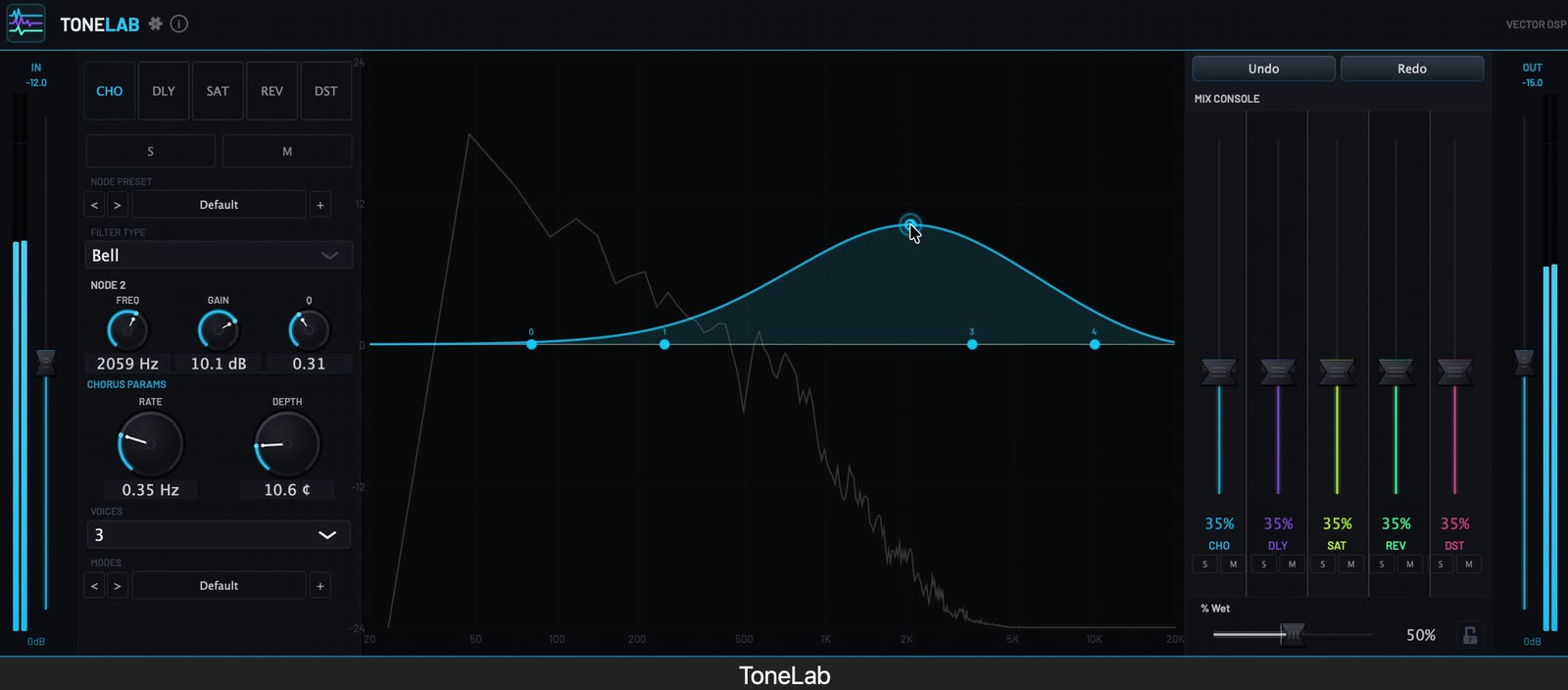
ToneLab confines reverb, distortion, delay, chorus and saturation to the frequency ranges you choose — the parallel send chain you'd hand-build from five buses and five EQs, in a single VST3 / AU / AAX insert.
For producers and mix engineers who want their FX surgical, not smeared. A Vector DSP product for macOS and Windows.
Carefully designed audio software built on industry-standard architecture.
A multi FX processor with a classic EQ interface that lets you apply effects to specific frequency ranges — not your entire signal. Reverb in the mids only. Distortion just in the lows. Five parallel lanes, each with its own EQ, in a single insert.
Get ToneLab →Visuals driven by the audio itself, rendered offline rather than captured off a screen — linear light, 16-bit float, no banding. Name and date when it's ready.
Three things ToneLab lets you stop doing by hand — and the engineering underneath each one.
Each lane's EQ decides where its effect lands, so a long reverb never washes into your 808. Real-time performance is the constraint every processing decision is made against — latency and CPU efficiency first, not as an afterthought.
Five sends, five buses, five EQ instances — rebuilt every session. ToneLab makes that routing permanent. Every parameter, algorithm and interface decision is deliberate; nothing is added for the sake of it.
Saturate the low mids, chorus the air, leave the vocal range untouched — without leaving the channel. Built in C++ on the same architecture professional audio companies use, and shipped in the formats you actually run: AU, VST3 and AAX.
Vector DSP is built on a straightforward idea: audio software should give you more control, not more complexity. We build DSP tools using industry-standard architecture — each one designed around a specific problem that existing plugins don't solve well.
I wanted something that didn't exist, so I spent a year building it. ToneLab is five parallel DSP lanes in C++ on JUCE, every one of them on a microsecond budget. I'm also the only person on the support email — which means the brain that wrote the bug has to explain it too.