DSP Algorithm Design for Audio Professionals Explained
DSP Algorithm Design for Audio Professionals Explained
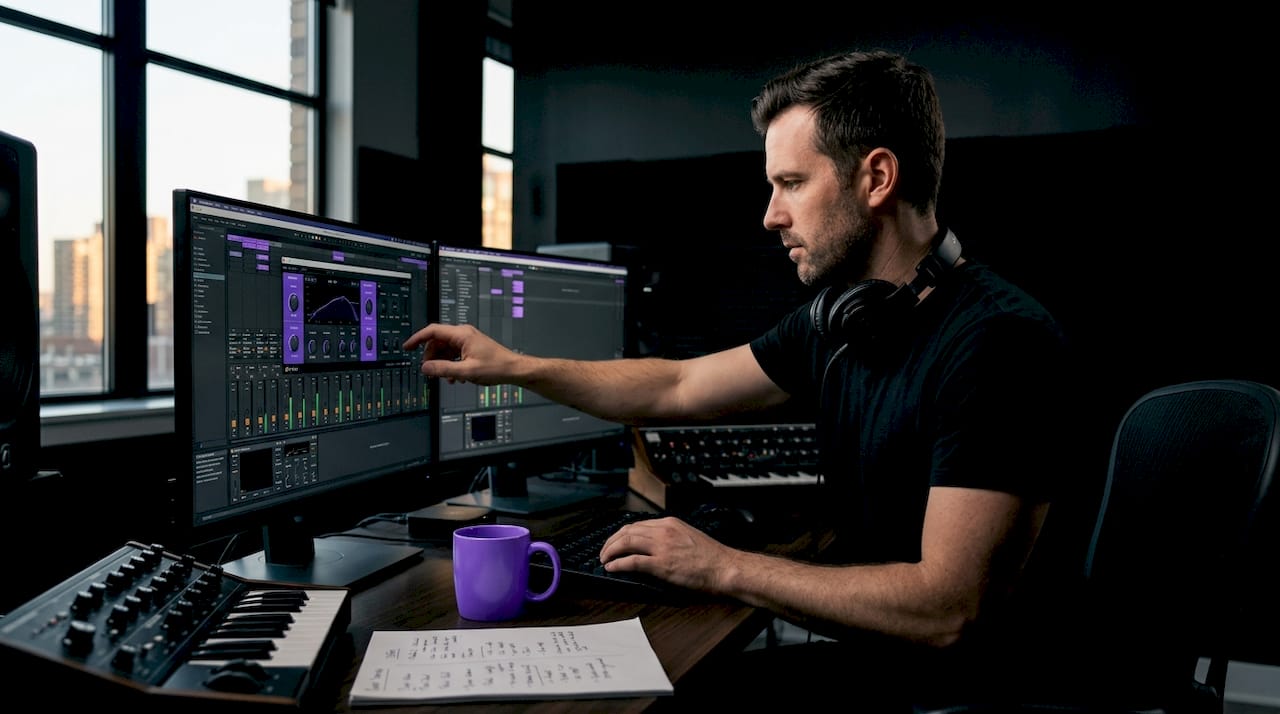
Understanding what is DSP algorithm design separates producers who work with audio tools from those who truly understand them. At its core, DSP algorithm design is the process of selecting, developing, and refining mathematical operations that transform digitized audio signals into exactly the sound you need. Whether you're building a reverb plugin, designing a multiband compressor, or studying audio engineering, the principles behind digital signal processing algorithms govern every effect, filter, and dynamic processor you use daily.
Table of Contents
- Key takeaways
- What is DSP algorithm design: core principles
- Core algorithm types used in music production
- Practical design steps and real-world trade-offs
- Advanced techniques: multirate DSP and modern implementation
- My honest take on learning DSP algorithm design
- Build better audio tools with Vector-dsp
- FAQ
Key takeaways
| Point | Details |
|---|---|
| DSP design is intentional | Algorithm selection follows specific audio goals, not trial and error with math. |
| Filter type determines trade-offs | FIR offers linear phase, IIR offers efficiency. Choosing between them shapes latency and sound quality. |
| Iteration beats perfection | Designing DSP algorithms requires testing by ear and by measurement, not just verifying math. |
| Multirate processing reduces load | Decimation and interpolation techniques cut computation costs significantly in real-time audio. |
| Algorithm and implementation are separate | Keeping math logic separate from hardware code makes DSP systems easier to maintain and optimize. |
What is DSP algorithm design: core principles
DSP algorithm design involves choosing mathematical algorithms like filters and transforms to process digitized audio signals for specific outcomes such as noise reduction, equalization, or reverberation. Before any algorithm runs, an analog-to-digital converter captures your audio signal, sampling it at regular intervals and quantizing each sample into a binary value. At 44.1kHz and 24-bit depth, that's over a million bits of data generated every second from a single mono track.
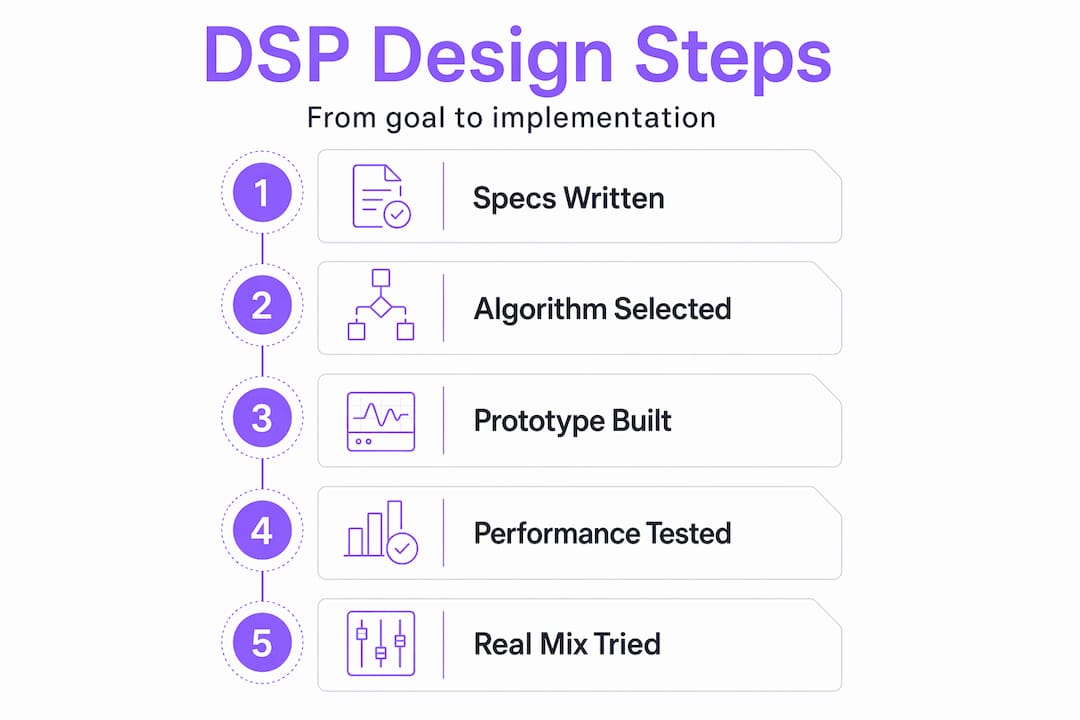
From there, the workflow follows a clear path. You define your audio processing goal, select an algorithm or combination of algorithms that can achieve it, implement that algorithm in code or hardware, and test the result against your original specification. The math at the heart of this process draws from a relatively small set of building blocks: filters, transforms like the FFT, convolution operations, and increasingly, adaptive methods that respond to the signal itself.
The design workflow has four practical phases:
- Specify the goal. What does the processed signal need to sound like? Define frequency targets, dynamic behavior, or noise floor requirements precisely.
- Select the algorithm. Match your specification to appropriate filter types or transform methods based on known trade-offs.
- Implement and test. Write or configure the algorithm, then verify performance with both measurement tools and critical listening.
- Refine. Adjust coefficients, filter order, or processing chain structure until the result meets the spec.
Pro Tip: Write your audio specification before you touch any code or plugin parameter. "A highpass filter at 80Hz with less than 1dB of passband ripple" is a design spec. "Make it sound less muddy" is not. One of those will get you to a working algorithm faster.
Core algorithm types used in music production
The most common digital signal processing algorithms in audio fall into a handful of well-defined categories, each with specific strengths and use cases.
FIR vs. IIR filters
FIR and IIR filters are the foundation of almost every EQ, crossover, and effect processor you use. FIR (Finite Impulse Response) filters have a linear phase response, meaning all frequencies are delayed by the same amount through the filter. That consistency makes them popular for mastering EQs and linear-phase plugins. The trade-off is computational cost. A high-quality FIR filter may require hundreds or thousands of multiply-accumulate operations per sample.

IIR (Infinite Impulse Response) filters are modeled after analog circuits, which is why they appear in virtually every console-style EQ, compressor, and saturator plugin. They're computationally efficient but introduce phase shift that varies with frequency. For most mixing scenarios, that's not a problem. For phase-critical parallel processing, it can matter significantly.
| Feature | FIR filter | IIR filter |
|---|---|---|
| Phase behavior | Linear phase | Nonlinear, frequency-dependent |
| Computational cost | Higher (many coefficients) | Lower (recursive feedback) |
| Stability | Always stable | Can become unstable if misdesigned |
| Analog sound character | Neutral | Closer to analog circuit behavior |
| Best use case | Mastering, linear-phase EQ | Real-time mixing, saturation, dynamics |
FFT and convolution
The FFT converts time-domain audio to the frequency domain, making it possible to analyze, manipulate, and display spectral content in real time. Every spectrum analyzer, vocoder, and convolution reverb relies on FFT as a core operation. Convolution itself describes how one signal shapes another, which is why impulse response reverbs work: they convolve your dry audio with a recorded room impulse to produce a convincing spatial effect.
Adaptive filtering
Adaptive filters outperform static filters in non-stationary noise scenarios, which makes them the right tool for live stage noise reduction and dynamic acoustic environments. Algorithms like LMS (Least Mean Squares) continuously adjust filter coefficients based on incoming signal conditions. The result is a filter that "tracks" the noise floor in real time rather than relying on a fixed profile set during static calibration.
Pro Tip: If you're designing a noise gate plugin or any real-time noise reduction tool, look at adaptive filtering before assuming a fixed filter will do the job. Stage environments change constantly, and LMS-based approaches handle that variability far better.
Practical design steps and real-world trade-offs
Designing DSP algorithms for actual studio and live audio contexts introduces constraints that textbooks rarely emphasize. Latency, computational budget, and phase behavior all become real problems the moment you move from simulation to a plugin running in a DAW.
Start with requirements. A mastering limiter and a live guitar effects pedal processor share almost nothing in common despite both being "DSP audio tools." The mastering limiter can tolerate latency if lookahead is built in. The guitar pedal cannot tolerate even a few milliseconds of added delay without the player noticing. Defining your latency budget before choosing an algorithm eliminates a large category of options immediately.
Iterative design using MATLAB or similar software tools lets you move quickly from specification to a working prototype. The DSP System Toolbox workflow follows a clear loop: specify filter requirements, select a design algorithm, generate an implementation object, and verify the result against your original spec. If the result doesn't meet requirements, you adjust the specification or try a different algorithm family.
Common pitfalls to watch for in any DSP algorithm design project:
- Aliasing. When processing involves frequency shifting or nonlinear operations, aliased artifacts appear above the Nyquist frequency. Oversampling the signal before processing and then downsampling afterward is the standard fix.
- Numeric overflow. Fixed-point implementations in hardware or embedded DSP chips have strict numeric range limits. Scale your signal appropriately before any multiply operation.
- Phase cancellation. Parallel processing chains that use IIR filters may cause phase cancellation when summed. Test in mono to catch this early.
- Filter instability. IIR filter coefficients that seem mathematically valid can still produce unstable behavior at sample rate boundaries. Always verify pole placement.
FFT parameters and window functions significantly affect how algorithm performance is perceived during testing. A rectangular window will produce spectral leakage that can make a well-designed filter look noisy on a measurement display. Use appropriate windowing for your analysis context and verify your measurement setup before concluding that an algorithm has failed.
Pro Tip: Test every DSP algorithm you design in both a controlled measurement environment and in a real mix context. A filter that looks perfect on a frequency response plot may introduce audible coloration that only becomes obvious when processing a full drum bus.
Advanced techniques: multirate DSP and modern implementation
Multirate DSP is one of the most practically useful areas of DSP algorithm design and one of the least discussed in introductory resources. Decimation and interpolation techniques let you process audio at a lower sample rate than the input, perform the computation, and then upsample back to the original rate. That approach can dramatically reduce the number of operations per second required for narrowband filters or analysis tasks.
Multistage and polyphase filtering techniques extend this further by cascading smaller filter stages with decimation and interpolation at each stage. For narrow bandpass filters used in spectral analysis or formant processing, this approach reduces computation by an order of magnitude compared to a single-stage design at full sample rate.
| Technique | What it does | When to use it |
|---|---|---|
| Decimation | Downsamples signal by factor N | Narrowband filtering, analysis |
| Interpolation | Upsamples signal by factor M | Output reconstruction, rate matching |
| Polyphase decomposition | Splits filter into parallel sub-filters | Efficient FIR filter implementation |
| Multistage filtering | Cascades stages with rate changes | Very narrow bandpass, EQ analysis |
On the implementation side, separating algorithmic math from hardware execution details is one of the most important principles in professional DSP development. Your filter coefficient math should be defined independently from concerns like memory layout, thread scheduling, or SIMD vectorization. That separation makes algorithms portable across platforms and far easier to debug when behavior changes between hardware targets.
Machine learning is entering DSP algorithm design in meaningful ways. Neural networks now model analog hardware characteristics with high accuracy, and AI-based noise suppression systems process audio in real time with results that outperform classical adaptive filters in many scenarios. The underlying DSP pipeline still handles signal capture, windowing, and buffering, but the "algorithm" performing the processing may be a trained model rather than a hand-designed filter.
My honest take on learning DSP algorithm design
I've seen a lot of audio professionals and students approach DSP with the assumption that the math is the hard part. In my experience, the math becomes straightforward once you've worked through it a few times. The genuinely difficult part is developing the ear-to-algorithm connection: knowing which algorithm property is causing what you're hearing.
What I've learned after years of working on DSP-based audio tools is that most design mistakes don't come from incorrect math. They come from skipping the specification phase and jumping straight to implementation. When you don't define what "correct" sounds like before you start, you end up tuning parameters indefinitely with no clear stopping point.
The other thing I'd push back on is the idea that more complex algorithms always produce better results. I've heard IIR filters at low orders solve problems that elaborate FIR designs couldn't, simply because the nonlinear phase behavior added a subtle warmth that the linear-phase version removed. The filter design methodology matters less than understanding what each choice costs you perceptually.
My advice: learn to read a frequency response and phase plot before you write a single line of DSP code. Then prototype fast, test by ear in a real mix, and iterate. That cycle will teach you more than any textbook chapter on z-transforms alone.
— Kai
Build better audio tools with Vector-dsp
If you're moving from understanding DSP algorithm design to building actual audio plugins, Vector-dsp provides the architecture and development resources to make that transition practical.
Vector-dsp builds professional-grade audio software rooted in precise DSP design, real-time performance, and low-latency execution. The ToneLab platform is built specifically for music producers and audio developers who need a reliable foundation for plugin development across VST3, AU, and AAX formats. Whether you're designing your first filter plugin or working on a complex multiband processor, Vector-dsp gives you the tools and technical framework to move from algorithm concept to finished product.
FAQ
What is DSP algorithm design in simple terms?
DSP algorithm design is the process of selecting and developing mathematical operations that process digital audio signals to achieve a specific outcome, such as equalization, reverb, or noise reduction. It combines signal theory, filter design, and practical implementation into a workflow that transforms raw audio data into processed sound.
What are the most common DSP algorithms in music production?
The most common digital signal processing algorithms in music production include FIR and IIR filters for equalization and dynamics, FFT for spectral analysis, convolution for reverb and impulse response processing, and adaptive filters for noise reduction in real-time environments.
What is the difference between FIR and IIR filters?
FIR filters have linear phase response and are always stable, but require more computation. IIR filters are more efficient and closer to analog character, but introduce nonlinear phase shift and can become unstable if designed incorrectly.
How do you start designing a DSP algorithm for audio?
Start by writing a precise specification for what the processed signal should sound like, including frequency targets, dynamic behavior, and latency limits. Then select an algorithm type that matches those requirements, implement it in a prototyping environment like MATLAB, and verify both by measurement and critical listening.
Why does multirate processing matter for audio DSP?
Multirate processing reduces the computational load of audio DSP by allowing filters to operate at a lower sample rate than the input signal. Decimation and polyphase techniques make narrowband filtering and spectral analysis significantly more efficient, which is critical for real-time plugin performance.