What Is Audio Forensics Processing: an Expert Guide
What Is Audio Forensics Processing: an Expert Guide
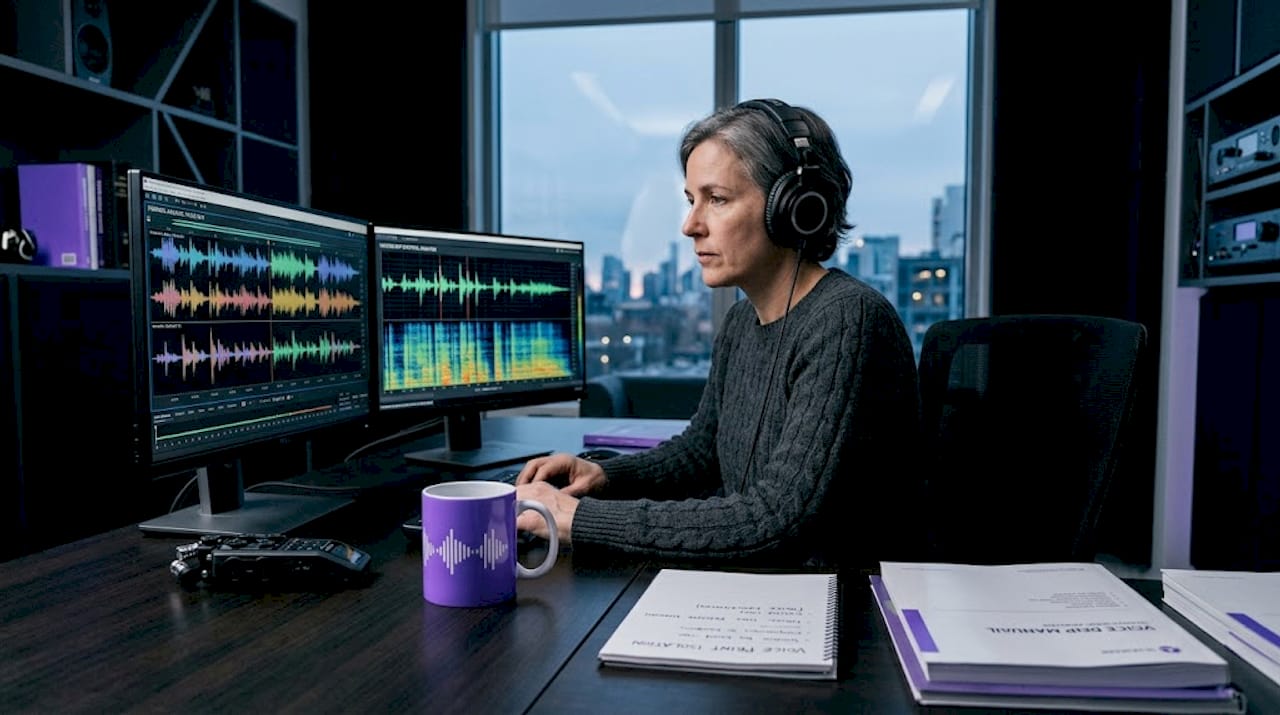
Audio forensics processing is not audio editing with a legal label slapped on it. It is a rigorous scientific discipline covering the analysis, authentication, and processing of recorded sound for use in legal and investigative contexts. If you work in law enforcement, litigation, or forensic analysis, understanding what this process actually involves changes how you collect, handle, and present audio evidence. This guide breaks down the core techniques, the step-by-step workflow, the tools that matter, and the limits you need to respect before audio reaches a courtroom.
Table of Contents
- Key takeaways
- What audio forensics processing actually covers
- The forensic audio workflow from start to finish
- Technical tools and techniques in depth
- Applications and real limitations of audio forensics
- Choosing the right experts and software
- My perspective on where forensic audio actually stands
- Take your audio analysis further with Vector-dsp
- FAQ
Key takeaways
| Point | Details |
|---|---|
| It's a scientific discipline | Audio forensics processing involves enhancement, authentication, and comparison — not basic editing. |
| Chain of custody is non-negotiable | All work must be done on a forensic copy, with every step documented for court admissibility. |
| Spectrograms are primary evidence | Spectrographic analysis visualizes audio data in ways that make tampering and speech patterns visible to courts. |
| ENF analysis verifies time and location | Matching recorded power grid hum to historical records can confirm when and where a recording was made. |
| AI tools help but require expert oversight | Machine learning improves detection accuracy, but unqualified use risks over-processing and evidentiary damage. |
What audio forensics processing actually covers
At its core, audio forensics divides into three distinct areas: enhancement, authentication, and comparison. Each one serves a different legal purpose, and confusing them is one of the most common mistakes professionals make when first engaging with forensic audio work.
Enhancement improves the intelligibility of a recording without changing its evidentiary content. The goal is clarity, not creativity. Techniques include noise reduction, filtering, and equalization applied conservatively to make speech or other sounds more understandable. The critical constraint is that enhancement must never alter what actually happened acoustically. You are revealing what is there, not constructing something new.
Authentication answers a different question entirely: is this recording genuine? Experts analyze internal consistency, metadata, file structure, and acoustic artifacts to determine whether a recording has been tampered with, edited, or fabricated. This is where tools like ENF analysis and spectrographic inspection become central.
Comparison involves measuring audio against known reference material. Speaker identification is the most well-known application, where a questioned voice recording is compared against a known exemplar. Acoustic event analysis falls here too, such as matching a gunshot recording to a specific firearm.
Common tools used across these three areas include:
- Digital audio workstations configured for non-destructive analysis
- Spectrographic analysis software such as Adobe Audition, iZotope RX, and specialized forensic platforms
- Metadata inspection utilities for examining file headers and timestamps
- ENF analysis tools that cross-reference power grid frequency databases
- Speaker comparison software built around established phonetic and acoustic models
Pro Tip: Never run enhancement processes on the original evidence file. Always work from a verified forensic copy and log every tool, setting, and parameter you apply before moving to the next step.
The forensic audio workflow from start to finish
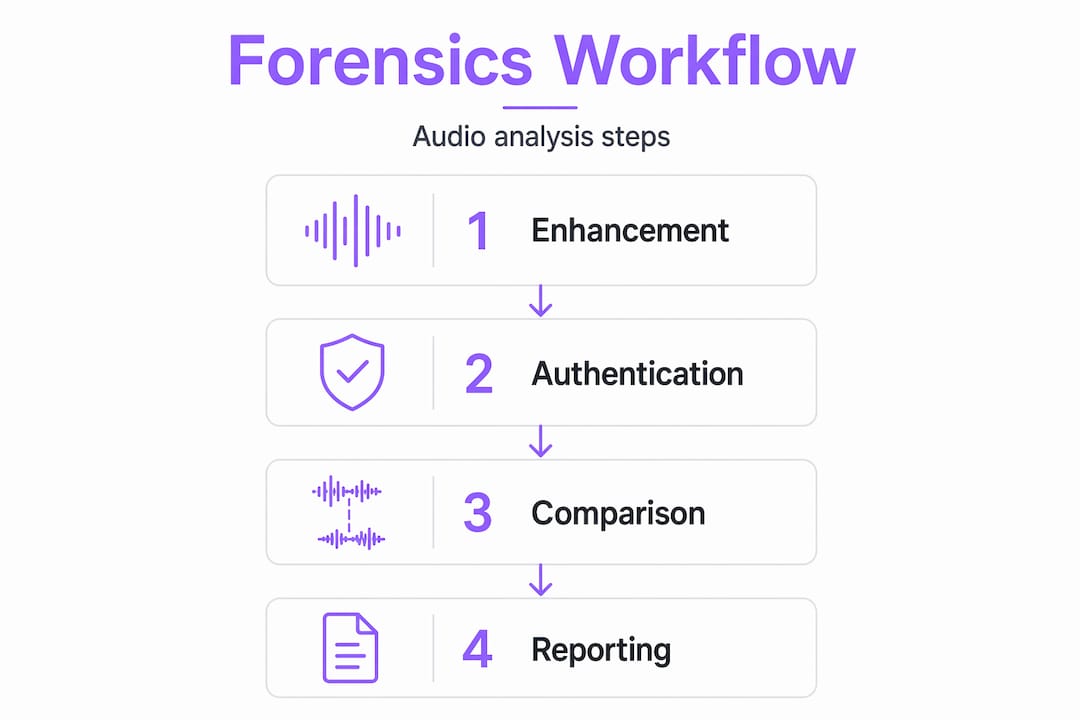
Getting the analysis right means getting the process right first. The forensic workflow begins before a single waveform is touched, with creating and verifying a secure bit-for-bit working copy of the original evidence. This preserves the original's metadata and ensures that nothing about the source file is altered during analysis.
- Create and verify a forensic working copy. Generate a cryptographic hash of the original file before doing anything else. This hash becomes your proof of integrity. Any work you do from this point happens on the copy only.
- Define the region of interest (ROI). Not every second of a recording is evidentiary. Identify the specific segment relevant to the investigation before applying any processing. This prevents unnecessary signal manipulation and keeps your documentation focused.
- Assess the recording's challenges. Listen critically and note background noise types, compression artifacts, microphone distortion, and any audible anomalies. This assessment informs which techniques are appropriate and which are too aggressive for the material.
- Apply enhancement cautiously. Use the most conservative processing that achieves the necessary intelligibility. Over-processing with AI enhancement tools risks introducing synthetic artifacts that reduce the recording's evidentiary value and may be challenged in court.
- Conduct authentication analysis. Run spectrographic and waveform inspection, check metadata, and apply ENF analysis where the recording conditions support it.
- Document every single step. Every action must be logged with timestamps, screenshots, parameter settings, and plain-language explanations. This documentation is what makes your analysis reproducible and defensible under cross-examination.
- Produce a formal report. The report should present findings clearly, acknowledge uncertainty honestly, and explain the methods used in terms that a judge or jury can follow.
Pro Tip: Judges and opposing counsel will challenge your methodology before they challenge your conclusions. If you cannot show exactly what you did and why, even strong findings lose credibility.
Technical tools and techniques in depth
The scientific methods behind audio evidence processing are more nuanced than most legal professionals realize. Understanding them helps you evaluate the quality of a forensic report and ask the right questions of an expert witness.
Spectrographic analysis
A spectrogram translates audio into a three-dimensional visual representation: time on the horizontal axis, frequency on the vertical axis, and intensity shown through color or brightness. Spectrograms serve as primary court evidence because they make invisible acoustic phenomena visible. An expert can identify speech patterns, background sounds unique to a location, and discontinuities that indicate editing. A cut in a recording rarely sounds obvious to the ear, but it leaves a visible seam in a spectrogram.
Waveform inspection
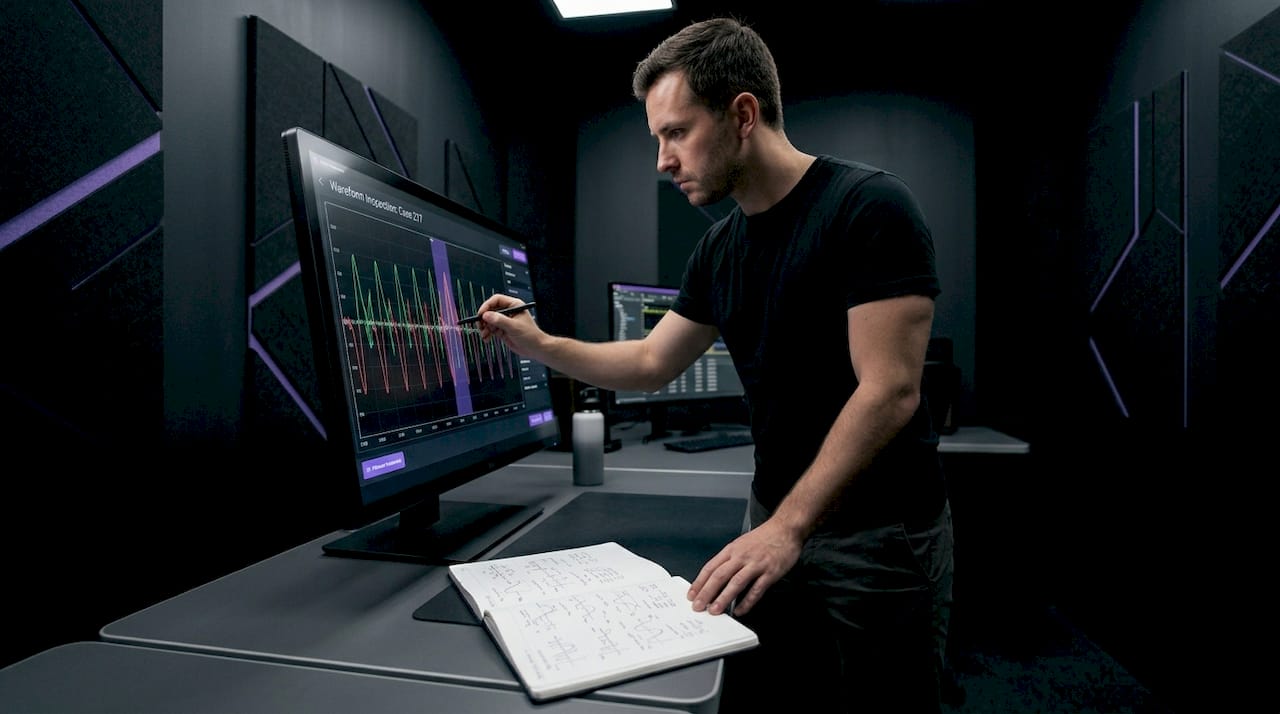
Waveform analysis examines the amplitude of sound over time. Unnatural flat sections, abrupt changes in noise floor, or repeated waveform segments can indicate tampering. When combined with spectrographic data, waveform inspection strengthens authentication findings considerably.
ENF analysis
The Electronic Network Frequency is the hum produced by electrical power grids, typically at 50 or 60 Hz depending on the region. This frequency fluctuates slightly but measurably over time, and these fluctuations are recorded in historical databases. By extracting the ENF signal from a recording and matching it against those records, analysts can verify when and where a recording was made. Fabricated or edited recordings often fail this test because the ENF pattern breaks continuity.
Here is how the major technical methods compare for evidentiary use:
| Method | What it detects | Limitations |
|---|---|---|
| Spectrographic analysis | Tampering, speech patterns, location-specific sounds | Requires clean recording; heavy compression reduces accuracy |
| Waveform inspection | Edits, noise floor changes, amplitude anomalies | Less definitive alone; works best alongside spectrograms |
| ENF analysis | Recording time and location verification | Only effective when ENF signal is present in the recording |
| Metadata inspection | File timestamps, encoding history, device information | Metadata can be manipulated; must be corroborated |
| Machine learning tools | Copy-move forgery, speaker identity, anomaly detection | Requires expert interpretation; prone to false positives without validation |
Modern hybrid neural-handcrafted frameworks for detecting copy-move audio forgery achieve detection accuracy around 93 to 94 percent. That figure sounds impressive, but it also means a measurable error rate. No single method provides certainty on its own. The strongest forensic analyses layer multiple techniques and acknowledge where each one has limits.
Applications and real limitations of audio forensics
Understanding what audio forensics can and cannot prove keeps expectations realistic and prevents costly mistakes in legal proceedings.
Audio forensics rarely provides definitive proof on its own. It functions as supporting evidence within a broader investigative picture. A voice comparison might show that a recording is consistent with a known speaker without proving beyond doubt that it is that person. Enhancement might make speech intelligible without guaranteeing that every word has been correctly identified. Courts understand this when expert witnesses communicate it honestly. The problem arises when reports overstate findings.
Key limitations that every investigator and attorney should understand:
- Recording quality at capture determines what is recoverable. Heavily compressed files, low sample rates, and poor recording conditions constrain what enhancement and analysis can reveal.
- Environmental noise complexity affects how reliably speech can be separated and identified.
- Synthetic audio and deepfakes are an emerging challenge. AI-generated voice recordings can defeat older authentication methods, and machine learning detection tools are evolving rapidly to address this.
- Cognitive bias in the analyst is a real risk. Knowing what a recording is supposed to say before analyzing it can unconsciously shape interpretation.
- Chain of custody gaps can invalidate otherwise sound analysis if there is any question about whether the evidence was altered before reaching the forensic examiner.
When audio forensics has contributed meaningfully to case outcomes, it has usually done so in combination with physical evidence, witness testimony, and digital records. The value lies in corroboration, not standalone proof.
Choosing the right experts and software
Not all forensic audio services are equal, and the gap between a credible expert report and an inadmissible one often comes down to methodology and documentation practices.
When evaluating a forensic audio expert, ask these questions:
- What is your formal training in audio forensics, and are you familiar with AES and SWGDE standards?
- Can you provide a sample report that demonstrates your documentation process?
- What software platforms do you use, and can you explain why each one is appropriate for the task?
- Have you testified as an expert witness before, and has your methodology been challenged?
For software selection, prioritize platforms designed for non-destructive analysis with full parameter logging. Avoid any tool marketed as a one-click enhancement solution for forensic use. AI audio enhancement technology has real value, but it requires configuration by someone who understands the acoustic fundamentals, not just the interface.
Pro Tip: If a forensic expert cannot explain their methodology in plain language, that is a problem in court and a problem for your case. Clarity of explanation is part of the job, not optional.
If you need to work with a certified forensic expert for legal proceedings, consulting a court-qualified digital forensics specialist can help you understand the evidentiary standards your analysis will need to meet.
My perspective on where forensic audio actually stands
I have watched audio forensics mature from a niche specialty into a field that regularly appears in major criminal and civil cases. And the biggest lesson I have taken from that shift is this: the technology is not the hard part. The hard part is discipline.
Every case where forensic audio has failed in court traces back not to faulty science but to faulty process. An analyst who skipped documentation. An expert who overstated what a comparison actually proved. A team that ran aggressive processing on a file without keeping the pre-processing version. These are human failures, not technical ones.
The arrival of AI tools has complicated things further. They are genuinely useful for detection and enhancement. But I have seen analysts treat machine learning outputs as conclusions rather than starting points, and that is a serious mistake. A 94 percent accuracy rate means something when an expert explains what it implies. It means something very different when it is presented as proof.
My advice for legal and investigative professionals: treat audio evidence the way you treat physical evidence. Handle it carefully, document everything, work with specialists who can explain their methods, and be honest about uncertainty. The field is advancing fast, and the standards are strengthening. That is a good thing for everyone who depends on these findings to be right.
— Kai
Take your audio analysis further with Vector-dsp
If this guide has clarified the technical standards behind forensic audio work, the next step is having the right processing tools to meet those standards.
Vector-dsp builds professional-grade audio software grounded in the kind of precise digital signal processing that forensic work demands. Whether you need clean, controlled enhancement without introducing artifacts or want to understand how DSP architecture affects the integrity of your audio signal, the tools at Vector-dsp are built with that level of rigor in mind. For a closer look at precision audio processing built for professionals who cannot afford guesswork, explore ToneLab and see how thoughtful DSP design translates into results you can defend.
FAQ
What is audio forensics processing?
Audio forensics processing is a scientific discipline involving the enhancement, authentication, and comparison of recorded audio for legal and investigative use. It follows strict documentation and chain-of-custody protocols to produce court-admissible findings.
What can audio forensics uncover in a legal case?
Audio forensics can identify tampered recordings, verify the time and location of a recording through ENF analysis, improve speech intelligibility, and compare voices against known samples. It functions as supporting evidence rather than standalone proof.
How does ENF analysis work in audio authentication?
ENF analysis extracts the power grid frequency hum embedded in a recording and matches it against historical databases to verify when and where the recording was made. Discontinuities in the ENF pattern can indicate editing or fabrication.
What are the most common audio forensics techniques?
The main techniques include spectrographic analysis, waveform inspection, metadata examination, ENF analysis, and speaker comparison. Modern labs also use machine learning tools to detect copy-move forgery and other forms of audio manipulation.
Why is documentation so critical in audio forensics processing?
Every processing step must be logged with parameters and screenshots so that the analysis can be reproduced and verified in court. Without transparent documentation, even technically sound findings can be challenged or excluded as evidence.