Neural Audio Processing: A 2026 Guide for Audio Pros
Neural Audio Processing: A 2026 Guide for Audio Pros

Neural audio processing is the application of deep learning neural networks to analyze, synthesize, and manipulate audio signals in ways that classical signal processing cannot match. The industry term you'll encounter in research is deep learning audio modeling, though "neural audio processing" has become the working shorthand across production studios and academic labs alike. Applications span speech recognition, music generation, text-to-speech synthesis, speaker diarization, and AI-driven mastering. Tools like UniAudio 2.0 and neural audio codecs are redefining what's possible at every stage of the audio chain, from capture to final delivery.
What is neural audio processing and how does it work?
Neural audio processing uses artificial neural networks trained on large audio datasets to learn the statistical and perceptual structure of sound. Unlike traditional digital signal processing (DSP), which applies hand-coded mathematical rules to audio, neural models learn their behavior directly from data. That distinction matters enormously in practice.
The workflow follows three phases:
- Data collection. Engineers record paired input and output signals from a physical system, such as a guitar amplifier or analog compressor, or they assemble large labeled datasets for tasks like speech recognition.
- Model training. A neural network minimizes the loss between its predicted output and the real target signal. UniAudio 2.0 trained on massive, cross-task datasets to develop generalized audio understanding across speech, music, and environmental sound.
- Deployment and inference. The trained model runs in real time, processing incoming audio through learned weights rather than fixed equations.
The architectures powering these models vary by task. Convolutional neural networks (CNNs) excel at local feature extraction, such as detecting transients or tonal patterns. Transformers handle long-range dependencies, making them well suited for music generation and speech synthesis. Encoder-quantizer-decoder structures underpin neural audio codecs, which compress audio into compact latent token sequences. Neural audio codecs use residual vector quantization (RVQ) and psychoacoustic loss functions to preserve perceptual fidelity even at very low bitrates. The practical result is that audio can be compressed by roughly 100x in sampling rate, making it feasible for large language models (LLMs) to process sound as discrete tokens.
Pro Tip: When evaluating a neural audio model for production use, check whether it was trained on data that matches your target domain. A model trained on clean speech will underperform on noisy field recordings, regardless of its architecture.
Data preparation is often the hardest part of the pipeline. Managing large-scale datasets with aligned audio-text or audio-visual pairs requires custom storage formats and manifest pipelines, and misaligned data degrades model quality faster than any architectural flaw.
Neural audio vs. traditional DSP: which approach wins?
The honest answer is that neither approach wins outright. Each has a defined domain of strength, and the most capable production systems use both.
Traditional DSP operates on what practitioners call the white-box model. Every parameter is explicit: filter coefficients, threshold values, attack and release times. You know exactly what the algorithm does at every sample. That transparency is valuable when you need predictable, repeatable behavior with tight latency budgets.
Neural models operate as black boxes. Neural networks replicate complex hardware behaviors with high fidelity, but you cannot directly inspect or adjust the internal parameters the way you would a parametric EQ. The tradeoff is significant creative power for reduced direct control.
| Attribute | Traditional DSP | Neural Audio |
|---|---|---|
| Parameter transparency | Full control over every variable | Limited direct parameter access |
| Nonlinear modeling | Difficult, requires approximations | Native strength |
| Training data required | None | Large, well-aligned datasets |
| Inference latency | Deterministic and low | Variable, hardware dependent |
| Creative flexibility | Constrained by algorithm design | Broad, learned from data |
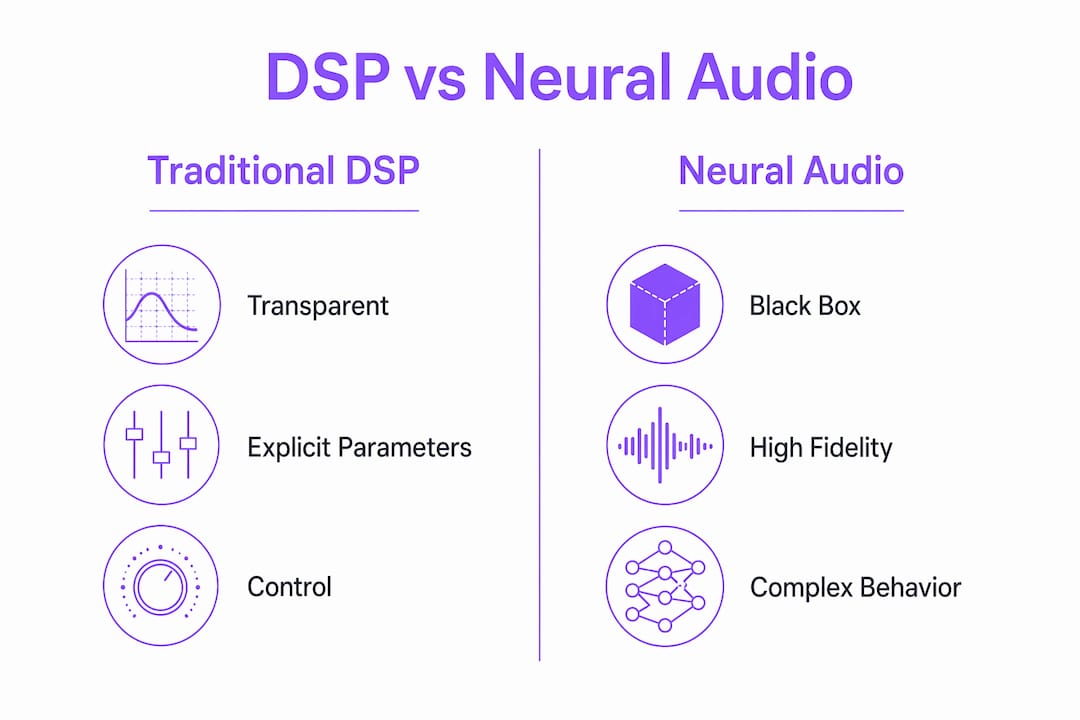
The most productive framing for working audio professionals is this: use DSP where you need control and predictability, and use neural models where the problem is too complex for hand-coded rules.
A third path is gaining traction in research and commercial tools: gray-box modeling. Hybrid gray-box approaches combine a physical DSP structure with neural components that fill in the nonlinear gaps. You retain some parameter interpretability while gaining the fidelity of a learned model. For plugin developers and researchers building hardware emulations, gray-box methods represent the current state of the art.
Key limitations of neural audio to keep in mind:
- Models can fail unpredictably on out-of-distribution audio, such as unusual instruments or extreme processing chains.
- Real-time inference demands significant compute, though frameworks like RTNeural are narrowing that gap.
- Efficient neural audio training requires well-aligned multimodal datasets, which are expensive and time-consuming to build.
What neural audio techniques and tools are shaping the field?
The techniques driving neural audio forward are not monolithic. Several distinct methods have matured enough to appear in commercial products and open research frameworks.
Neural audio codecs are the foundational layer for LLM-based audio generation. Autoencoders with quantized latent spaces reduce sampling rates by approximately 100x, making audio modeling with LLMs coherent and computationally tractable. The number of RVQ levels in a codec directly controls the tradeoff between bitrate and audio quality. Too many RVQ levels increase token sequence length and inference latency; too few reduce reconstruction fidelity. RVQ dropout is the current best practice for mitigating that tradeoff during training.
Unified foundation models like UniAudio 2.0 and the NAVA project represent the direction the field is moving. NAVA and UniAudio point toward multimodal, context-aware architectures that handle speech, music, and environmental sound within a single model rather than requiring separate specialized systems. That consolidation has direct implications for production workflows: one model can eventually replace a rack of single-task tools.
Real-time inference frameworks like RTNeural and TensorFlow Lite enable neural models to run inside VST3, AU, and AAX plugin formats with latency low enough for live monitoring. That is the bridge between research-grade models and the tools you actually load in your DAW.
Pro Tip: If you're building or evaluating a neural audio plugin for live use, benchmark inference latency at your session's buffer size before committing to a model architecture. A model that sounds perfect at 512 samples may introduce unacceptable delay at 64 samples.
The AI audio processing use cases now available to working engineers include text-to-speech voice cloning, automatic stem separation, polyphonic pitch correction, and generative music composition. Each of these was either impossible or prohibitively expensive with classical DSP alone.
Applications of neural audio in sound engineering and music production
Neural audio techniques have moved from research papers into production workflows faster than most engineers anticipated. The practical impact shows up across every stage of the signal chain.
- Automatic mastering and loudness management. Services and plugins now use neural models trained on thousands of professionally mastered tracks to apply gain staging, EQ curves, and limiting decisions without manual intervention. The model infers target loudness and spectral balance from the mix itself.
- Polyphonic pitch correction. Classical pitch correction algorithms struggle with chords and overlapping harmonics. Neural approaches handle polyphonic material by learning the pitch structure of the source rather than applying a fixed detection algorithm.
- Source separation. Neural networks solve source separation tasks that classical DSP cannot, because they recognize patterns the way human listeners do rather than relying on frequency-domain heuristics. Separating vocals, drums, and bass from a stereo mix is now a routine task.
- Audio restoration and noise reduction. Neural models trained on degraded and clean audio pairs learn to reconstruct missing information, remove broadband noise, and repair clipping artifacts with perceptual accuracy that spectral subtraction methods cannot approach. Explore AI audio enhancement techniques to see how this applies to archival and broadcast work.
- Generative sound design. Text-to-audio and audio-to-audio generation models let sound designers describe a texture or environment in plain language and receive a synthesized result. That shifts the creative bottleneck from technical execution to conceptual direction.
Mark Heath noted in 2024 that automation is changing audio professionals from manual operators to curators and orchestrators of AI tools. That observation is accurate and worth sitting with. The skill set that made you effective five years ago is not the same one that will make you effective five years from now.
Key takeaways
Neural audio processing is most effective when engineers understand both the neural model's capabilities and the traditional DSP principles it builds on, because neither approach alone covers every production scenario.
| Point | Details |
|---|---|
| Core definition | Neural audio processing applies deep learning to analyze, synthesize, and manipulate audio beyond classical DSP limits. |
| Three-phase workflow | Every neural audio model follows data collection, model training, and real-time deployment as its core pipeline. |
| Codec compression | Neural audio codecs reduce sampling rates by roughly 100x, enabling LLMs to process audio as discrete tokens. |
| Gray-box advantage | Hybrid gray-box models combine DSP parameter control with neural fidelity for hardware emulation tasks. |
| Role shift | Audio professionals are moving from manual operators to curators of AI-driven tools, requiring new technical fluency. |
Where i think neural audio is actually headed
I've spent years watching DSP frameworks evolve, and the current moment feels less like incremental progress and more like a structural change in how audio tools get built. The shift from white-box DSP to black-box neural modeling is real, but the more interesting development is the gray-box middle ground. Engineers who understand both the math behind a biquad filter and the architecture of a recurrent neural network are going to be the ones building the most capable tools over the next decade.
What concerns me about the current conversation is the tendency to treat neural audio as a replacement for DSP literacy. It isn't. A neural model that emulates a compressor is only as good as the training data and the loss function used to build it. If you don't understand what a compressor is doing in the signal domain, you cannot evaluate whether the model is doing it correctly. That knowledge gap will produce bad tools and worse decisions.
The future of DSP technology points toward unified foundation models that handle speech, music, and noise reduction in a single architecture. NAVA and UniAudio 2.0 are early evidence of that trajectory. My advice: learn how neural audio codecs work, understand RVQ at a conceptual level, and start experimenting with real-time inference frameworks now. The engineers who wait for the tools to become fully turnkey will find themselves several steps behind when those unified models arrive.
— Kai
Hear neural audio processing in action with Vector-dsp

Vector-dsp builds professional audio plugins grounded in advanced DSP and neural audio modeling, designed for engineers who want precision and real-time performance in the same package. ToneLab applies neural modeling techniques to hardware emulation and mastering tasks, running inside VST3, AU, and AAX hosts with the low-latency performance your session demands. If you work in music production, sound design, or post-production and want tools built on the principles covered in this article, Vector-dsp's plugin lineup is worth exploring. Visit Vector-dsp to see what's available and what's in development.
FAQ
What is neural audio processing in simple terms?
Neural audio processing is the use of trained artificial neural networks to analyze, modify, and generate audio signals. It differs from traditional DSP by learning behavior from data rather than applying fixed mathematical rules.
How does neural audio processing differ from standard DSP?
Traditional DSP uses explicit, hand-coded algorithms with full parameter transparency. Neural audio models learn their behavior from training data and can replicate complex, nonlinear audio characteristics that classical algorithms cannot model accurately.
What are the main applications of neural audio in music production?
Key applications include automatic mastering, polyphonic pitch correction, source separation, noise reduction, and generative sound design. Each of these tasks benefits from the pattern-recognition capabilities that neural networks provide.
What is a neural audio codec?
A neural audio codec is an encoder-quantizer-decoder model that compresses audio into low-bitrate latent tokens using residual vector quantization. These codecs reduce audio sampling rates by roughly 100x, making audio processing with large language models computationally feasible.
Do audio professionals need to understand DSP to use neural audio tools?
Yes. Understanding traditional DSP principles is necessary to evaluate whether a neural model is performing correctly and to diagnose failures. Neural audio tools do not replace DSP literacy; they extend what DSP-literate engineers can accomplish.