Network Audio Technology Explained for Sound Professionals
Network Audio Technology Explained for Sound Professionals
Network audio technology is the transmission of multiple digital audio channels over standard Ethernet infrastructure, replacing the point-to-point analog cabling that has defined professional audio installations for decades. Where a traditional analog snake might carry 24 channels across 24 individual cable runs, a single Cat6a Ethernet cable carries hundreds of channels simultaneously using protocols like Dante, AES67, AVB, and SMPTE ST 2110. Understanding network audio technology explained through the lens of IP transport, synchronization, and protocol interoperability is now a core competency for any sound engineer working in live production, broadcast, or studio integration. The shift is not just about fewer cables. It fundamentally changes how audio systems scale, route, and recover from failure.
How network audio technology works
Network audio transmits audio channels over IP networks using standard Ethernet hardware, converting analog or digital audio signals into data packets that travel alongside other network traffic. The core transport mechanism is the Real-time Transport Protocol (RTP), which carries audio payload over UDP. RTP does not guarantee delivery, but it prioritizes low latency over retransmission, which is exactly the right tradeoff for live audio where a late packet is worse than a missing one.
Synchronization is where network audio gets technically demanding. Every device on the network must share a common clock reference, or you get phase drift, clicks, and dropouts. The Precision Time Protocol (IEEE 1588 PTP v2) and its automotive and AV variant, generalized PTP (gPTP, defined in IEEE 802.1AS), achieve sub-microsecond clock alignment across all connected devices. AES67 implementations use RTP over UDP multicast for audio transport and PTP for clock synchronization, with session announcement handled by SAP and mDNS protocols.
Quality of Service (QoS) configuration on managed switches is the third pillar of reliable network audio. Without QoS, a burst of file transfer traffic can delay audio packets long enough to cause audible artifacts. Stream Reservation Protocol (SRP), part of the AVB/TSN suite, goes further by reserving bandwidth end-to-end before a stream even starts.
Here is the signal chain for a typical network audio transmission:
- Audio is captured at the source device (microphone preamp, console, or interface) and converted to PCM samples.
- PCM samples are packetized into RTP frames, typically carrying 48 samples per packet at 48 kHz, yielding 1 ms packet intervals.
- Packets are tagged with DSCP markings for QoS priority and transmitted over Ethernet.
- Managed switches forward packets based on QoS priority, using IGMP snooping to route multicast streams only to subscribed receivers.
- The receiving device recovers the media clock from PTP timestamps and reconstructs the audio stream with minimal jitter.
Pro Tip: Configure your managed switches with DSCP EF (Expedited Forwarding) markings for audio traffic. Without this, a single large file transfer on the same network segment can introduce enough jitter to cause audible dropouts in a live mix.
Dante vs. AES67 vs. AVB: which protocol fits your workflow?
The four dominant protocols in professional audio networking each solve a different problem, and choosing between them is a matter of matching protocol strengths to your specific deployment context.
| Protocol | Primary use case | Latency | Interoperability | Infrastructure requirement |
|---|---|---|---|---|
| Dante | Studio, live sound, installed AV | Sub-millisecond | Dante ecosystem + AES67 bridge | Standard 1 Gbps Ethernet |
| AES67 | Cross-vendor broadcast and AV | 1 ms typical | Broad, vendor-neutral | Standard Ethernet with PTP |
| AVB/TSN | Automotive, installed AV | Deterministic, under 2 ms | AVB-capable switches required | AVB-enabled managed switches |
| SMPTE ST 2110 | Broadcast production facilities | Sub-microsecond sync | Broadcast-specific | 10 Gbps Ethernet typical |
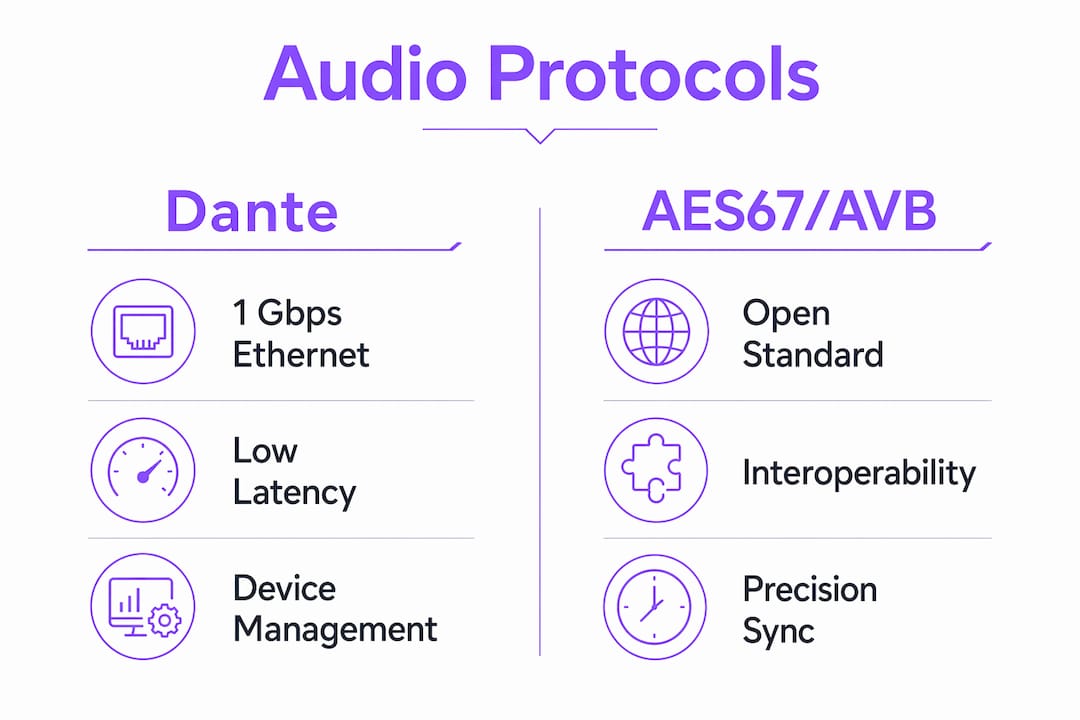
Dante operates over standard 1 Gbps Ethernet with sub-millisecond latency and powers more than 3,500 products worldwide. That ecosystem breadth is Dante's defining advantage. Audinate's Dante Controller software handles device discovery and routing through a graphical matrix, which means you can patch a Shure ULXD receiver to a Yamaha CL5 console without touching a single physical connector. This is what understanding audio networking looks like in practice.
Dante and AES67 are designed to complement each other, with Dante excelling in device management and AES67 ensuring cross-vendor interoperability within shared IP environments. When your facility mixes Dante devices with AES67-native gear from manufacturers like Lawo or Genelec, enabling AES67 mode on Dante devices creates a standards-compliant bridge without replacing hardware.
SMPTE ST 2110 treats audio and video as separate essence streams, synchronizing audio using IEEE 1588 PTP v2 to achieve sub-microsecond alignment. This essence-based approach is critical in broadcast environments where audio and video must remain frame-accurate across a facility. ST 2110 is not a replacement for Dante in a touring rig. It is the right tool for a broadcast master control room running on 10 Gbps infrastructure.
Key considerations when selecting a protocol:
- Dante works best when you need rapid deployment, broad device compatibility, and a managed software routing layer.
- AES67 is the right choice when you need vendor-neutral interoperability across a mixed-manufacturer facility.
- AVB/TSN delivers deterministic guarantees that matter in automotive zonal architectures and installations where switch-level bandwidth reservation is non-negotiable.
- SMPTE ST 2110 belongs in broadcast facilities where essence-based transport and sub-microsecond synchronization justify the infrastructure investment.
Common challenges in network audio implementation
Latency and jitter are the two failure modes that define whether a network audio system sounds professional or amateur. End-to-end latency includes cable propagation delay, switch forwarding delay, and processing delay at each device. Typical latency targets for live sound critical applications are under 2 milliseconds, and every switch hop adds measurable delay. A system with six unmanaged switches in the signal path will fail this target regardless of which protocol you use.
Jitter is subtler and more damaging than raw latency. Even if average latency is acceptable, packet arrival variance causes the receiving device's buffer to underrun or overrun, producing clicks and distortion. Dedicated hardware for media clock recovery is the correct solution here. Software-only PTP implementations on general-purpose CPUs introduce jitter that hardware clock recovery circuits eliminate entirely. The STMicroelectronics Stellar G6 automotive MCU demonstrates this principle: it uses hardware-based TSN with 802.1AS gPTP to achieve less than 2 ms latency with zero jitter for in-cabin audio.
Multicast management is the challenge most engineers underestimate on their first network audio deployment. Audio streams sent to multicast addresses flood every port on an unmanaged switch, consuming bandwidth and causing congestion. IGMP snooping on managed switches solves this by tracking which ports have subscribed receivers and forwarding multicast streams only to those ports. VLAN segmentation adds another layer of isolation, keeping audio traffic separate from corporate IT traffic on shared infrastructure.
Common implementation pitfalls and their solutions:
- Unmanaged switches in the signal path: Replace with managed switches supporting DSCP QoS and IGMP snooping.
- Mixed cable grades: Cat6a or higher is recommended for AES67 and ST 2110 installations. Cat5e introduces crosstalk and attenuation at higher channel counts.
- Software-only PTP on commodity hardware: Use dedicated hardware clock recovery for any deployment where jitter tolerance is under 100 nanoseconds.
- No redundancy planning: Ring topologies with Media Redundancy Protocol (MRP) or parallel redundant networks provide failover in under 50 milliseconds.
Pro Tip: Before finalizing any network audio installation, run a PTP clock analysis tool like ptpd or the Dante Controller's network performance view to verify clock sync stability over 24 hours. A clock that drifts under load will cause intermittent dropouts that are nearly impossible to diagnose during a live event.
Real-world applications across professional audio environments
Network audio is not a single-use technology. Its deployment spans broadcast master control rooms, touring live sound rigs, corporate AV installations, recording studios, and now automotive cabins.
| Environment | Protocol typically used | Primary benefit |
|---|---|---|
| Broadcast facility | SMPTE ST 2110, AES67 | Frame-accurate essence transport |
| Live touring | Dante | Rapid patching, broad device support |
| Corporate AV | Dante, AVB | Scalable installation, remote management |
| Recording studio | Dante, AES67 | Flexible routing, multi-room integration |
| Automotive | AVB/TSN | Deterministic latency, cable reduction |
In broadcast, facilities like large television networks have replaced entire analog routing infrastructures with ST 2110 over 10 Gbps Ethernet, reducing physical patch bay complexity while gaining the ability to reroute audio from a software interface. In live touring, a Dante-based system allows a front-of-house engineer to pull a monitor mix from the stage box without running a separate cable. The benefits of network audio in these contexts include reduced cabling cost, faster setup, and the ability to reconfigure routing without physical intervention.
The automotive sector represents the most technically demanding application. AVB TSN uses IEEE 802.1AS for gPTP synchronization, Stream Reservation Protocol for bandwidth reservation, and Forwarding and Queuing for Time-Sensitive Streams for traffic shaping. This replaces point-to-point speaker wiring with a zonal Ethernet backbone, cutting harness weight significantly in vehicles where every gram affects efficiency. For sound engineers moving into automotive audio design, understanding DSP algorithm design becomes as important as understanding the network layer itself.
Network audio for home theater is a growing adjacent application, with AVB-capable receivers and AES67-compatible processors appearing in high-end residential installations. The same principles that govern a broadcast facility apply at smaller scale: managed switches, PTP synchronization, and QoS configuration determine whether the system performs reliably.
Key takeaways
Network audio technology succeeds or fails based on synchronization quality, protocol selection, and switch configuration, not on cable count alone.
| Point | Details |
|---|---|
| Protocol selection matters | Match Dante, AES67, AVB, or ST 2110 to your deployment context and infrastructure budget. |
| Synchronization is hardware-level | Software PTP alone is insufficient; dedicated media clock recovery hardware eliminates jitter at scale. |
| QoS and IGMP snooping are non-negotiable | Managed switches with DSCP marking and multicast control prevent audio dropouts on shared networks. |
| Cat6a is the minimum cable standard | Lower-grade cabling introduces crosstalk and attenuation that degrades reliability at professional channel counts. |
| Dante and AES67 are complementary | Enabling AES67 mode on Dante devices creates cross-vendor interoperability without replacing existing hardware. |
Why most engineers get network audio wrong the first time
The most common mistake I see is treating network audio as a cable replacement project rather than a systems integration project. Engineers who excel at analog signal flow sometimes underestimate how much the IT layer governs audio performance. You can have the best Dante-enabled console on the market and still get dropouts if your switches are not configured correctly.
The second mistake is ignoring clock domain management. I have seen installations where every device reports PTP lock, but the system still produces intermittent clicks. The cause is almost always a switch that claims PTP support but implements it in software on a shared CPU, introducing jitter that hardware clock recovery would eliminate. The insight from STMicroelectronics' work on the Stellar G6 applies equally to studio and live sound: determinism and clock synchronization define success more than any other variable.
My honest recommendation is to spend as much time on switch selection and QoS configuration as you spend on device selection. A Cisco Catalyst or Aruba 2930 series switch configured correctly will outperform a more expensive switch with default settings every time. Also, learn to read PTP clock analysis data. It tells you more about your network's audio readiness than any spec sheet.
The future of this field points toward tighter integration between network audio transport and real-time DSP processing. As AI audio enhancement tools mature, the ability to apply processing at any node in a network audio system, rather than at a fixed hardware insert point, will redefine what a mixing architecture looks like. Engineers who understand both the network transport layer and DSP signal processing will have a significant advantage in that environment.
— Kai
Take your network audio work further with Vector-dsp
Vector-dsp builds professional audio software grounded in the same DSP principles that make network audio systems perform at their ceiling. If you are integrating Dante or AES67 into a production environment and need processing tools that match the precision of your transport layer, Vector-dsp's plugin lineup, built on VST3, AU, and AAX formats with real-time low-latency performance, is designed for exactly that workflow. The architecture prioritizes deterministic processing and minimal latency, which aligns directly with what network audio demands at the signal processing stage. Explore the full range of professional audio tools at Vector-dsp and see how precision DSP design complements a well-built network audio system.
FAQ
What is network audio technology?
Network audio technology is the transmission of multiple digital audio channels over standard IP-based Ethernet networks using protocols like Dante, AES67, AVB, and SMPTE ST 2110. It replaces dedicated analog cabling with a single network infrastructure that carries hundreds of audio channels simultaneously.
How does audio over IP work?
Audio over IP converts PCM audio samples into RTP packets transmitted over UDP on an Ethernet network, with PTP clock synchronization ensuring all devices share a common time reference. QoS settings on managed switches prioritize audio packets to maintain sub-millisecond latency.
What is the difference between Dante and AES67?
Dante is a complete proprietary ecosystem with built-in device discovery and routing software, while AES67 is an open interoperability standard that enables cross-vendor audio transport over IP. Dante devices can operate in AES67 mode to communicate with non-Dante gear on the same network.
What cable standard does network audio require?
Cat6a or higher is the recommended cable standard for professional network audio installations using AES67 or SMPTE ST 2110, as lower grades introduce crosstalk and attenuation at high channel counts and under PoE conditions.
Can network audio work for live sound with under 2 ms latency?
Yes. Dante achieves sub-millisecond latency over standard 1 Gbps Ethernet, and AVB/TSN systems using hardware-based gPTP synchronization consistently deliver under 2 ms end-to-end latency when managed switches with proper QoS configuration are used throughout the signal chain.