Psychoacoustics Music Production Applications Guide
Psychoacoustics Music Production Applications Guide
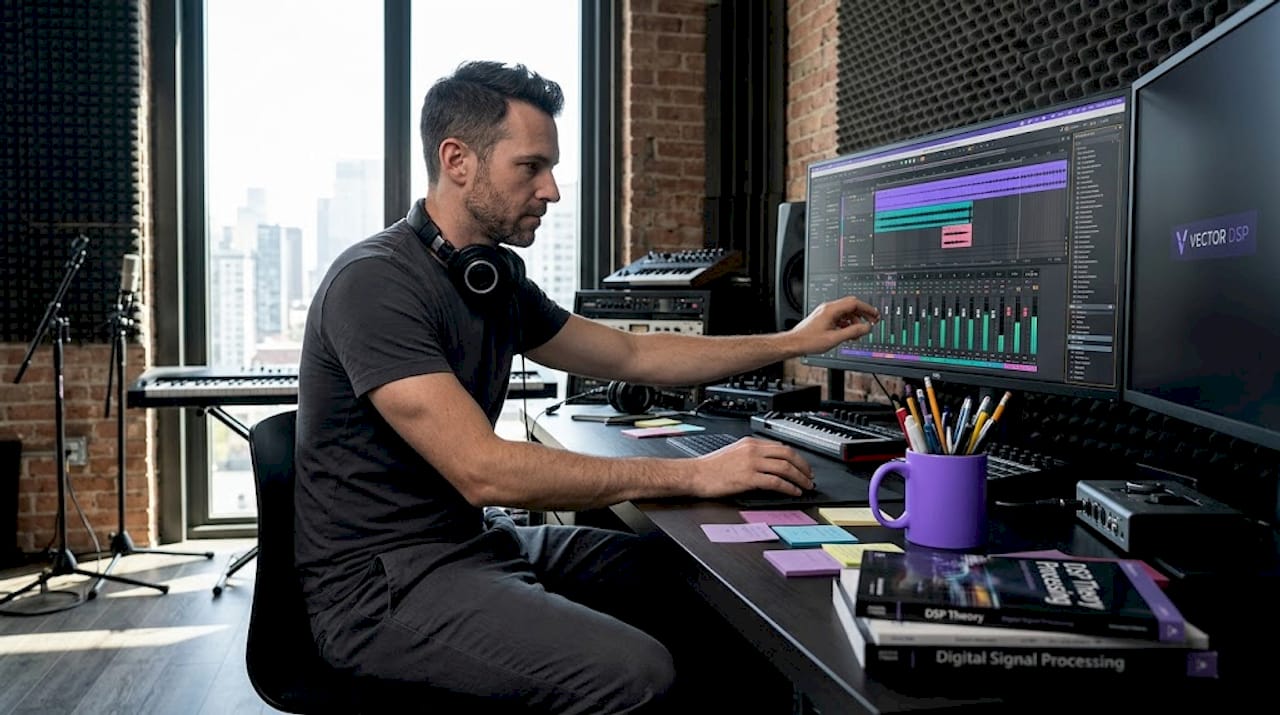
Dense mixes that fight themselves are one of the most frustrating problems in music production. You can have technically clean audio and still end up with a mix that sounds muddy, flat, or emotionally inert. Psychoacoustics music production applications give you a way out of that trap. Rather than guessing why your kick drum disappears at low volumes or why your vocal gets swallowed by synths, you get a map of how the human auditory system actually processes sound. That map changes every decision you make.
Table of Contents
- Key Takeaways
- Psychoacoustics music production applications: the core concepts
- Sound design and arrangement for clarity
- Mixing with spatial depth, reverb, and loudness
- Compression, codecs, and mastering decisions
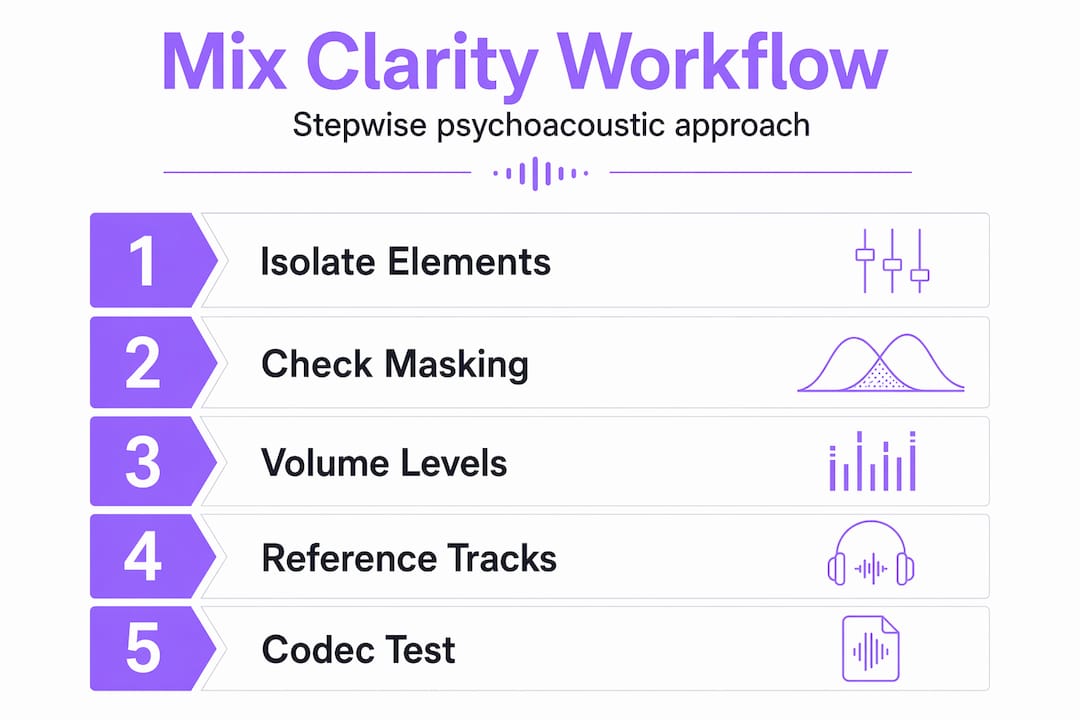
- A practical psychoacoustic workflow
- My honest take on psychoacoustics in production
- Hear the difference with Vector-dsp
- FAQ
Key Takeaways
| Point | Details |
|---|---|
| Masking drives mix clarity | Elements competing in the same critical band reduce each other's audibility; EQ and arrangement fix this. |
| Perception beats amplitude | Loudness and frequency sensitivity vary by ear, so mixing to your meter alone leads to imbalanced results. |
| Timing shapes perceived tightness | Adjustments of 10 to 30 ms between elements shift how rhythmically locked a mix sounds. |
| Spatial cues create dimension | Psychoacoustic hearing cues, not just panning, determine how convincingly sounds occupy three-dimensional space. |
| Codec behavior is production-relevant | Transient design and mastering decisions directly affect how streaming compression treats your audio. |
Psychoacoustics music production applications: the core concepts
Psychoacoustics is the study of how the brain interprets sound, not just how sound behaves physically. For music producers, that distinction matters more than most theory ever will.
The single most useful concept in day-to-day production is masking. Simultaneous masking occurs when one sound makes a nearby frequency inaudible while both are playing. Temporal masking extends that effect: a loud sound can suppress perception of a quieter sound for up to 200 ms before and after it occurs. Masking in the same critical band is why your lead vocal can disappear behind a mid-heavy guitar even when both peak at the same level on your meter.
Fletcher-Munson curves illustrate a second reality producers often ignore. Ear sensitivity varies by frequency, meaning a 100 Hz tone and a 3 kHz tone at the same amplitude will not sound equally loud. Your mix decisions are automatically filtered through this non-linear response, which is why boosting low end at low monitoring volumes can produce boomy results at higher playback levels.
Two more concepts round out the essentials: auditory streaming and spatial hearing. Auditory streaming describes how the brain groups sounds into separate perceptual objects. When instruments share too many overlapping timbral properties, the brain struggles to separate them, and the mix collapses into one dense blob. Spatial hearing, driven by inter-aural time differences and amplitude differences, determines perceived depth and position, and reverberation acts as one of its primary cues.
Pro Tip: Monitor your mixes at multiple volume levels, including uncomfortably low ones. Fletcher-Munson curves mean your balance shifts with level, and a mix that sounds correct loud often falls apart quiet.
Sound design and arrangement for clarity
Knowing the theory matters nothing if you cannot apply it before you reach for a plugin. Arrangement is your first and most powerful psychoacoustic tool.
-
Map your frequency real estate before you start layering. Assign each element a primary frequency range it owns. Bass guitar lives below 200 Hz. Acoustic guitar fills 200 Hz to 2 kHz. Synth pads occupy 500 Hz to 4 kHz. Letting two elements dominate the same band creates the exact critical band masking that makes mixes sound congested.
-
Use subtractive EQ on supporting elements, not just additive. If your guitars and keys share the same upper-mid presence range, cut 2 to 4 kHz on the element that should sit behind the vocal. Careful EQ reduces masking and lets each element exist perceptually without amplitude reduction.
-
Design timbral contrast between similar instruments. If you have two synth pads, one should be darker and more diffuse while the other carries brightness and movement. This gives the auditory system distinct streaming cues so it can separate them automatically.
-
Use transients strategically. Attack characteristics are the primary signal the brain uses to identify the onset of a new sound source. Blunted attacks on competing elements cause them to smear together. Sharp, defined transients on rhythmic elements strengthen auditory streaming and give the listener clear separation between layers.
-
Apply timing offsets between competing elements. Small timing adjustments of 10 to 30 ms between rhythmically similar parts shift perceived tightness and can create separation where frequency EQ alone cannot.
Pro Tip: Before you EQ anything, mute all but two competing elements and listen to them in isolation together. You will identify masking problems faster than any spectrum analyzer will show you.
Mixing with spatial depth, reverb, and loudness
One of the most valuable shifts you can make is treating panning not as left-right placement but as a full spatial positioning tool built on how the ears actually work.
The human auditory system uses inter-aural time delay, inter-aural level difference, and head-related transfer function (HRTF) cues to locate sounds in three dimensions. Standard stereo panning handles level difference but ignores time and HRTF cues almost entirely. Spatial audio production formats like Dolby Atmos and Ambisonics use psychoacoustic spatial hearing models to position sounds convincingly in height and depth, not just left and right.
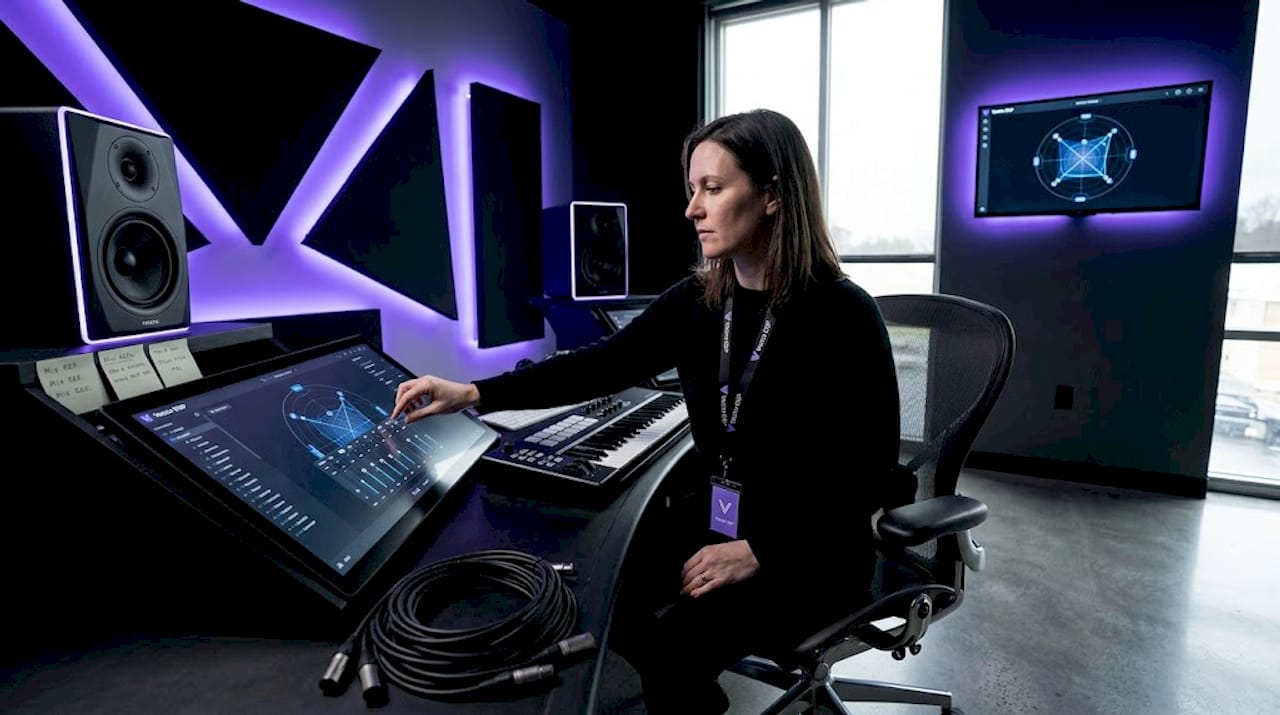
Even within stereo, reverb is a depth tool, not a texture tool. Pre-delay controls perceived distance from the source. Shorter pre-delay places a sound close; longer pre-delay pushes it back. Spatial workflows built around psychoacoustic hearing cues produce more believable depth than blindly adding room ambience.
Here is a reference for common psychoacoustic spatial mixing decisions:
| Technique | Psychoacoustic effect | Common error |
|---|---|---|
| Short reverb pre-delay (0 to 10 ms) | Sound perceived as close and present | Washy, distant lead elements |
| Long reverb pre-delay (20 to 40 ms) | Sound perceived as distant, background | Pushing lead elements too far back |
| Panning with slight delay offset | Convincing stereo width via Haas effect | Phase issues when summed to mono |
| High-frequency roll-off on distant elements | Simulates air absorption, increases depth | All elements at the same HF brightness |
| Loudness reduction for background elements | Perceived as spatially recessed | Over-relying on reverb for distance |
On loudness: loudness perception is frequency-dependent, so gain staging decisions cannot be made by looking at meters alone. A mix that reads at the same RMS across the frequency range will not sound balanced across the frequency range. Use A/B referencing against tracks that translate well across systems alongside your metering.
Compression, codecs, and mastering decisions
This is where psychoacoustics moves from creative technique into engineering necessity, and where many producers lose quality without knowing why.
Lossy audio compression formats like MP3 and AAC are built entirely on psychoacoustic models. Perceptual audio coding works by identifying which spectral components will be masked by louder simultaneous sounds and removing or encoding them with fewer bits. The encoder decides what you will not hear, and if your mix has poor spectral distribution or excessive density, the encoder makes worse decisions on your behalf.
Temporal masking plays a specific role that producers who master for streaming need to understand. Temporal masking and transient treatment affect how codecs allocate bits across time windows. Poor transient design, specifically dense attacks with no pre-masking relief, can trigger pre-echo artifacts. These are faint ghost sounds that appear before a loud transient and are one of the most disorienting quality degradations in streamed audio.
Pro Tip: Always export a test MP3 or AAC encode at streaming bitrate and compare it directly to your WAV master. Listen specifically on earbuds and laptop speakers. Artifacts that survive that test will survive the platform.
The EBU R128 loudness standard targets integrated loudness at -23 LUFS for broadcast, but streaming platforms apply their own normalization that makes competitive loudness less relevant than translation quality. Mixing to a consistent integrated LUFS target prevents the normalization algorithm from making unpredictable level adjustments that distort your intended loudness balance.
For quality verification, tools like PEAQ (Perceptual Evaluation of Audio Quality) simulate human auditory perception to objectively measure perceived audio quality and output grades on a 1 to 5 scale. That gives you an objective perceptual check without a listening panel.
A practical psychoacoustic workflow
Here is how you apply all of this across a production from start to finish.
Preparation phase:
- Build a frequency map of every element in your arrangement before committing any levels or processing
- Identify critical band overlaps between the three to five most spectrally dense elements
- Decide which elements own their frequency range and which ones support from a distance
Execution phase:
- Apply subtractive EQ to supporting elements to free up perceptual space for lead elements
- Set panning with time-based cues alongside level differences, especially for elements that need to feel wide without causing mono phase issues
- Adjust transient shaping on rhythmic elements to sharpen auditory stream onset cues
- Set reverb pre-delay intentionally to establish depth relationships between elements
- Ride your integrated loudness target across the full mix using LUFS metering, not peak or RMS alone
Verification phase:
- Check the mix on at least three playback systems: studio monitors, earbuds, and a phone speaker
- Export a 320 kbps MP3 and compare it to the WAV for codec artifacts
- Run a PEAQ analysis if you have access to perceptual quality assessment tools
- Listen at low volume to catch Fletcher-Munson balance shifts
For plugins that use psychoacoustic principles directly, look at tools that incorporate audio compression psychoacoustics into their processing architecture rather than applying generic dynamics shaping. The difference is audible. For a foundation in production tools, a solid overview of sound design principles will contextualize how these concepts connect across your entire signal chain.
Pro Tip: Keep a dedicated reference session with four to five tracks you know translate well. Run every critical mix decision past those references before you call anything done.
My honest take on psychoacoustics in production
I have worked with producers who treat psychoacoustics like an academic detour. They read about Fletcher-Munson curves and immediately return to pulling the same EQ moves they always have. That is a missed opportunity on a real scale.
What actually changed my production work was not memorizing the theory. It was accepting that my ears are being tricked constantly, and that understanding the mechanism of the trick lets me work with it instead of against it. The moment I started treating masking as an arrangement problem rather than a mixing problem, my mixes started translating on the first playback outside the studio.
There is also a persistent myth that scientific understanding kills creative intuition. I disagree strongly. Knowing why a sound disappears in a mix does not constrain how you respond to it. It multiplies your options. You can EQ, rearrange, retimbre, or retrigger. Four tools where before you had one.
The producers I have seen stall out are the ones who stay purely intuitive and wonder why the same problems repeat across every session. The ones who stall out from over-analysis are usually applying theory without listening critically. The balance is not complicated. Understand the mechanism, then use your ears to confirm the result. Every time.
— Kai
Hear the difference with Vector-dsp
If psychoacoustic principles belong in your signal chain, they should be in your plugins too.
Vector-dsp builds professional-grade audio software designed around precision DSP and real-world perceptual performance. ToneLab applies frequency-dependent processing that reflects how loudness perception actually works, giving you tone shaping that translates across playback systems instead of just reading well on meters. The entire Vector-dsp product suite is built for producers and engineers who want meticulous control, not approximations. Visit Vector-dsp to explore the full plugin lineup, check upcoming releases, and see how precision DSP design makes the psychoacoustic principles in this guide audible in your sessions.
FAQ
What is psychoacoustic masking in mixing?
Psychoacoustic masking occurs when a louder sound makes a quieter sound in the same frequency band inaudible. In mixing, this means elements sharing critical bands compete for audibility, and EQ or arrangement changes resolve the problem.
How do Fletcher-Munson curves affect mix decisions?
Fletcher-Munson curves show that human hearing sensitivity varies by frequency, meaning your ear does not perceive all frequencies at equal loudness for the same amplitude. Mix engineers adjust levels and EQ based on perceived blend rather than linear amplitude readings.
Why does my mix sound different after MP3 encoding?
MP3 encoding removes frequencies predicted to be masked and uses temporal masking models to allocate bits. Dense mixes with poor transient design increase the chance of audible artifacts like pre-echo after encoding.
What is EBU R128 and why does it matter for streaming?
EBU R128 defines integrated loudness targeting at -23 LUFS to maintain consistent perceived loudness across playback systems. Mixing to a stable LUFS target prevents streaming platform normalization from making unpredictable level corrections.
How does spatial audio use psychoacoustics?
Spatial audio formats like Dolby Atmos use inter-aural time and level differences alongside HRTF modeling to position sounds in three-dimensional space. These formats are built around how the auditory system localizes sound, not traditional channel routing.