Music Information Retrieval Explained for Researchers
Music Information Retrieval Explained for Researchers

Music information retrieval (MIR) is the interdisciplinary science of extracting, organizing, and retrieving meaningful information from music using computational audio analysis. The field spans signal processing, machine learning, musicology, and human-computer interaction, making it one of the most technically layered areas in digital music research. MIR powers the systems behind music search engines, automatic playlist generation, instrument recognition, and mood-based classification. Understanding music information retrieval means understanding how computers learn to "hear" music the way humans do, and then act on that understanding at scale.
What is music information retrieval, and how does it work?
Music information retrieval is defined as the set of methods and systems that allow computers to analyze audio signals and extract structured, searchable information from them. The field draws on four core functions that any information retrieval system must perform: representing, storing, organizing, and providing access to information so users can find what they need. In MIR, those functions apply directly to audio content, symbolic notation, metadata, and lyrics.
MIR systems process music through a pipeline that begins with raw audio and ends with structured representations a computer can query. A researcher searching for "songs with a melancholic minor-key melody at 90 BPM" is asking a MIR system to parse pitch, tempo, and emotional content simultaneously. That kind of query requires multiple analytical layers working together.

The field has also evolved from metadata-based to cognitive, explainable systems that link abstract audio features to human-understandable concepts like mood and intent. That shift is what separates modern MIR from simple tag-based search.
What are the fundamental techniques and data types used in MIR?
MIR systems operate on several distinct data types, each carrying different musical information. Choosing the right combination determines how well a system performs on a given retrieval task.
Core data types in MIR:
- Audio content: The raw waveform or spectrogram, analyzed for pitch, timbre, rhythm, and dynamics using algorithms like Mel-Frequency Cepstral Coefficients (MFCCs) and harmonic peak detection.
- Symbolic representations: MIDI files and sheet music encode pitch and duration explicitly, making them easier to analyze than raw audio but less representative of real-world recordings.
- Metadata: Artist name, genre tags, release year, and instrumentation labels provide structured context that complements audio analysis.
- Lyrics: Text-based analysis using n-gram matching and natural language processing adds semantic meaning to audio features.
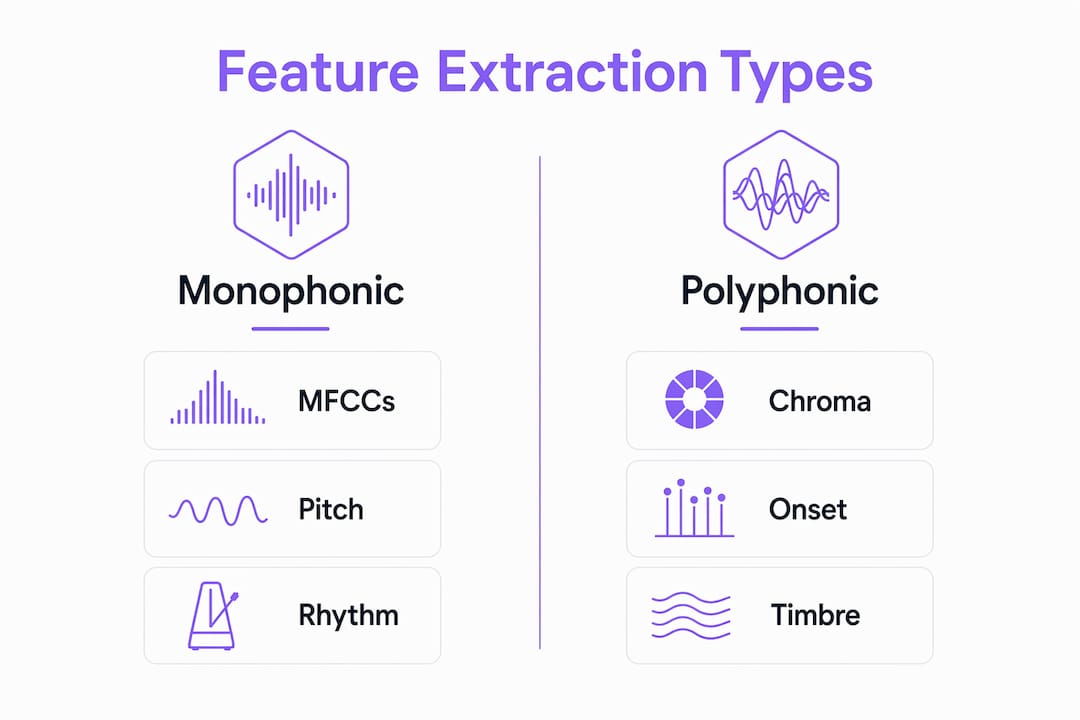
Feature extraction is the process of converting raw audio into numerical vectors that algorithms can compare. MFCCs capture timbral texture by modeling how the human auditory system perceives frequency. Harmonic peak analysis identifies the dominant pitches in a signal, which is useful for melody detection. Chroma features map audio energy onto the 12 pitch classes of the Western scale, enabling chord recognition.
Polyphonic music presents the hardest challenge in feature extraction. When multiple instruments play simultaneously, isolating individual melodic lines or rhythmic patterns requires source separation techniques before any meaningful feature can be extracted. This is why excessive feature accumulation in classifiers can reduce accuracy. Adding more features without domain-specific selection introduces noise rather than signal.
Pro Tip: When building a MIR classifier, start with a small, domain-specific feature set. MFCCs plus chroma features cover most genre and mood classification tasks. Add spectral contrast or rhythm features only after benchmarking the baseline.
How do modern MIR systems use neural sparse retrieval and music-language models?
The gap between traditional n-gram methods and neural approaches is large. Neural sparse retrieval achieves 91.4% recall@10 on large music corpora, compared to 57.7% for trigram-based methods. That difference means a user searching a catalog of millions of tracks will find the right result in the top 10 results more than nine times out of ten, versus fewer than six times with older methods.
Neural sparse retrieval works by converting audio or text queries into sparse high-dimensional vectors where only the most relevant dimensions carry weight. This makes the index compact and the retrieval fast. Amazon Music's High Confidence Index (HCI) uses this approach to handle fuzzy matching at industrial scale, tolerating typos, alternate spellings, and transliterations in user queries.
| Method | Recall@10 | Latency profile | Scale suitability |
|---|---|---|---|
| Trigram n-gram matching | 57.7% | Low | Medium |
| Neural sparse retrieval | 91.4% | Sub-millisecond (offline precomputed) | High |
| Ontology-guided multimodal | Higher for rare content | Medium | Medium to High |
Compact music-language models represent another major advance. Models like TinyMU are at least 10x smaller than typical large audio-language models yet deliver competitive reasoning and classification performance. That size reduction matters because it enables deployment on edge devices, which opens MIR to mobile applications and embedded systems without cloud dependency.
Multimodal frameworks combine audio features, lyrics, and metadata under a shared ontology. Ontology-guided multimodal retrieval improves precision, recall, and mean average precision especially for rare or niche content that metadata alone cannot describe. The ontology acts as a shared vocabulary that links audio features to human-readable musical concepts.
Pro Tip: For researchers building retrieval systems on limited compute, TinyMU-style compact models are worth benchmarking before committing to a large model architecture. The performance gap is smaller than most expect, and the deployment advantages are significant.
What role does disentangled representation play in music similarity?
Holistic embeddings treat a track as a single vector summarizing everything about it. That approach works for broad genre classification but fails when a user wants to find songs that sound rhythmically similar but tonally different. Disentangled representations separate melody, rhythm, and timbre into independent embedding spaces, producing three separate cosine similarity scores for each pair of tracks.
The MERIT framework demonstrates this directly. It returns independent scores for melodic contour, rhythmic groove, and timbral character. A query like "find tracks with the same groove as this song but a brighter timbre" becomes computationally tractable because the system can weight each dimension independently.
Practical advantages of disentangled embeddings:
- Users can specify which musical factor matters most for a given search.
- Recommendation systems can explain why two tracks are similar in human-understandable terms.
- Classification systems can flag tracks that share rhythm but differ in melody, which holistic embeddings would treat as similar overall.
- Research tasks like cover song detection benefit from separating melodic similarity from timbral similarity.
The evolution toward interpretable MIR systems reflects a broader shift in the field. Early MIR systems classified tracks by genre and stopped there. Modern systems aim to link audio features to the kind of nuanced descriptions a music critic or producer would use. Disentangled representations are the technical mechanism that makes that possible.
What do real-world MIR system architectures look like?
Deploying MIR at scale requires balancing semantic accuracy with strict latency constraints. The standard architecture separates computation into two phases.
- Offline embedding computation: Neural models process the entire music catalog and store the resulting embeddings in an index. This phase can run on powerful hardware without time pressure.
- Online query processing: When a user submits a query, the system performs only minimal tokenization and vector weighting before searching the precomputed index. Pre-computing embeddings offline reduces online query overhead, achieving sub-millisecond latency in large-scale systems.
- Reranking: A lightweight reranking model refines the top results using additional signals like user history or contextual metadata.
- Feedback integration: Systems like Amazon Music's HCI incorporate user feedback loops that improve recall by a measurable margin over time.
- Feature selection audit: Before deployment, engineers audit the feature set to remove redundant or noisy features. Domain-specific feature selection improves classification accuracy and reduces index size.
The most common failure mode in production MIR systems is feature overaccumulation. Teams add features incrementally during development, and each addition looks beneficial in isolation. At scale, the accumulated noise degrades precision. A disciplined feature selection process, run before indexing, prevents this.
For researchers building smaller systems, the same principle applies. A well-chosen set of MFCCs, chroma vectors, and rhythm features will outperform a bloated feature set on most standard MIR benchmarks. The machine learning audio processing pipeline that works in production almost always starts with fewer features than the experimental prototype used.
What applications and research directions are driving MIR forward?
MIR powers a wider range of applications than most researchers outside the field realize. The most visible use case is music recommendation, but the technology reaches much further.
- Automatic indexing: Systems classify tracks by instrument, emotion, tempo, and key without human tagging, enabling large catalogs to become searchable at scale.
- Music education: MIR tools analyze student performances and provide feedback on pitch accuracy and rhythmic consistency. ICT tools support music students and teachers by enabling sharing, analysis, and preservation of musical content.
- Cover song detection: MIR systems identify melodic similarity across different recordings of the same composition, which has direct applications in copyright enforcement.
- Playlist generation: Streaming platforms use MIR features to build playlists that maintain consistent energy, mood, or tempo across tracks.
AI in music should not be equated solely with generation. Understanding and retrieval systems are equally important in professional workflows, and they represent the majority of deployed music AI by volume. The research community is increasingly focused on explainability, cultural adaptability, and user behavior modeling as the next frontiers. Open datasets like the Million Song Dataset and tools like Librosa give researchers a practical starting point for open-source audio tools without requiring proprietary data.
Key Takeaways
Music information retrieval is the science of extracting structured, queryable information from audio using feature extraction, neural retrieval, and disentangled representations to power search, recommendation, and classification at scale.
| Point | Details |
|---|---|
| Neural sparse retrieval outperforms n-grams | Recall@10 reaches 91.4% with neural methods versus 57.7% for trigram matching. |
| Disentangled embeddings improve search precision | Separating melody, rhythm, and timbre lets users query by specific musical factors. |
| Offline precomputation enables real-time search | Computing embeddings before query time reduces online latency to sub-millisecond levels. |
| Feature selection beats feature accumulation | Adding domain-specific features improves accuracy; adding indiscriminate features introduces noise. |
| Compact models democratize MIR research | Models like TinyMU deliver competitive performance at a fraction of the compute cost. |
Why the field is more interesting than it looks from the outside
Most people who encounter MIR for the first time assume it is a solved problem. Music has metadata. Streaming platforms have recommendations. What is left to figure out? The answer is almost everything that matters.
The hard part of MIR is not finding a track you already know. It is finding a track you cannot describe precisely. A producer searching for "something with the same rhythmic tension as a specific drum break but a warmer low-end" is asking a system to reason about musical factors that holistic embeddings cannot separate. That is where disentangled representations like MERIT change the game, and it is the research direction I find most compelling right now.
The other thing worth saying directly: the AI-in-music conversation is dominated by generation. Text-to-music models get the press coverage. But the retrieval and understanding side of music AI is where the practical value lives for working researchers and professionals. A system that can accurately index a catalog of 100 million tracks by mood, tempo, and timbral character is more useful to most music workflows than a generative model. The field is starting to recognize this, and the shift toward compact, explainable, retrieval-focused models reflects it.
For anyone entering MIR research, my strongest advice is to resist the temptation to start with the largest model available. Start with a clean feature set, a well-understood benchmark, and a retrieval architecture you can explain. The fundamentals compound. The complexity can come later.
— Kai
Vector-dsp and audio analysis for MIR professionals

Vector-dsp builds professional audio software grounded in digital signal processing principles that align directly with the demands of MIR workflows. Researchers and professionals who need precise control over audio feature extraction, real-time signal analysis, and low-latency processing will find that Vector-dsp's approach to DSP-based audio tools reflects the same architectural discipline that makes production MIR systems work. The emphasis on intentional design and industry-standard formats like VST3, AU, and AAX means the tools integrate into existing research and production environments without friction. For professionals applying MIR techniques in practice, Vector-dsp offers a technically grounded foundation worth exploring.
FAQ
What is music information retrieval?
Music information retrieval is the science of extracting, organizing, and retrieving structured information from music using computational methods. It combines signal processing, machine learning, and musicology to enable applications like music search, classification, and recommendation.
How does neural sparse retrieval improve music search?
Neural sparse retrieval converts queries into sparse high-dimensional vectors and searches a precomputed index, achieving 91.4% recall@10 compared to 57.7% for traditional trigram methods. The result is faster, more accurate retrieval across large music catalogs.
What are disentangled music representations?
Disentangled representations separate a track's musical properties, such as melody, rhythm, and timbre, into independent embedding spaces. Systems like MERIT return separate similarity scores for each factor, enabling more precise and explainable music similarity search.
What is the role of feature selection in MIR systems?
Feature selection determines which audio properties a classifier uses to analyze tracks. Adding too many features without domain-specific filtering introduces noise and reduces accuracy. A targeted set of features like MFCCs and chroma vectors outperforms larger, less curated feature sets.
How do compact music-language models benefit MIR research?
Compact models like TinyMU deliver reasoning and classification performance comparable to much larger models while being deployable on edge devices. This makes advanced MIR accessible to researchers without large-scale compute infrastructure.