Machine Learning Audio Processing Applications: 2026 Guide
Machine Learning Audio Processing Applications: 2026 Guide

Machine learning audio processing applications are defined as systems that use trained models to extract, analyze, enhance, or generate audio signals across speech, music, and environmental sound domains. This field, formally known as audio signal processing ML or deep learning for audio, has moved well beyond academic research. Frameworks like UniAudio 2.0, MOSS-Audio, and AudioMosaic now give developers production-ready architectures for tasks ranging from speech enhancement to full audio generation. If you are building audio tools in 2026, these models are your starting point, not your finish line.
What are the main machine learning techniques used in audio processing?
The dominant approach in modern audio signal processing ML is sequence modeling with Transformers and large language models (LLMs). Audio is tokenized into discrete units, then processed the same way text tokens are. UniAudio 2.0 frames this as unified audio language modeling, separating reasoning tokens from reconstruction tokens. It uses a ReasoningCodec with 1024 and 8192 codebook variants, trained on 100 billion text tokens and 60 billion audio tokens. That scale means the model generalizes across speech, music, and sound effects without task-specific fine-tuning.
Self-supervised contrastive learning is the second major technique. Instead of relying on labeled data, models learn audio representations by contrasting augmented views of the same signal. AudioMosaic achieves mAP 50.19 on AudioSet-2M and 97.2% accuracy on ESC-50 using structured time-frequency masking and contrastive objectives. That outperforms generative pretraining methods on the same benchmarks. The key insight is that masked token strategies tailored to audio spectral sparsity yield better representations than uniform masking applied blindly.

Attention mechanisms drive a third class of techniques, specifically for speech enhancement. DB-CANet and SESAME both use time-frequency transformer architectures, but with different tradeoffs. SESAME integrates sparse Mixture-of-Experts in its transformer blocks, handling both magnitude and phase denoising through a pipeline of STFT, DenseEncoder, MoE FFNs, MaskDecoder, PhaseDecoder, and ISTFT reconstruction. This architecture balances model capacity against computational load without degrading output quality.
Temporal representation is the fourth technique worth understanding deeply. MOSS-Audio encodes raw audio into continuous temporal representations at 12.5 Hz with explicit time-marker insertion, then projects them into LLM embedding space for autoregressive text generation. Explicit time markers significantly improve timestamp accuracy and multimodal alignment. This matters most in tasks like time-aware question answering or captioning where the model must reason about when something happens in the audio, not just what it is.
- Transformer sequence modeling: Converts audio into tokens for LLM-style reasoning across speech, music, and sound
- Contrastive self-supervised learning: Learns representations without labels using structured masking (AudioMosaic, AudioSet)
- Attention-based enhancement: Applies time-frequency attention for speech denoising (DB-CANet, SESAME with MoE)
- Temporal embedding: Inserts time markers into audio representations for timestamp-accurate multimodal reasoning (MOSS-Audio)
Pro Tip: When choosing a technique, match it to your data availability. Contrastive methods like AudioMosaic shine when labeled data is scarce. Transformer sequence models need large corpora but generalize better across tasks.
Which open-source tools provide practical ML audio pipelines?
The sommelier project from Naver AI is the most complete end-to-end reference pipeline available today. It combines NeMo Sortformer for speaker diarization, Whisper for ASR, PANNs for music detection, and Demucs for vocal extraction into a single configurable system. Sommelier exposes configurable thresholds for segmentation and clustering, which means you can tune each component independently rather than treating the whole system as a black box. That design philosophy is what separates production-ready pipelines from research demos.
For browser and Node.js environments, the audio-ml library brings real-time ML directly into JavaScript and TypeScript. It implements TensorFlow.js FastConformer ASR with streaming-capable decoding and event-driven per-frame processing. This covers voice activity detection, noise reduction, speaker identification, and music analysis in a single package. If you are building a web-based audio tool or a Node.js service, this library removes the need to port Python models manually.
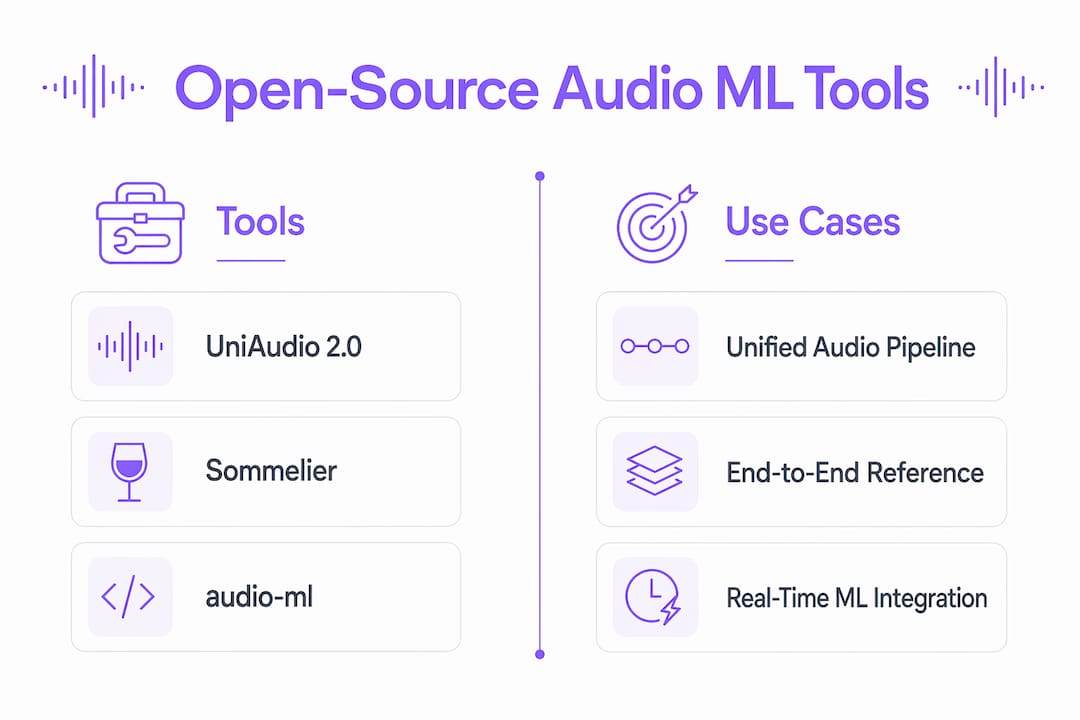
The table below maps the major open-source tools to their primary use cases and key technical characteristics.
| Tool | Primary Use Case | Key Architecture | Deployment Target |
|---|---|---|---|
| UniAudio 2.0 | Unified audio understanding and generation | ReasoningCodec, LLM token modeling | Research, fine-tuning |
| MOSS-Audio | Speech, music, and sound captioning | Temporal embeddings at 12.5 Hz, LLM projection | Research, QA tasks |
| Sommelier | Diarization, ASR, music separation | NeMo, Whisper, PANNs, Demucs ensemble | Production pipelines |
| audio-ml | Real-time browser and server audio ML | TensorFlow.js FastConformer, per-frame events | Web, Node.js |
| Sonance | Conversational AI DJ and music retrieval | WebRTC, VAD, Qdrant vector search | Interactive apps |
Sonance deserves special attention as an example of semantic-to-acoustic rendering. It maps natural language mood inputs to acoustic parameters, then performs hybrid semantic and acoustic retrieval on a large music vector database using Superlinked and Qdrant. The system uses WebRTC, VAD, ultra-fast LLM reasoning, and streamed TTS for a fully interactive experience. This is what automated audio editing with AI looks like when semantic intent drives the entire signal chain.
Pro Tip: Before committing to a pipeline architecture, check whether each component in the stack shares a compatible audio tokenizer. Mismatched tokenizer versions between diarization, ASR, and generation modules cause silent failures that are hard to debug in production.
How do you select and integrate ML models for audio enhancement?
Model selection for audio enhancement comes down to three tradeoffs: parameter count, latency, and task coverage. DB-CANet makes this concrete. It achieves real-time speech enhancement with just 0.15M parameters using dual-branch dense networks and depthwise separable convolutions with time-frequency coordinate attention. That is a model you can deploy on constrained hardware without a GPU. Deploying speech enhancement relies as much on architectural parameter efficiency and low latency as on improved loss functions or datasets.
Codec compatibility is the next integration concern. Standardizing on a discrete audio tokenizer early prevents silent integration issues and accelerates development cycles. The MOSS-Audio-Tokenizer uses a causal Transformer architecture trained on 3 million hours of audio, with encoder and decoder combined at 1.6 billion parameters and top-2 expert routing for stable inference. If your generation and understanding modules use different tokenizers, you will hit mismatched codebook indices that corrupt generation paths in ways that are not immediately obvious.
For complex production pipelines, ensemble techniques improve reliability. Sommelier uses an ASR Mixture-of-Experts ensemble alongside its diarization and music separation components. The benefit is that no single model failure brings down the entire pipeline. Each component can be versioned, swapped, and tuned independently.
Here is a practical checklist for model integration:
- Confirm tokenizer compatibility between all audio models in the pipeline before writing integration code
- Profile inference latency per frame on your target hardware before selecting model size
- Use VAD as a gating layer to avoid running expensive models on silence or noise
- Version each model checkpoint separately and log which version produced each output
- Test diarization segmentation thresholds on domain-specific audio before deploying to production
What are the best practices for deploying ML audio applications?
Production deployment of ML audio applications fails most often at the pipeline synchronization layer, not the model layer. VAD, diarization, ASR, music separation, and alignment must share a consistent view of the audio timeline. Synchronized pipeline tuning across all components is what separates a reliable system from one that produces inconsistent transcripts or misaligned speaker labels. Treat each component's configuration knobs as first-class engineering concerns, not afterthoughts.
Real-time applications require per-frame deterministic processing. The audio-ml library's architecture demonstrates this: each frame is processed within a fixed latency budget using event-driven callbacks. Per-frame deterministic processing prevents buffer overruns and keeps latency predictable across varying input conditions. If your architecture processes variable-length chunks, you will see latency spikes that are nearly impossible to eliminate without redesigning the processing loop.
Multi-stage training and domain-specific evaluation are non-negotiable for production quality. A model trained on clean studio recordings will degrade on noisy field recordings. Evaluate on audio that matches your deployment environment, not just standard benchmarks like AudioSet or ESC-50. AudioMosaic's Speech Commands accuracy of 99.03% is impressive on that benchmark, but your production accuracy will differ if your audio characteristics diverge from the benchmark distribution.
- Prioritize architectural efficiency first. Choose models like DB-CANet that meet latency budgets on your target hardware before optimizing for accuracy.
- Standardize your tokenizer. Lock in a single discrete audio tokenizer across all pipeline components before writing integration code.
- Expose configuration knobs. Make diarization thresholds, VAD sensitivity, and clustering parameters tunable at runtime, not hardcoded.
- Evaluate on domain audio. Build a test set from your actual deployment environment and track metrics separately from public benchmarks.
- Log component outputs independently. Store intermediate outputs from each pipeline stage to isolate failures during debugging.
Pro Tip: Run your full pipeline on 10 minutes of real deployment audio before launch. Benchmark scores tell you how a model performs in isolation. Pipeline integration tests tell you how it performs in your system.
Key takeaways
Machine learning audio processing applications succeed when model selection, tokenizer standardization, and pipeline synchronization are treated as equally important engineering constraints.
| Point | Details |
|---|---|
| Tokenizer standardization | Lock in a single audio tokenizer early to prevent silent codec mismatches across pipeline components. |
| Architectural efficiency | Models like DB-CANet prove that 0.15M parameters can deliver real-time enhancement on constrained hardware. |
| Self-supervised learning | AudioMosaic's contrastive approach outperforms generative pretraining on AudioSet, ESC-50, and Speech Commands. |
| Pipeline synchronization | Sommelier's configurable thresholds show that tuning component settings is as critical as model accuracy. |
| Per-frame determinism | Real-time audio ML requires fixed-latency per-frame processing to avoid buffer overruns in production. |
Where ML audio engineering gets interesting
I have spent a lot of time with audio ML pipelines, and the thing that surprises most engineers is how little the model accuracy score predicts production performance. You can have a state-of-the-art speech enhancement model and still ship a broken product because the diarization thresholds were never tuned for your specific recording conditions.
The shift toward unified foundation models like UniAudio 2.0 and MOSS-Audio is genuinely significant. These models reason across speech, music, and environmental sound in a single architecture. That cross-domain reasoning capability changes what is possible in tools like Sonance, where a natural language mood description drives the entire acoustic retrieval chain. We are moving from task-specific models to audio-native LLMs, and the engineering implications are substantial.
What I find underappreciated is the role of open-source collaboration in accelerating this field. The sommelier pipeline, audio-ml, and AudioMosaic are all publicly available and actively maintained. Engineers who contribute to these projects build intuition that no paper can teach. If you want to understand AI audio enhancement tools at a deep level, run the sommelier pipeline on your own audio and tune every threshold manually. That exercise will teach you more about production audio ML than reading a dozen research papers.
The next frontier is semantic audio generation at scale. Sonance points toward a world where producers describe a sound in natural language and the system renders it acoustically. That workflow will require tight integration between LLM reasoning, vector retrieval, and real-time DSP. Engineers who understand both the ML layer and the DSP algorithm design layer will be the ones who build the tools that matter.
— Kai
Build smarter audio tools with Vector-dsp
The ML models covered in this guide handle the intelligence layer. The DSP layer is where audio quality is actually realized in production. Vector-dsp builds professional-grade audio plugins and processing tools designed for engineers who need both precision and real-time performance in the same workflow.
ToneLab is Vector-dsp's production tool for engineers integrating ML-driven processing into sound design workflows. It combines DSP-grade signal processing with the flexibility modern audio production demands. If you are building pipelines that connect ML models to real audio output, explore ToneLab as the DSP layer your ML stack needs. Visit Vector-dsp to see the full product lineup and development resources built for audio professionals who take signal quality seriously.
FAQ
What are machine learning audio processing applications?
Machine learning audio processing applications are systems that use trained models to analyze, enhance, classify, or generate audio signals. Common tasks include speech enhancement, speaker diarization, automatic speech recognition, music analysis, and audio generation.
How does deep learning for audio differ from traditional DSP?
Traditional DSP uses hand-designed filters and transforms. Deep learning for audio learns signal representations directly from data, enabling tasks like speech denoising and source separation that are difficult to specify with fixed rules.
Which open-source framework is best for audio ML pipelines?
The sommelier project is the most complete open-source reference for production audio ML pipelines, combining NeMo Sortformer diarization, Whisper ASR, PANNs music detection, and Demucs vocal extraction in a single configurable system.
How is ML used in audio for real-time applications?
Real-time audio ML uses per-frame deterministic processing within fixed latency budgets. The audio-ml library implements this with TensorFlow.js FastConformer ASR and event-driven frame callbacks, supporting VAD, noise reduction, and speaker identification in browser and Node.js environments.
What is the role of audio tokenization in ML models?
Audio tokenization converts raw audio into discrete units that LLMs can process as sequences. UniAudio 2.0 uses a ReasoningCodec with 1024 and 8192 codebook variants, trained on 60 billion audio tokens, enabling unified reasoning across speech, music, and sound effects.