Ambient Music Production: A Producer's Complete Guide
Ambient Music Production: A Producer's Complete Guide
Ambient music production is the practice of crafting immersive, slow-evolving audio environments where texture and spatial depth take precedence over melody and rhythm. Formally recognized as a genre by Brian Eno in the late 1970s, ambient music operates on what Eno called "two levels of listening": active and passive. You can focus on it or let it wash over you. That dual function shapes every production decision, from the length of an envelope to the depth of a reverb tail. Understanding what ambient music production demands technically and creatively is the first step toward making work that genuinely holds space.
What is ambient music production and its core principles?
Ambient music production is defined as a compositional approach that prioritizes atmosphere, texture, and space over traditional melody or rhythm. The goal is not a song with a hook. The goal is a sonic environment the listener can inhabit.
The foundational logic here is subtractive, not additive. Most music production teaches you to build up. Ambient production teaches you to carve away. Every element you add must justify its presence by contributing to the atmosphere, not competing with it.
Space itself functions as an instrument. Designing the sonic environment before adding sounds creates a unified world rather than a pile of unrelated textures. Think of it as architecture: you define the room before you furnish it.
Ambient tracks are also characterized by slow evolution. Nothing snaps or punches. Sounds breathe in and out over long durations, creating movement without urgency. That patience is not a stylistic quirk. It is the defining structural feature of the genre.
What are the fundamental sonic elements of ambient production?
The building blocks of ambient music differ significantly from those of any rhythmic genre. Here is what actually matters at the foundational level:
- Texture and timbre over melody. Sustained tonal beds, noise layers, and harmonic drones carry the composition. Pitch matters less than color and weight.
- Long attack and release envelopes. Ambient pads use attack envelopes ranging from 2–10 seconds and release times of 4–15+ seconds. That slow bloom is what gives pads their weightless quality.
- Low filter cutoffs with gentle modulation. Harsh high frequencies break the spell. Keeping filter cutoffs low and using slow LFO sweeps maintains subtle movement without aggression.
- Frequency allocation across layers. Each layer should occupy a distinct frequency range. Sub-bass drones, mid-range pads, and high shimmer textures each need their own space to avoid muddiness.
- Sonic restraint. The most powerful ambient tracks often contain fewer than five active elements at any given moment. Restraint is a technique, not a limitation.
Natural and found sounds belong here too. Wind, rain, distant traffic, and room tone all carry emotional information that pure synthesis cannot replicate. Blending organic material with synthetic textures is not an aesthetic choice. It is a production strategy.
Pro Tip: Record room tone in every space you work in. A 30-second capture of silence in a stairwell or parking garage becomes an irreplaceable ambient texture you cannot synthesize.
Which tools and techniques are essential for ambient soundscapes?
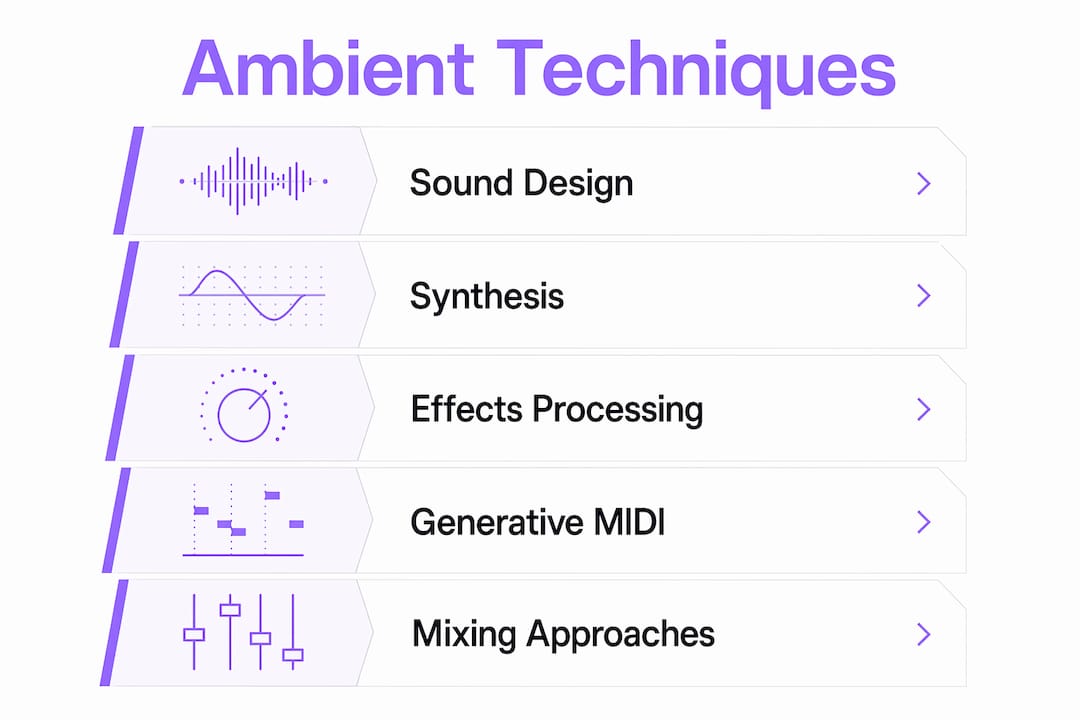
Ambient music production relies on a specific set of synthesis methods and effects processing approaches. The tools below are not optional extras. They are the core vocabulary of the genre.
Synthesis methods
Granular synthesis is the most powerful tool in ambient production. It slices audio into micro-segments between 10 and 200 milliseconds, then reassembles them with randomized parameters. The result is shimmering, non-repetitive texture that no other synthesis method produces. Plug-ins like Ableton's Granulator III, Straylight by Native Instruments, and Emergence by Output all use granular engines to transform mundane recordings into complex soundscapes.
Long-attack pads built in wavetable or subtractive synthesizers form the harmonic backbone of most ambient tracks. Slow LFO modulation on filter cutoff and pitch creates the sense of organic breathing that distinguishes professional ambient work from static loops.
Effects processing
Reverb and delay are not mix tools in ambient production. They are compositional instruments. A convolution reverb loaded with an impulse response from a cathedral or cave defines the physical world your sounds inhabit. Long pre-delay on reverb keeps the dry signal audible before the tail blooms, preserving clarity.
Stereo imaging tools like mid-side processing widen the field without pushing elements out of phase. This is critical for headphone listening, which is where most ambient music is consumed.
| Tool type | Example plugins | Primary function |
|---|---|---|
| Granular synthesis | Granulator III, Straylight, Emergence | Texture generation and randomized movement |
| Reverb | Valhalla Room, Convolution reverbs | Spatial depth and environment design |
| Delay | Echobode, Replika XT | Rhythmic texture and echo-based movement |
| Modulation | LFO Tool, Subtle modulation plugins | Slow parameter evolution |
| Stereo imaging | MSED, Ozone Imager | Width and spatial placement |
Generative and automation techniques
Generative MIDI techniques automate filter cutoffs, panning, and granular parameters to create textures that evolve without repeating. This prevents loop fatigue over extended listening. Modular environments like Eurorack hardware or VCV Rack software excel at this because they allow random voltage sources to drive any parameter continuously.
Pro Tip: Route a slow random LFO to three separate parameters simultaneously: filter cutoff, reverb send level, and stereo width. The interaction between them creates movement that sounds organic rather than programmed.
How does ambient production differ from other genres in mixing?
Ambient mixing is a fundamentally different discipline from mixing rhythmic music. The comparison below makes the contrast clear.
| Mixing element | Rhythmic genres | Ambient production |
|---|---|---|
| Low end | Punchy, transient-driven kick and bass | Sustained sub drones, no transient peaks |
| Midrange | Vocals, guitars, synths competing for space | Sparse pads with wide frequency gaps |
| High end | Crisp hi-hats, bright leads | Gentle shimmer, rolled-off harshness |
| Dynamics | Compression for punch and glue | Minimal compression, natural swell |
| Reverb | Used to place sounds in a mix | Used to define the entire sonic world |
Ambient mixing requires sonic purity. Without drums or hooks to distract the listener, every technical flaw becomes audible. Clumsy reverb, phasing issues, and muddy low-mids are immediately obvious in a sparse ambient mix. This is why professional ambient producers spend more time subtracting than adding.
Subtractive EQ is the primary mixing tool. Carving out narrow frequency bands from each layer prevents buildup and maintains the sense of openness that defines the genre. A high-pass filter at 80 Hz on every non-bass element alone clears enormous space in the low-mid range.
Treating space as a compositional voice also means resisting the urge to fill silence. Gaps between textures carry as much meaning as the sounds themselves. This is the hardest discipline for producers trained in other genres to internalize.
Pro Tip: Mix ambient tracks at low volume. If the sense of space and depth disappears when you turn it down, your reverb and low-end balance need work. Great ambient mixes hold their spatial quality at any playback level.
What are the best practices for producing compelling ambient tracks?
These are the production habits that separate professional ambient work from generic background music.
- Start with one evolving pad. Build the entire track's harmonic and textural identity from a single source before adding anything else. This forces coherence from the beginning.
- Process sounds deeply before layering. Foundation sounds often come from pitch-shifted field recordings or heavily processed electric guitar. Processing at the source creates a cohesive sonic world rather than a collection of unrelated elements.
- Use reverb sends, not inserts. Sending multiple elements to a shared reverb bus creates a unified space. Inserting reverb on individual channels creates multiple disconnected spaces that fight each other.
- Combine synthetic and organic sources. Field recordings of wind, train stations, and tape static blend with synthesis to add emotional warmth and avoid clinical-sounding results. The contrast between the two is where the most interesting textures live.
- Apply subtractive logic throughout. Regularly evaluate whether each element enhances or clutters the atmosphere. When in doubt, remove it. Restraint produces more powerful ambient work than density.
- Automate everything slowly. Volume, filter cutoff, reverb send level, and panning should all move over the course of minutes, not seconds. Slow automation creates the sense of a living, breathing environment.
For MIDI-driven modulation in ambient production, generative approaches consistently outperform static sequences. A random MIDI arpeggiator set to long note lengths and low velocity variation produces movement that feels composed rather than mechanical.
Pro Tip: Record a 10-minute improvised ambient session without stopping to edit. Then listen back and identify the two or three moments that feel genuinely alive. Build your track around those moments instead of constructing it from scratch.
Key takeaways
Ambient music production succeeds through restraint, spatial design, and slow evolution rather than through density, melody, or rhythmic structure.
| Point | Details |
|---|---|
| Space is a compositional tool | Design the sonic environment first, then add sounds that belong inside it. |
| Subtractive logic drives mixing | Remove elements that clutter atmosphere; use subtractive EQ to carve frequency space. |
| Long envelopes define the genre | Attack times of 2–10 seconds and releases of 4–15+ seconds create the signature ambient bloom. |
| Organic and synthetic sources combine | Field recordings add emotional warmth that pure synthesis cannot replicate. |
| Generative techniques prevent fatigue | Automating slow modulations keeps textures alive and non-repetitive over extended listening. |
Why ambient production is harder than it looks
Most producers assume ambient music is easy because it has fewer elements. That assumption is wrong. Minimalism exposes every flaw. A poorly placed reverb tail, a slightly off-tuned pad, or a muddy low-mid buildup has nowhere to hide when there is no kick drum or vocal to distract from it.
I have found that the creative challenge in ambient production is not generating ideas. It is resisting the urge to add more. Every time I open a session and feel the pull to layer another texture, I ask whether the track needs it or whether I am just uncomfortable with the space. That discomfort with silence is the single biggest obstacle most producers face when they first approach the genre.
The producers whose ambient work genuinely holds attention over 20 or 30 minutes share one habit: they treat patience as a production tool. They let a single pad evolve for four minutes before introducing anything new. They automate reverb send levels over the course of an entire track. They record field recordings specifically for a project rather than pulling from a sample library.
Integrating real-world sounds and organic material is the technique I recommend most to producers who feel their ambient work sounds clinical. A recording of rain on a window or the hum of a refrigerator processed through a granular engine becomes something entirely new. It carries the emotional memory of the original sound while functioning as pure texture. That combination is what gives the best ambient music its sense of place and feeling.
Generative methods are the other practice I return to constantly. Letting a random voltage source or a probability-based MIDI plugin drive filter cutoffs and grain parameters removes the composer's hand from the moment-to-moment detail. The result sounds alive in a way that manually programmed automation rarely achieves.
— Kai
Take your ambient production further with Vector-dsp
Ambient production rewards producers who understand the tools behind spatial depth and textural movement. Vector-dsp builds professional-grade audio plugins grounded in advanced DSP technology, designed for creators who need precise control over reverb, modulation, and sound design at the signal level.

If you are building ambient soundscapes and want to understand the signal processing principles behind the effects you use, the DSP design principles behind spatial audio are worth studying directly. For producers focused on creative effects processing as a compositional tool, Vector-dsp's resources connect technical precision with creative application. Explore the full plugin lineup and production guides at vector-dsp.com.
FAQ
What is ambient music production in simple terms?
Ambient music production is the process of creating audio environments that prioritize texture, space, and atmosphere over melody or rhythm. The goal is an immersive sonic world rather than a traditional song structure.
What software is best for ambient music production?
Ableton Live, Logic Pro, and Bitwig Studio are the most widely used DAWs for ambient production. For granular synthesis specifically, plug-ins like Granulator III, Straylight by Native Instruments, and Emergence by Output are standard tools.
How does granular synthesis work in ambient music?
Granular synthesis slices audio into micro-segments between 10 and 200 milliseconds and reassembles them with randomized parameters. This creates shimmering, non-repetitive textures that form the core of many ambient soundscapes.
Why is reverb so important in ambient production?
Reverb defines the physical space your sounds inhabit. In ambient music, it functions as a compositional instrument rather than a mix tool, creating the sense of depth and environment that makes a track feel immersive.
How do I avoid muddy mixes in ambient production?
Each layer should occupy a distinct frequency space and move at a different rate. Use subtractive EQ to carve out overlapping frequencies, and apply high-pass filters to every non-bass element to preserve low-end clarity.