Spatial Audio Technology Explained for Audio Pros
Spatial Audio Technology Explained for Audio Pros

Spatial audio is defined as an object-based sound technology that places individual audio sources at precise three-dimensional coordinates, replicating how humans naturally hear sound from every direction. Unlike traditional stereo, which locks sound to a left-right horizontal plane, spatial audio adds height and depth to the listening field. The core mechanisms behind this are Head-Related Transfer Functions (HRTF), binaural rendering, and dynamic head tracking. Together, these technologies make spatial audio technology explained not just a consumer novelty but a production-level discipline that every serious audio professional needs to understand.
How does spatial audio technology work?
Spatial audio works by treating every sound source as an independent object with its own X, Y, and Z coordinates in a three-dimensional space. Traditional channel-based formats route audio to fixed speaker positions. Object-based audio assigns each sound its own metadata, telling the playback system exactly where to render it regardless of the speaker configuration.
The key perceptual engine behind spatial audio is the HRTF. HRTF simulates how ears and head filter sound, allowing a standard two-channel headphone mix to create the illusion of sounds coming from above, behind, or beside the listener. This is why spatial audio can work on ordinary headphones without any additional hardware.

Binaural rendering takes the HRTF data and applies it in real time during playback. The renderer calculates the precise delay, frequency coloration, and level difference each ear would receive from a given sound position. The result is a convincing three-dimensional soundstage delivered through two drivers.
Dynamic head tracking adds another layer of realism. Gyroscopes and accelerometers anchor audio relative to the listener's environment, not to the listener's head. When you turn your head left, the sound stays where it is in the virtual room. Modern devices have reduced head tracking latency to imperceptible levels, eliminating the audio lag that plagued earlier implementations.
- Object-based audio: Each sound carries 3D coordinate metadata independent of speaker count.
- HRTF: Filters audio to simulate the acoustic effect of the human head and ear shape.
- Binaural rendering: Applies HRTF in real time for headphone-based 3D playback.
- Dynamic head tracking: Uses motion sensors to keep the virtual soundstage fixed in space.
- Processing cost: Spatial audio demands more processing power than stereo, which accelerates battery drain on mobile devices.
Pro Tip: If you are mixing for headphone delivery, test your binaural render on multiple HRTF profiles before finalizing. Generic HRTFs vary widely in elevation accuracy across listeners.
How does spatial audio differ from surround sound?
The core difference between spatial audio and traditional surround sound is the axis of sound placement. Surround formats like 5.1 and 7.1 operate on a horizontal plane only. Spatial audio adds a vertical axis, placing sounds above and below the listener as well.
Channel-based surround sound routes audio to fixed speaker positions at mix time. A 5.1 mix has six discrete channels: left, center, right, left surround, right surround, and a low-frequency effects channel. The mix is locked to those positions. If you play it back on a different speaker layout, the rendering is approximate at best.
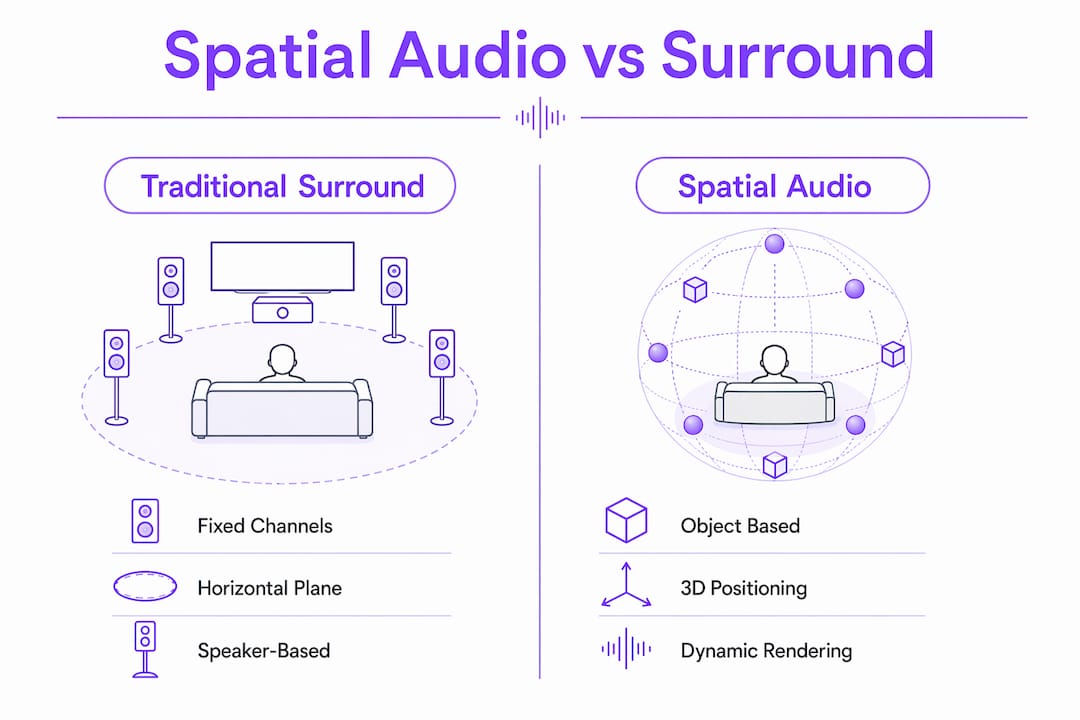
Object-based spatial audio supports up to 128 simultaneous sound objects, each with its own position metadata. The playback renderer adapts those positions to whatever speaker array or headphone system is available. A mix made for a 7.1.4 cinema system can fold down gracefully to a two-channel headphone output without losing its spatial intent.
| Feature | Traditional surround sound | Spatial audio |
|---|---|---|
| Sound placement | Horizontal plane only | Full 3D including height |
| Audio format | Fixed channel-based | Object-based with metadata |
| Playback flexibility | Tied to specific speaker count | Adapts to any playback system |
| Max sound objects | Limited by channel count | Up to 128 simultaneous objects |
| Hardware requirement | Dedicated multi-speaker setup | Works on headphones and speakers |
| Primary applications | Cinema, home theater | Music, gaming, film, broadcast |
The practical implication for producers is significant. A spatial mix is not a fixed deliverable tied to one speaker configuration. It is a set of instructions the renderer interprets for each playback context. That flexibility is what makes spatial audio worth the additional production investment.
What are the main spatial audio formats and standards?
Spatial audio encompasses several proprietary formats with distinct encoding approaches, which creates confusion even among professionals. The three most widely adopted are Dolby Atmos, Sony 360 Reality Audio, and MPEG-H.
Dolby Atmos is the dominant format across cinema, music streaming, and gaming. Dolby Atmos uses a bed channel plus up to 128 audio objects, each carrying position metadata that the renderer interprets at playback. Its music adaptation arrived in 2019, which accelerated consumer adoption through platforms like Apple Music and Amazon Music HD. Producing a Dolby Atmos mix requires adherence to specific loudness standards, including Dolby's dialogue normalization target of 18 LUFS, which differs from standard stereo loudness practices.
Sony 360 Reality Audio takes a different technical approach. Sony 360 Reality Audio applies spherical harmonic representation to encode diffuse and ambient sound fields. This method excels at capturing the enveloping quality of a room or concert hall. It is designed primarily for music rather than cinema or gaming.
MPEG-H targets broadcast and interactive audio. MPEG-H supports interactive features like real-time dialogue level adjustment and multiple audio perspectives within a single broadcast stream. South Korea and parts of Europe have adopted it for next-generation broadcast audio.
- Dolby Atmos: object-based, dominant in music and cinema, widely supported on streaming platforms.
- Sony 360 Reality Audio: spherical harmonic encoding, optimized for music streaming.
- MPEG-H: broadcast-focused, interactive audio features, adopted in select markets.
- All three formats generate significantly larger file sizes than stereo. ADM BWF files can reach 30 times the size of an equivalent stereo WAV, which has real implications for storage and streaming pipeline design.
Understanding psychoacoustics in music production helps producers make informed decisions about which format suits a given project and delivery target.
Where is spatial audio being used right now?
Spatial audio has moved well beyond the cinema into music production, gaming, live events, and broadcast. Each application uses the technology differently, and the hardware requirements vary accordingly.
Music production and streaming represent the fastest-growing application area. Producers now deliver Dolby Atmos mixes alongside stereo masters for platforms like Apple Music, Amazon Music HD, and Tidal. Spatial audio mixing uses XYZ positioning automation within DAW environments, with renderers like the Dolby Atmos Renderer adapting mixes in real time for different speaker arrays and binaural output. Professional Dolby Atmos production requires 7.1.4 speaker monitoring and dedicated renderer licenses, representing a significant infrastructure commitment beyond a standard stereo studio.
Gaming is where spatial audio delivers the most measurable performance benefit. Spatial audio in gaming renders precise directional cues that allow players to locate opponents by sound position alone. Modern consoles and PC platforms support spatial audio engines natively, and competitive players treat it as a functional advantage rather than a listening preference.
- Music streaming: Deliver Dolby Atmos and stereo masters simultaneously for maximum platform compatibility.
- Gaming: Use head-tracking-enabled headphones to maintain accurate positional cues during play.
- Film and TV: Mix for both cinema speaker arrays and headphone binaural delivery from a single session.
- Live events: Real-time spatial rendering for arena concerts is an emerging application, with object-based PA systems placing instruments in specific zones of the venue.
- Broadcast: MPEG-H enables interactive audio in live sports and news, letting viewers adjust dialogue levels or switch commentary languages.
Pro Tip: When managing large spatial audio sessions, cloud storage for audio professionals becomes a practical necessity. ADM BWF files are large, and version control across a spatial mix session requires more bandwidth than a typical stereo project.
Apple's implementation adds a personalization layer worth noting. Apple uses TrueDepth ear scans to build personalized HRTF profiles, which markedly improve elevation perception. This points toward where the technology is heading: individualized rendering rather than generic approximation.
The future of DSP technology will likely accelerate this personalization trend, as AI-driven HRTF generation becomes computationally feasible on consumer devices.
Key Takeaways
Spatial audio is object-based sound technology that assigns each source a 3D position, enabling height and depth perception through HRTF, binaural rendering, and dynamic head tracking across any playback system.
| Point | Details |
|---|---|
| Object-based audio | Each sound carries 3D metadata, allowing the renderer to adapt to any speaker layout. |
| HRTF is the core engine | Head-Related Transfer Functions create 3D perception through standard two-channel headphones. |
| Spatial vs. surround | Spatial audio adds a vertical axis and supports up to 128 objects; surround sound is locked to horizontal channels. |
| Format matters | Dolby Atmos, Sony 360 Reality Audio, and MPEG-H each use different encoding methods suited to different delivery contexts. |
| Production infrastructure | Professional spatial mixes require 7.1.4 monitoring, dedicated renderers, and larger file storage than stereo. |
What I've learned from working with spatial audio in practice
The most common misconception I encounter is that spatial audio is simply "better stereo." It is not. It is a fundamentally different production discipline with its own monitoring requirements, loudness standards, and delivery pipeline. Treating it as an upgrade to your existing stereo workflow leads to mixes that sound disorienting rather than immersive.
The second thing that surprises most producers is how much the listening environment matters. A spatial mix that sounds extraordinary on a calibrated 7.1.4 system can collapse into a muddy blur on generic earbuds without proper binaural rendering. The format is only as good as the renderer interpreting it at the other end.
The infrastructure demands are real and worth planning for honestly. Spatial audio file sizes are not a minor inconvenience. Efficient post-production project tracking becomes genuinely important when you are managing multiple format deliverables and large ADM BWF sessions simultaneously.
My honest view on the stereo-versus-spatial debate: stereo will not disappear. Expert consensus holds that spatial audio will augment rather than replace stereo for the foreseeable future. Stereo is simpler, smaller, and universally compatible. The practical path forward is delivering both from a single spatial session, which is already standard practice on major streaming platforms.
The area I watch most closely is HRTF personalization. Generic HRTFs are a compromise. When personalized profiles become standard on consumer devices, the gap between a professional monitoring environment and a pair of headphones will narrow significantly. That is when spatial audio becomes truly universal rather than a premium feature.
— Kai
Vector-dsp and professional spatial audio production
Audio professionals working with spatial audio formats need DSP tools built for precision, not approximation. Vector-dsp develops professional-grade audio software grounded in advanced digital signal processing, designed for producers and engineers who require meticulous control over every stage of sound manipulation.

Vector-dsp's plugin lineup targets the VST3, AU, and AAX formats used in the DAW environments where spatial mixes are built. The focus on real-time performance and low latency aligns directly with the demands of object-based audio sessions, where rendering accuracy and processing efficiency are non-negotiable. Producers who want tools built on hardware and software DSP principles rather than marketing claims will find Vector-dsp's approach worth exploring. Visit Vector-dsp to see what is currently in development.
FAQ
What is spatial audio in simple terms?
Spatial audio is a technology that places sounds at specific positions in a three-dimensional space around the listener, including above and below, rather than just left and right like stereo.
How does HRTF make spatial audio work on headphones?
Head-Related Transfer Functions simulate how the human head and ears filter sound from different directions, allowing a two-channel headphone mix to create convincing height and depth perception without additional speakers.
What is the difference between Dolby Atmos and Sony 360 Reality Audio?
Dolby Atmos uses object-based audio with position metadata and supports up to 128 sound objects, while Sony 360 Reality Audio uses spherical harmonic encoding optimized for music streaming and ambient sound fields.
Does spatial audio work without special headphones?
Spatial audio works on standard headphones through binaural rendering, though head-tracking-enabled devices provide a more immersive experience by anchoring the soundstage to the listener's environment rather than their head position.
Why are spatial audio files so much larger than stereo files?
Spatial audio formats like ADM BWF carry object metadata and multi-track audio data, which can make files up to 30 times larger than an equivalent stereo WAV, creating real demands on storage and streaming infrastructure.