Low-Latency Audio Thread Programming: A 2026 Guide
Low-Latency Audio Thread Programming: A 2026 Guide

Low-latency audio thread programming is the practice of designing audio processing threads that consistently meet real-time deadlines by avoiding blocking operations and using lock-free data structures alongside SIMD optimizations. The industry term for this discipline is real-time audio processing, and the two phrases describe the same constraint: your audio callback must finish within its time budget or the listener hears a glitch. Miss that budget once, and you get an xrun. Miss it repeatedly, and your plugin or app is unusable. This guide covers thread isolation, lock-free communication, DSP throughput, and backpressure management, the four pillars every audio developer needs to get right.
What are the real-time constraints in low-latency audio thread programming?
Achieving sub-10ms round-trip latency requires strict isolation of the audio callback thread from heap allocations, mutex locks, file I/O, and network operations. Each of those operations can block for an unpredictable duration. The OS scheduler does not care that your audio callback is waiting; it will preempt your thread and hand the CPU to something else.
The list of prohibited operations on the audio thread is longer than most developers expect:
- No malloc or free. The heap allocator uses internal locks that can stall for milliseconds.
- No mutex locks. A priority-inverted mutex will block your real-time thread behind a low-priority one.
- No file I/O or network calls. Both can block indefinitely waiting for hardware or network responses.
- No logging. Most logging frameworks write to disk or call into the OS, triggering hidden blocking.
- No Objective-C or Swift runtime calls. These trigger hidden OS-level blocking that causes audible glitches even when the logic looks harmless.
Thread priority and CPU affinity matter as much as what you avoid. Audio callback threads require platform-specific priority settings and CPU pinning to guarantee minimal preemption and zero core migration. On Android, use SCHED_FIFO with a high priority value. On Apple platforms, use AudioWorkgroup APIs introduced in macOS 11. Pinning the thread to a performance core prevents the scheduler from migrating it to an efficiency core mid-callback, which would cut your available CPU budget in half without warning.
Pro Tip: Always check your hardware API mode before profiling DSP code. Misconfiguring Exclusive mode forces audio through the system mixer and adds 15–40ms of latency that no amount of DSP optimization can remove.

For a deeper look at configuring devices to Exclusive or Low Latency mode on Android and iOS, the Vector-dsp producer guide covers the platform-specific steps in detail.
How to design lock-free communication between audio and application threads?
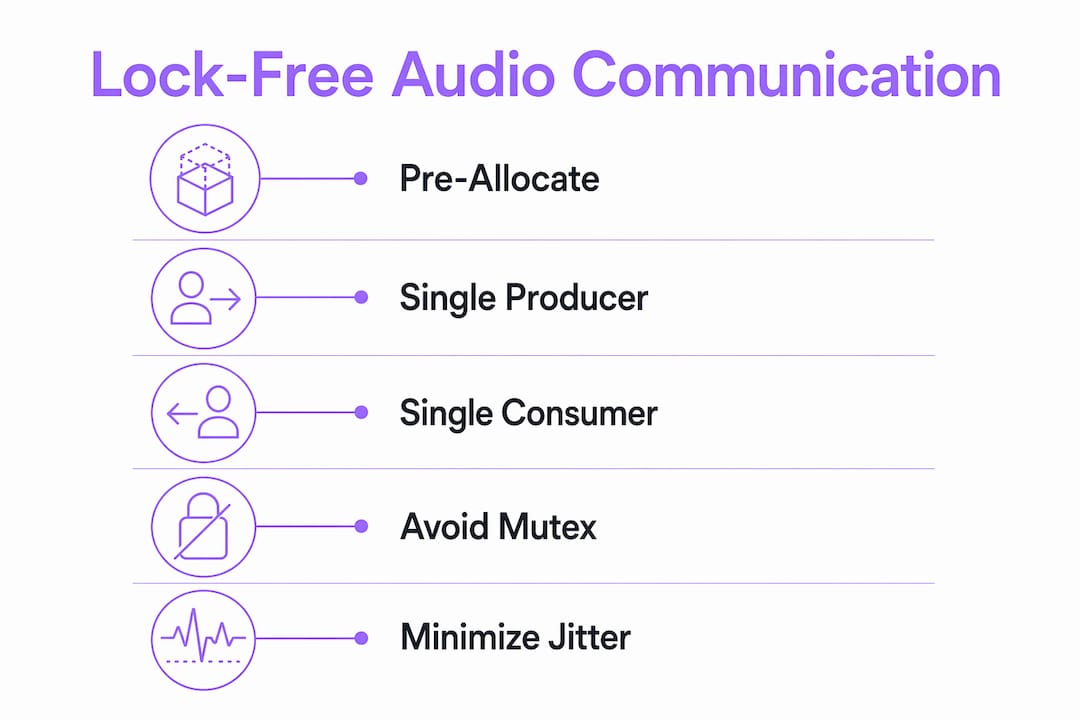
The industry standard for passing data between the audio callback and the rest of your application is a lock-free single-producer/single-consumer (SPSC) ring buffer. The audio thread reads from the buffer; the application thread writes to it. Neither thread ever blocks the other.
A ring buffer works by pre-allocating a fixed block of memory before the audio session starts. Pre-allocation is the key word. You size the buffer at initialization, never at runtime. A 2,048-sample buffer at 48kHz provides roughly 42ms of headroom, which smooths jitter from non-real-time background tasks without adding perceptible latency to the audio path.
Ring buffer vs. disruptor queue: which one to use?
| Feature | SPSC ring buffer | Disruptor-style queue |
|---|---|---|
| Complexity | Low | Medium to high |
| Throughput | Good for single producer/consumer | Superior with proper wait strategies |
| Cache behavior | Good with alignment | Excellent with cached cursor optimization |
| Best use case | Parameter updates, MIDI events | High-frequency DSP graph updates |
The disruptor queue's cached cursor optimization reduces cache line invalidation by minimizing shared cache line touches between producer and consumer. For most plugin and instrument use cases, a well-implemented SPSC ring buffer is sufficient. The disruptor pattern pays off when you need to pass large volumes of events at very high frequency.
False sharing is the silent killer of lock-free queue performance. Atomic head and tail pointers that share a cache line cause constant invalidation between threads even when the logic is correct. The fix is one line of C++: alignas(64) on each pointer, matching the 64-byte cache line size on ARM Cortex-A processors.
Here is the correct implementation sequence for a production SPSC ring buffer:
- Pre-allocate the buffer at session start using a fixed power-of-two size.
- Align head and tail pointers to separate 64-byte cache lines with
alignas(64). - Use
std::atomicwithmemory_order_acquireandmemory_order_releasefor correct visibility without full sequential consistency overhead. - Size the buffer to balance latency headroom against memory cost. Start at 2,048 samples and measure.
- Use atomic state snapshots for graph updates. The main thread builds a new graph; the audio thread atomically swaps the pointer to the new structure without touching the old one mid-callback.
Pro Tip: Use immutable, versioned graph structures for DSP routing changes. Atomic pointer swaps let the audio thread switch to a new processing graph with zero latency penalty and no risk of partial state reads.
Which DSP techniques maximize throughput within real-time budgets?
SIMD intrinsics are the single highest-leverage tool for audio thread optimization. ARM NEON and Apple's Accelerate framework produce a 3–4x throughput gain over standard scalar C++ DSP code. That gain means you can run more complex processing chains within the same callback time budget.
Hand-written SIMD intrinsics are more predictable than compiler auto-vectorization. Auto-vectorization depends on the compiler recognizing a loop pattern and choosing the right instruction set. Hand-written intrinsics give you exact control over which registers are used and when loads and stores happen. The result is sub-1% CPU usage of real-time budgets for complex processing chains, compared to unpredictable compiler output.
| Approach | Throughput | Predictability | Development cost |
|---|---|---|---|
| Scalar C++ | Baseline | High | Low |
| Compiler auto-vectorization | 2–3x | Medium | Low |
| Hand-written ARM NEON / Accelerate | 3–4x | High | Medium |
Zero-copy buffer design compounds the SIMD gains. Passing a pointer to the audio hardware's buffer directly into your FFT or filter kernel avoids a memcpy on every callback. For a 256-sample callback at 48kHz, that callback fires 187 times per second. Eliminating a memcpy on each call removes a measurable chunk of memory bandwidth pressure.
The key trade-offs in this area are worth naming directly:
- Frame-level processing increases computational cost per sample but reduces control latency. Use it for instruments where note-on response time matters.
- Block processing reduces per-sample overhead and is better suited to effects chains where a few milliseconds of additional processing latency is acceptable.
- Sliding-window or decoder-only architectures balance streaming performance with control latency, as the Magenta Realtime 2 project demonstrated with generative audio models running in real time.
For a practical walkthrough of SIMD usage with ARM NEON and Accelerate, the Vector-dsp DSP concepts guide covers buffer processing patterns in accessible terms.
What are the best runtime strategies for glitch-free audio streams?
Backpressure in a low-latency audio system occurs when the processing thread cannot keep up with the hardware's demand for samples. The result is an xrun: the hardware runs out of buffered audio and either outputs silence or repeats the last buffer. Both are audible.
Monitoring ring buffer occupancy and using dynamic resampling rate adjustments maintain jitter-free streams and handle timing mismatches. The key is measuring occupancy continuously, not just when a problem occurs.
Effective backpressure management uses these techniques:
- Hysteresis thresholds. Switch to a simpler DSP algorithm when buffer occupancy drops below a low watermark. Switch back when it recovers above a high watermark. The gap between the two thresholds prevents rapid mode flapping, which itself causes audible artifacts.
- Adaptive resampling. Adjust the resampling rate slightly to compensate for clock drift between the audio interface and the system clock. This is especially important for Bluetooth audio, where buffer size increases and adaptive resampling smooth inherent latency variability.
- Preplanned dropped-sample strategies. Decide in advance what happens when you must drop a sample. Silence is usually better than a corrupted buffer. Document the decision so it does not become a surprise during a live session.
Pro Tip: Never react to backpressure for the first time in production. Test your hysteresis thresholds under CPU stress conditions during development. Simulate a loaded system by running background tasks and verify that your mode-switching logic fires at the right occupancy levels.
The Vector-dsp debugging workflow guide covers how to instrument the audio callback thread for performance analysis without introducing the very blocking operations you are trying to avoid.
Key Takeaways
Effective real-time audio processing requires strict thread isolation, lock-free communication, SIMD-accelerated DSP, and explicit backpressure control working together as a system.
| Point | Details |
|---|---|
| Isolate the audio callback | Never call malloc, mutex, file I/O, or logging from the audio thread. |
| Use SPSC ring buffers | Pre-allocate at session start and align atomic pointers to 64-byte cache lines. |
| Apply SIMD intrinsics | ARM NEON and Accelerate deliver a 3–4x throughput gain over scalar C++ code. |
| Enable Exclusive mode | Misconfiguring the hardware API adds 15–40ms of mixer latency no DSP fix can remove. |
| Monitor buffer occupancy | Use hysteresis thresholds to switch algorithms before xruns occur, not after. |
What I have learned from years of real-time audio work
The most dangerous assumption in audio thread optimization is that avoiding malloc and mutexes is enough. It is not. I have debugged production crashes caused by a single NSLog call inside an audio callback on iOS, a call that looked completely harmless to the developer who wrote it. The Objective-C runtime triggered a lock under the hood, and the thread stalled. The fix took five minutes. Finding it took two days.
Thread priority tuning is the second area where I see developers leave performance on the table. Setting SCHED_FIFO on Android or using AudioWorkgroup on Apple platforms is not optional for sub-10ms latency. It is the baseline. Without it, the scheduler will preempt your audio thread whenever a higher-priority system process needs CPU time, and there is nothing your DSP code can do about it.
False sharing is the subtlest problem of the three. I have seen lock-free queues that were logically correct but performed worse than a mutex-protected queue because the head and tail pointers shared a cache line. The fix, adding alignas(64), took one line. The performance difference was measurable on every profiling run.
My strongest recommendation is iterative profiling with real hardware under realistic load. Instruments on macOS and Perfetto on Android both give you thread-level timing data without requiring you to add blocking instrumentation to the audio callback. Profile first, then optimize. The bottleneck is almost never where you expect it.
— Kai
Vector-dsp and real-time audio development
Vector-dsp builds professional audio plugins and DSP tools with real-time performance as a core design constraint, not an afterthought. Every plugin in the Vector-dsp lineup targets VST3, AU, and AAX formats with thread isolation and lock-free architecture built in from the start. If you are building or evaluating audio software that needs to meet strict latency budgets, the Vector-dsp platform is worth a close look. The engineering principles covered in this guide are the same ones that drive every Vector-dsp product decision.
FAQ
What operations are banned on the audio callback thread?
The audio callback thread must never call malloc, free, mutex locks, file I/O, network operations, logging, or Objective-C/Swift runtime methods. Each of these can block for an unpredictable duration and cause audible xruns.
What is a good ring buffer size for real-time audio?
A 2,048-sample buffer at 48kHz provides roughly 42ms of headroom and smooths jitter from non-real-time background tasks without adding perceptible latency to the audio path.
How much faster is SIMD over scalar C++ for audio DSP?
ARM NEON and Apple's Accelerate framework deliver a 3–4x throughput gain over standard scalar C++ DSP code, enabling complex processing chains to run within sub-1% of the real-time CPU budget.
What causes false sharing in lock-free audio queues?
False sharing occurs when atomic head and tail pointers in an SPSC queue share a CPU cache line. Use alignas(64) on each pointer to place them on separate 64-byte cache lines and eliminate the contention.
What is backpressure in an audio pipeline?
Backpressure occurs when the audio processing thread cannot produce samples fast enough to meet hardware demand. Monitoring ring buffer occupancy and switching to simpler algorithms at low-watermark thresholds prevents xruns before they happen.