Future of DSP Technology Explained for Audio Pros
Future of DSP Technology Explained for Audio Pros
Digital signal processing (DSP) is defined as the mathematical manipulation of digitized signals to filter, compress, analyze, or transform audio, vibration, and other real-world data in real time. The future of DSP technology explained through today's hardware and software trends reveals a field moving fast: AI inference fused directly into silicon, cloud-native immersive audio pipelines, and software-defined architectures replacing fixed-function chips. The professional DSP market is projected to grow from $580 million in 2024 to $710 million by 2029, driven by software-defined DSP and immersive audio workflows. That growth signals a structural shift, not a product cycle. For audio professionals, sound engineers, and music creators, understanding these DSP technology advancements is now a competitive skill, not optional background knowledge.
How are hardware advancements transforming DSP performance and efficiency?
The most consequential hardware shift in DSP right now is the arrival of dedicated hardware signal processors (HSPs) embedded directly alongside microcontroller cores. ST's STM32U3 family is the clearest current example. Its HSP delivers up to 13x FFT performance over a standard Cortex-M33 processor, accessed through simple API calls rather than low-level register programming. That performance gain at ultra-low power changes what is possible in battery-operated audio devices, wearables, and embedded sensing hardware.
The deeper implication is architectural. Hybrid designs that combine deterministic real-time control loops with hardware-accelerated DSP primitives deliver both low power and high throughput simultaneously. This is not a theoretical benefit. ST's IIS3DWB10IS vibration sensor integrates DSP and AI inference near the sensing element itself, delivering up to 4x processing performance while enabling predictive maintenance without offloading data to a host processor. The signal never leaves the sensor until a decision has already been made.
Performance comparison: HSP vs. standard Cortex-M33
| Metric | Cortex-M33 (baseline) | STM32U3 HSP |
|---|---|---|
| FFT throughput | 1x (reference) | Up to 13x faster |
| Power profile | Standard active | Ultra-low-power operation |
| AI inference support | Software only | Hardware-accelerated |
| API complexity | Low-level register access | Simple HAL API calls |
| Use case fit | General compute | Real-time DSP + edge AI |
This table illustrates why embedded audio hardware is converging on HSP-class designs. The performance gap is too large to ignore when you are designing a plugin host, a hardware effects unit, or a smart microphone array.
Pro Tip: When evaluating embedded DSP hardware for audio projects, check whether the chip exposes its accelerator through a standardized API like CMSIS-DSP. Hardware that requires proprietary low-level access creates long-term portability problems when you need to retarget your algorithm to a different silicon vendor.
What role do software ecosystems and DSP libraries play in the future of DSP technology?
Hardware acceleration only delivers its full value when paired with a mature software ecosystem. The DSP market shift toward ecosystem-focused solutions over standalone chips reflects exactly this reality. Software-defined DSP, where processing behavior is configured through firmware and libraries rather than fixed silicon, is now the dominant architecture in professional and embedded audio.
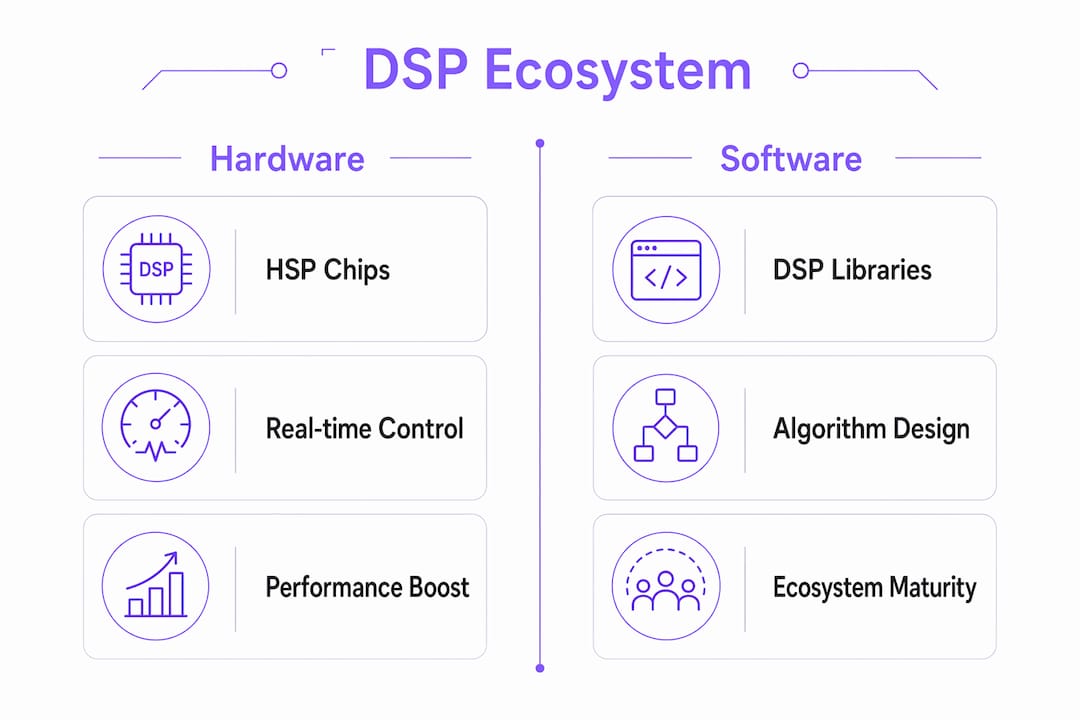
ARM's CMSIS-DSP library is the clearest example of this trend at scale. It provides architecture-aware optimizations for Cortex processors, including vector scaling, dot products, and FFT operations, with benchmarks showing 1.5x speed improvement over generic C implementations. That improvement compounds across a full signal chain. A developer building a multiband compressor or a convolution reverb benefits from every optimized primitive in the chain, not just one.
The practical advantages of standardized DSP libraries for audio developers include:
- Portability across hardware variants. CMSIS-DSP code written for a Cortex-M4 retargets to a Cortex-M55 with minimal changes, preserving years of algorithm development work.
- Reuse of validated primitives. Reusing well-optimized DSP primitives like filters, FFTs, and vector math eliminates the risk of subtle numerical errors introduced by hand-rolled implementations.
- AI-assisted configuration. Modern DSP toolchains increasingly use machine learning to suggest filter coefficients, compression curves, and EQ settings based on target response data.
- Faster iteration cycles. Developers who build on CMSIS-DSP or equivalent libraries spend time on algorithm design, not on reimplementing sine tables and window functions.
The hybrid hardware-software workflow is now the standard for serious DSP development. You design the algorithm in software, profile it against the hardware's accelerated primitives, and iterate until the latency and power budgets are both satisfied.
Pro Tip: Before writing a custom FFT or filter routine, check the CMSIS-DSP documentation for an existing primitive. The library covers over 60 function categories. Reinventing any of them is almost always slower and less numerically stable than using the validated version.
How are immersive and cloud-based audio workflows influencing next-gen DSP?
Object-based audio is the format that makes immersive sound production practical at scale, and MPEG-H is the standard defining how it works in professional workflows. MPEG-H enables immersive object-based audio workflows with metadata synchronized across cloud and on-premises environments using Control Track and SRT transport. The metadata travels with the audio as a synchronous first-class signal, not as a loosely coupled sidecar file. That distinction matters enormously when you are processing audio across distributed cloud nodes.
Cloud-based DSP pipelines for broadcast and streaming now follow a capture, process, and return model. Audio is captured on-premises, sent to cloud processing nodes running MPEG-H encoders and spatial renderers, and returned with preserved time alignment and object metadata intact. AWS has published detailed architecture guidance for exactly this workflow. The challenge is not the processing itself. It is maintaining sub-frame synchronization between the audio stream and its metadata across variable-latency network paths.
Latency comparison: codec options for real-time audio DSP
| Codec / Format | Frame size | Algorithmic delay | Suitable for live use |
|---|---|---|---|
| BLE Audio LC3 | 7.5 ms or 10 ms | ~11.5 to 12.5 ms total | Marginal for live monitoring |
| MPEG-H (broadcast) | Variable | Encoder-dependent | Broadcast and streaming |
| Uncompressed PCM | N/A | Buffer depth only | Studio and plugin chains |
| AAC-LC | 21.3 ms | ~40 ms typical | Streaming, not live |
BLE Audio's LC3 codec offers low-latency frame options at 7.5 ms or 10 ms with total algorithmic delays around 11.5 to 12.5 ms. That figure is acceptable for wireless monitoring but creates audible feel differences compared to wired connections in live performance contexts. Knowing these numbers lets you design DSP chains that stay within perceptual thresholds rather than discovering latency problems during a session.
The impact on live sound reinforcement is direct. FOH engineers running cloud-assisted processing for immersive venue systems must account for codec delay, network jitter buffers, and spatial renderer latency as separate budget items. The cloud-based metadata synchronization challenge requires treating control tracks as synchronous signals with the same timing discipline applied to audio frames.
What are the key challenges shaping future DSP algorithm design?
DSP algorithm development for audio is constrained by physics, mathematics, and hardware simultaneously. Getting all three right requires understanding where latency actually comes from in a signal chain.
-
Codec look-ahead and frame buffering. Every codec introduces a minimum delay equal to at least one frame. LC3's 7.5 ms frame means no audio exits the encoder until 7.5 ms of input has accumulated. Stack two codecs in a chain and the floor doubles before any processing begins.
-
Filter group delay. A 600-tap linear-phase FIR filter adds over 6 ms of latency at 48 kHz sampling. Linear-phase filters are prized for their phase response, but that property comes at a direct latency cost. Minimum-phase designs reduce group delay at the expense of phase linearity. Choosing between them is an engineering decision, not a preference.
-
Coefficient quantization and numerical stability. Fixed-point DSP implementations must account for coefficient quantization error and numerical stability. Poorly quantized filter coefficients can cause stopband rejection losses of 25 to 35 dB, turning a precision filter into a mediocre one. Double-precision floating point avoids most of these problems in software plugins, but embedded hardware often requires fixed-point arithmetic where these errors are real constraints.
-
Algorithm and hardware co-design. Strict latency budgets in real-time audio require balancing algorithm complexity, filter structures, and hardware capabilities together. Designing a complex algorithm and then asking whether the hardware can run it in time is the wrong sequence. The hardware's accelerated primitives should shape algorithm choices from the first design iteration.
-
Real-time deadline enforcement. DSP systems that miss their processing deadline produce audible glitches, not graceful degradation. Every algorithm in a real-time chain must complete within its allocated time slice, including worst-case execution paths. Profiling on target hardware, not on a development workstation, is the only way to verify this.
Understanding these constraints separates DSP practitioners who build reliable tools from those who build tools that work only under ideal conditions. For audio plugin developers working in VST3, AU, or AAX formats, these same principles apply at every buffer size from 32 to 2048 samples.
Key takeaways
Future DSP technology advances through hardware acceleration, software ecosystem maturity, and immersive audio standards working together, not independently.
| Point | Details |
|---|---|
| Hardware acceleration is decisive | HSP-class chips like ST's STM32U3 deliver up to 13x FFT gains, reshaping embedded audio design. |
| Software libraries multiply hardware gains | CMSIS-DSP provides validated, portable primitives that outperform generic C by 1.5x across Cortex targets. |
| Immersive audio demands metadata discipline | MPEG-H workflows require synchronous control tracks, not loosely coupled sidecar files, across cloud pipelines. |
| Latency budgets are non-negotiable | A single 600-tap FIR filter adds over 6 ms at 48 kHz. Every element in the chain must be accounted for. |
| Co-design is the correct sequence | Algorithm complexity must be shaped by hardware capabilities from the first design iteration, not retrofitted later. |
Where DSP is actually heading, from someone who watches it closely
The narrative around DSP technology advancements tends to focus on what is possible. What gets less attention is what becomes required. My observation over the past few years is that the gap between developers who understand latency budgeting at a system level and those who treat it as a plugin setting is widening fast. Immersive audio and cloud-based DSP are not future tools. They are current production requirements in broadcast and live sound, and they are arriving in music production workflows faster than most plugin developers are prepared for.
The shift from standalone DSP chips to integrated AI and software ecosystems is not just a hardware story. It changes what skills matter. Understanding CMSIS-DSP, knowing how MPEG-H handles object metadata, and being able to read a latency budget across a full signal chain are now practical competencies, not academic ones. The developers and engineers who build on standardized libraries and DSP algorithm design principles will move faster and produce more reliable tools than those starting from scratch each time.
My honest prediction: within three years, AI-assisted DSP configuration will be standard in professional DAW environments, and low-latency audio production will be a baseline expectation rather than a premium feature. The professionals who understand the underlying signal processing will be the ones who use those tools well rather than being constrained by them.
— Kai
Build with precision: Vector-dsp tools for modern DSP work
Vector-dsp builds professional audio plugins grounded in exactly the DSP principles covered in this article: low-latency algorithm design, numerical stability, and real-time performance across VST3, AU, and AAX formats. If you are a sound engineer, music producer, or audio developer who wants tools built with intentional DSP architecture rather than convenience shortcuts, Vector-dsp is worth your time. The Vector-dsp website covers the technical principles behind each product and provides resources for audio professionals who want to understand the signal processing behind the tools they use. Precision is not a marketing claim here. It is a design constraint applied from the first algorithm iteration.
FAQ
What is DSP technology in simple terms?
DSP, or digital signal processing, is the mathematical manipulation of digitized signals to filter, analyze, compress, or transform audio and other data in real time. It is the core technology behind audio plugins, noise cancellation, wireless codecs, and embedded sensing systems.
How does DSP technology work in audio plugins?
Audio plugins implement DSP algorithms that process digital audio buffers sample by sample or block by block, applying operations like filtering, convolution, and dynamic range control within strict real-time deadlines. The plugin format (VST3, AU, AAX) defines how the host DAW delivers audio buffers and timing information to the algorithm.
What are the biggest future trends in digital signal processing?
The leading trends in DSP technology are hardware acceleration through HSP-class chips, AI inference at the edge, software-defined DSP ecosystems built on libraries like CMSIS-DSP, and immersive object-based audio workflows using standards like MPEG-H. The DSP market is projected to reach $710 million by 2029, driven by these exact forces.
Why does latency matter so much in DSP design?
Latency in audio DSP is perceptible below 10 ms in live monitoring contexts, and every element in the signal chain contributes to the total. A single large FIR filter can add over 6 ms at 48 kHz, meaning algorithm choices directly determine whether a system is usable for real-time performance.
What is the impact of DSP on industries beyond audio?
DSP drives predictive maintenance in industrial sensing, wireless communication codecs in consumer electronics, and medical imaging signal reconstruction. ST's IIS3DWB10IS sensor demonstrates how embedded DSP and AI inference together enable real-time vibration analysis without any host processor involvement, a pattern now spreading across manufacturing, automotive, and healthcare applications.