Why Use Double Precision DSP for Audio Processing
Why Use Double Precision DSP for Audio Processing

Double precision digital signal processing (FP64) is defined as a 64-bit floating-point format that delivers roughly 15–16 significant decimal digits of accuracy, compared to the 7 digits offered by single precision (FP32). That gap matters enormously in audio. When you run iterative filters, feedback loops, or long accumulation chains, rounding errors compound with every calculation. Double precision keeps those errors small enough that they never reach your ears. This article explains the technical reasons why use double precision DSP, identifies the exact scenarios where it is non-negotiable, and gives you a practical framework for deploying it without killing your CPU budget.
Why use double precision DSP: the core technical case
Double precision and single precision differ in one fundamental way: bit depth. FP32 uses 32 bits, with 23 bits for the mantissa and 8 bits for the exponent. FP64 uses 64 bits, with 52 bits for the mantissa and 11 bits for the exponent. That wider exponent range prevents overflow and underflow in complex audio filtering, which is exactly where single precision breaks down first.
The practical consequence is numerical stability. Double precision prevents rounding errors in long-term accumulation, iterative optimization, and subtraction of near-equal numbers. In audio terms, that means a high-Q parametric EQ or a tight low-frequency IIR filter stays mathematically stable across thousands of sample iterations instead of drifting into noise or oscillation.

Floating-point math also has a structural advantage over fixed-point. Relative precision in floating-point preserves subjective audio fidelity better than the absolute precision of fixed-point systems. Fixed-point accuracy degrades as signal amplitude drops, while floating-point maintains consistent accuracy regardless of level. Double precision extends that consistency into the most demanding calculations.
Here is a direct comparison of the two formats:
| Property | Single precision (FP32) | Double precision (FP64) |
|---|---|---|
| Bit width | 32 bits | 64 bits |
| Significant digits | ~7 | ~15–16 |
| Exponent range | ~±38 | ~±308 |
| Memory per value | 4 bytes | 8 bytes |
| Primary audio use | Sample buffers, effects | Filter coefficients, accumulators |
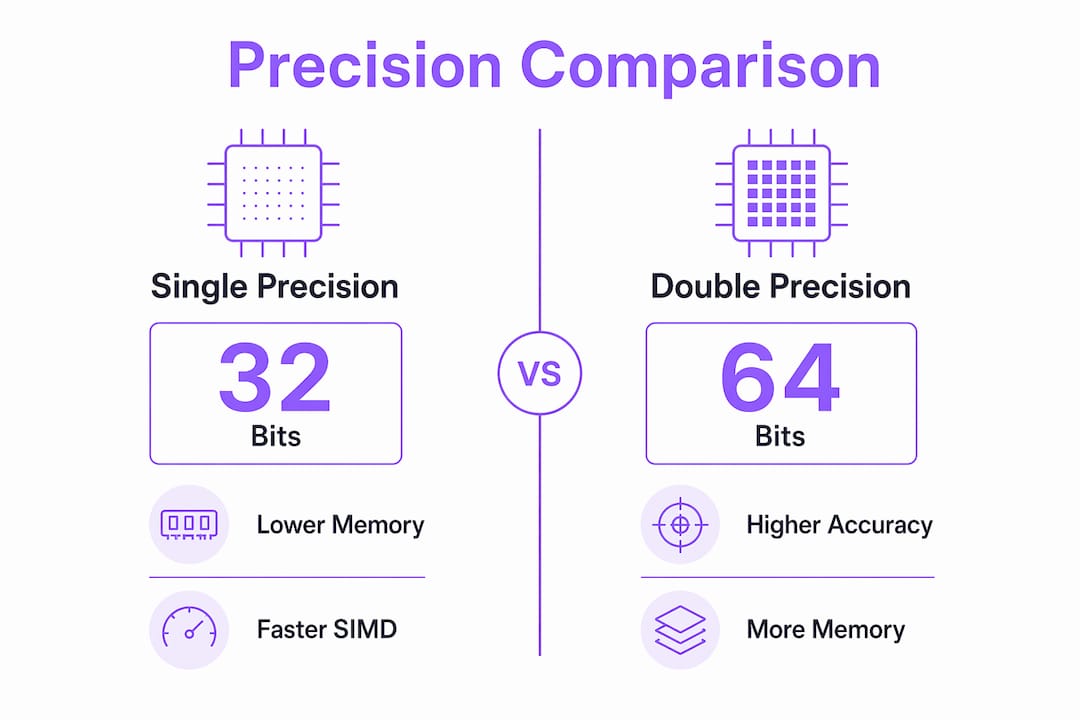
The memory column is not a footnote. It drives every performance trade-off you will encounter when choosing between the two formats.
When should audio professionals use double precision?
The answer is specific: use double precision at the stages of your signal chain where rounding errors accumulate or where a small numerical error produces an audible artifact.
The clearest cases are:
- IIR filters with low cutoff frequencies or high Q values. Coefficients for a 20 Hz shelf filter computed in FP32 can be so close in value that subtraction loses nearly all significant digits. FP64 preserves the difference.
- Feedback loops. Every sample fed back through a recursive algorithm carries its rounding error into the next calculation. Over time, FP32 errors stack into audible noise or instability.
- Mixer summing buses. Summing hundreds of channels in FP32 accumulates rounding error across every addition. A double precision accumulator keeps the bus clean.
- Long-term iterative optimization. Convolution reverb tails, spectral analysis, and adaptive filtering all involve thousands of sequential operations where error growth is the enemy.
- Complex FFTs over 1024 points. Floating-point hardware's dynamic range advantage over fixed-point becomes critical at larger transform sizes, and double precision extends that advantage further.
Single precision is entirely adequate for most sample-level processing: gain staging, simple delay lines, and straightforward convolution on short buffers. The distinction is not about quality preference. It is about whether the math is stable at all.
Pro Tip: If your IIR filter produces unexpected noise or self-oscillation at extreme settings, switch the coefficient calculation and state variable storage to FP64 before touching anything else. That single change resolves the majority of precision-related instability issues.
What are the performance trade-offs of double precision?
Double precision costs you. FP64 doubles the memory footprint, which increases cache pressure and can cause cache misses that degrade real-time audio performance. On a tight audio thread with a 64-sample buffer, a cache miss is not an abstraction. It is a glitch.
The SIMD vectorization problem compounds this. Most modern CPUs process twice as many FP32 values per clock cycle as FP64 values using AVX or SSE instructions. Switching a sample buffer from FP32 to FP64 can cut your vectorized throughput in half. That is a real cost on any plugin running at 192 kHz with a low buffer size.
The trade-off table looks like this in practice:
| Scenario | FP32 performance | FP64 performance |
|---|---|---|
| Sample buffer processing | Fast, SIMD-friendly | Slower, half SIMD width |
| Filter coefficient storage | Adequate for simple filters | Required for high-Q or low-frequency filters |
| Summing accumulator | Acceptable for short chains | Necessary for large mix buses |
| Memory bandwidth | Low pressure | High pressure, risk of cache misses |
| Hardware DSP chips | Widely supported | Supported on dsPIC33A and similar DP-FPU devices |
The dsPIC33A series addresses this directly. Its DP-FPU (double precision floating-point unit) handles FP64 natively, which removes the software overhead penalty on supported hardware. For embedded audio applications, hardware support for double precision changes the cost calculation significantly.
Pro Tip: Profile your plugin's CPU usage with a tool like Intel VTune or Xcode Instruments before switching entire processing chains to FP64. You will almost always find that only 10–20% of your code is responsible for precision-sensitive calculations. Target those stages only.
How to implement double precision DSP in your workflow
The most effective approach treats precision as a configurable design parameter rather than a fixed choice. Start development in double precision, verify correctness, then optimize down to single precision where the quality loss is inaudible.
A practical implementation sequence looks like this:
- Prototype everything in FP64. Write your filter, compressor, or reverb algorithm entirely in double precision. This gives you a mathematically correct reference implementation to compare against.
- Identify precision-sensitive stages. Run A/B comparisons between your FP64 prototype and an FP32 version. Listen for noise floor changes, instability at extreme settings, and low-frequency filter drift.
- Apply mixed-precision DSP selectively. Keep FP64 on filter coefficients, state variables, and summing accumulators. Drop to FP32 on sample buffers and simple gain operations.
- Validate with test signals. Use sine sweeps, impulse responses, and near-silence signals to catch artifacts that music playback might mask.
- Avoid hardcoding precision types. Hardcoding 'double' everywhere is an anti-pattern. Parameterized arithmetic types in C++ templates let you switch precision per algorithm stage without rewriting code.
- Audit your algorithm structure before adding precision. If your filter only works correctly in FP64, that may signal a structural problem. Requiring double precision can mask numeric stability problems that better algorithm design would eliminate.
Modern audio development relies on mixed-precision strategies: high precision on critical filter coefficients and accumulators, single precision on sample buffers. This approach reduces CPU load while maintaining audio quality. Libraries like the stillwater-sc mixed-precision-dsp header-only C++20 library make per-stage precision selection practical without architectural overhead.
The most common mistake audio developers make is treating double precision as a quality upgrade rather than a correctness tool. It does not make a mediocre algorithm sound better. It prevents a good algorithm from breaking under numerical stress. Understanding that distinction is what separates a well-designed DSP algorithm from one that only works at room temperature with a 44.1 kHz sample rate and a gentle signal.
Key Takeaways
Double precision DSP is a correctness tool, not a quality upgrade: use FP64 at precision-sensitive stages like filter coefficients and summing accumulators, and FP32 everywhere else.
| Point | Details |
|---|---|
| Use FP64 for critical stages | Apply double precision to IIR coefficients, feedback loops, and summing buses where rounding errors accumulate. |
| FP32 handles most audio tasks | Sample buffers, simple delays, and gain operations do not require double precision and run faster in FP32. |
| Mixed precision is the standard | Selective FP64 on accumulators and FP32 on buffers balances audio quality with real-time CPU performance. |
| Prototype in FP64, optimize down | Start development in double precision to verify correctness, then reduce precision where A/B tests confirm no audible difference. |
| Precision does not fix bad algorithms | If your design only works in FP64, restructure the math first before treating double precision as the solution. |
The precision trap most audio developers fall into
The most persistent misconception I encounter is that double precision is simply "better quality." Audio developers reach for FP64 the way a mixing engineer reaches for a high-end preamp: as a default upgrade. That framing causes real problems.
I have reviewed plugin code where every variable, every buffer, every intermediate calculation was declared as double. The developer's reasoning was sound on the surface: more precision equals fewer artifacts. But the result was a plugin that consumed twice the memory bandwidth, triggered cache misses on every audio callback, and still had audible noise at extreme filter settings. The noise was not a precision problem. It was a filter topology problem that FP64 was masking rather than solving.
The insight that changed how I think about this is that requiring double precision often indicates a flawed algorithm design. If you restructure your biquad implementation to use a transposed direct form II topology instead of direct form I, you can often achieve stable results in FP32 at settings where the naive implementation needed FP64. The precision requirement was a symptom, not the disease.
What I find genuinely exciting about the current state of DSP technology is the shift toward configurable precision pipelines. C++20 template-based libraries that let you specify precision per algorithm stage are changing how professional audio tools get built. You no longer have to choose between a uniform FP32 plugin that breaks at extreme settings and a uniform FP64 plugin that taxes your CPU. You can be surgical about it.
My practical advice: treat double precision as a scalpel, not a paint roller. Know exactly which stages of your signal chain are numerically sensitive, apply FP64 there, and leave the rest in FP32. That approach produces plugins that are both accurate and fast.
— Kai
Vector-dsp and precision-aware audio plugin design

Vector-dsp builds professional audio plugins with precision-aware DSP at the architecture level. ToneLab is designed with mixed-precision DSP principles built in, applying FP64 where numerical stability demands it and FP32 where performance requires it. The result is a platform where filter coefficients and accumulators get the precision they need without taxing your real-time audio thread. If you are building or evaluating audio plugin architecture for professional production work, Vector-dsp's approach to precision-first design gives you a concrete reference point for what thoughtful DSP engineering looks like in practice.
FAQ
What is double precision DSP in simple terms?
Double precision DSP uses 64-bit floating-point numbers (FP64) to perform audio calculations with roughly 15–16 significant digits of accuracy. Single precision (FP32) provides only about 7 digits, which is insufficient for numerically sensitive operations like high-Q IIR filters or large summing buses.
Does double precision always sound better than single precision?
No. Double precision prevents numerical errors in specific algorithm types. For most sample-level processing, single precision is indistinguishable in quality and runs faster. The difference only becomes audible when rounding errors accumulate enough to produce noise or instability.
When does double precision cause performance problems?
FP64 doubles memory bandwidth demand and reduces SIMD vectorization efficiency, which can cause cache misses and CPU overload in real-time audio threads. Applying double precision to entire sample buffers rather than just critical stages is the most common source of performance degradation.
What is mixed-precision DSP?
Mixed-precision DSP applies different floating-point formats to different stages of an algorithm. Filter coefficients and accumulators use FP64 for stability, while sample buffers use FP32 for speed. This approach is now the standard practice in professional audio plugin development.
Can hardware DSP chips run double precision natively?
Yes. The Microchip dsPIC33A series includes a native DP-FPU (double precision floating-point unit) that handles FP64 calculations without software emulation overhead, making it suitable for embedded audio applications that require high-accuracy filtering.