SIMD Audio Optimization: A 2026 Guide for DSP Developers
SIMD Audio Optimization: A 2026 Guide for DSP Developers

What is SIMD audio optimization?
SIMD audio optimization is the practice of applying Single Instruction, Multiple Data parallelism to audio DSP code so that one CPU instruction processes several audio samples at once instead of one. The result is a fundamental shift from serial, sample-by-sample computation to vectorized, block-based processing that your hardware was already built to handle.
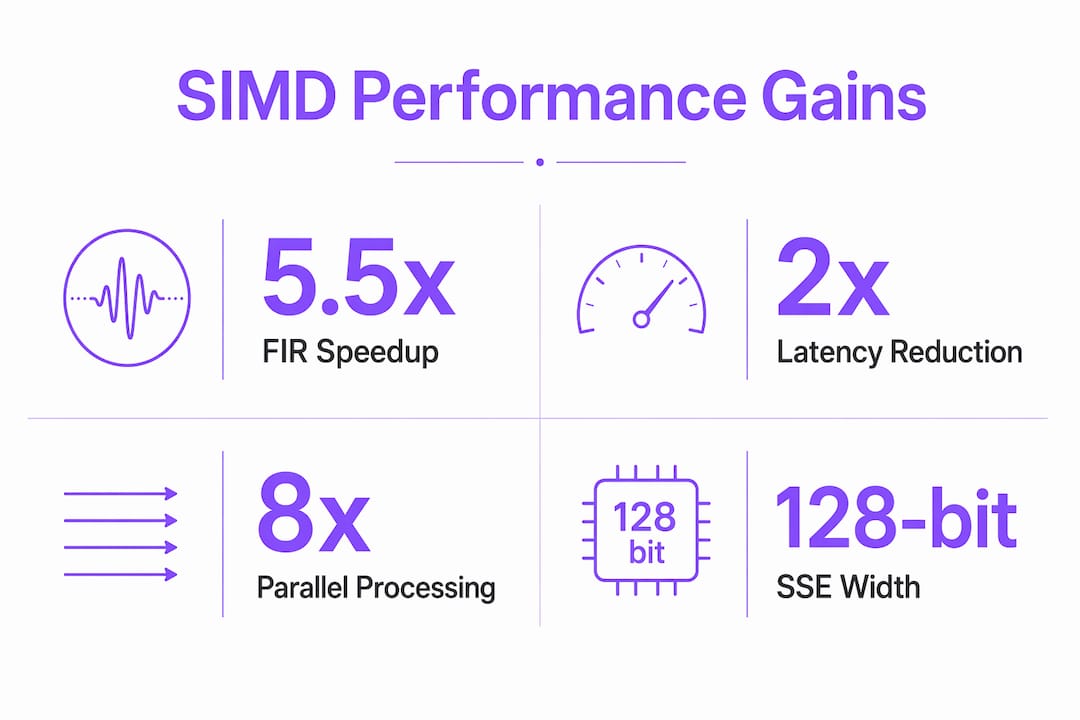
Most audio code still runs scalar: one sample in, one sample out, repeat. Meanwhile, the vector units inside modern Intel and ARM processors sit largely idle. SSE handles 4 single-precision floats per instruction, AVX2 handles 8, and AVX-512 handles 16. Without SIMD, you leave 75–94% of the CPU's parallel capacity unused on every audio buffer.
The practical payoff is concrete. Benchmarks show FIR filters running 4–5.5x faster with SIMD versus scalar code, and convolution algorithms see gains well beyond that range for longer impulse responses. Those numbers translate directly to lower buffer underruns, tighter latency headroom, and more DSP headroom per plugin instance.
Key areas where SIMD applies immediately in audio DSP:
- Gain and mixing operations: Scaling or summing entire buffers maps perfectly to vector arithmetic, with near-linear speedup relative to SIMD width.
- FIR filtering: A 64-tap filter that needs 64 multiply-accumulate operations per sample drops to 8 vector instructions with AVX2.
- Convolution reverb: Long impulse responses require thousands of multiply-adds per output sample. SIMD turns real-time convolution from a bottleneck into a practical implementation.
- Oscillator banks: Wavetable and additive synthesis compute multiple oscillator phases in parallel rather than iterating serially.
- Format conversion and buffer arithmetic: Interleaving, de-interleaving, and type conversion all vectorize cleanly.
The instruction sets you will encounter most often in audio DSP work are SSE (128-bit, 4 floats), AVX/AVX2 (256-bit, 8 floats), and AVX-512 (512-bit, 16 floats) on x86 platforms, plus ARM NEON (128-bit, 4 floats) on Apple Silicon and mobile targets.
How SIMD actually works inside an audio processing pipeline
The core mechanism is the vector register. Instead of loading one float into a general-purpose register, a SIMD instruction loads a packed vector: 4 floats into a 128-bit XMM register (SSE), 8 floats into a 256-bit YMM register (AVX/AVX2), or 16 floats into a 512-bit ZMM register (AVX-512). The CPU then applies one arithmetic operation to every lane of that register simultaneously.
For audio buffer processing, the workflow looks like this:
- Load: Pull a vector's worth of samples from a contiguous memory block into a SIMD register.
- Compute: Execute multiply, add, fused multiply-add (FMA), or other operations across all lanes at once.
- Store: Write the result vector back to the output buffer.
- Advance: Move the pointer forward by the SIMD width and repeat until the buffer is exhausted.
Key SIMD terms every audio developer should know:
- Vector register: A wide CPU register holding multiple data elements packed side by side.
- Lane: One element slot within a vector register (e.g., one float in an 8-float AVX2 register).
- Intrinsic: A C/C++ function that maps directly to a single SIMD assembly instruction, such as
_mm256_fmadd_psfor AVX2 fused multiply-add. - Loop vectorization: Restructuring a scalar loop so the compiler or developer can execute multiple iterations in one SIMD pass.
- Scalar tail: The leftover samples at the end of a buffer when its length is not evenly divisible by the SIMD width, processed with a fallback scalar loop.
- Data alignment: Arranging buffer memory at 16, 32, or 64-byte boundaries so SIMD load/store instructions run at full speed.
- NEON: ARM's equivalent of SSE/AVX, used on Apple Silicon, iOS, and Android targets.
Intel Intrinsics give you direct, instruction-level control without writing assembly. JUCE's SIMDRegister class sits one level higher, abstracting the platform differences so the same source code compiles to AVX2 on Intel and NEON on ARM. On the compiler side, GCC 12+, Clang 14+, and MSVC 2022 can auto-vectorize simple loops when you pass -O3 -march=native, though that coverage has real limits for complex DSP code.
Memory layout matters as much as the instructions themselves. Interleaved stereo buffers (LRLRLR) break vectorization because left and right samples are not contiguous. Planar buffers (LLLRRR) let you run vector instructions across an entire channel without scatter-gather overhead.

Benefits and real limitations of SIMD in real-time audio DSP
SIMD's headline benefit is throughput. FIR filters achieve 4–5.5x speedups over scalar equivalents, and convolution algorithms with long impulse responses can see dramatically higher gains depending on filter length and hardware generation. For a plugin running at a 64-sample buffer, that margin is the difference between glitch-free output and dropout.
Beyond raw speed, SIMD offers a structural advantage that multi-threading cannot: parallelism without concurrency. There are no mutexes, no race conditions, and no audio thread synchronization hazards. You get parallel computation entirely within a single thread, which keeps real-time audio code predictable and safe.
Pro Tip: Before reaching for multi-threading to solve a CPU bottleneck, check whether the inner loop is vectorized first. A single-threaded SIMD pass on a FIR filter often outperforms a multi-threaded scalar version with far less complexity.
The limitations are real and worth understanding before you commit to a vectorization effort:
- Branching kills performance. Conditional logic inside a SIMD inner loop forces the CPU to execute all branches with masking, collapsing throughput to scalar levels. Restructure algorithms to use mathematical masking or lookup tables instead.
- Short filters gain little. Filters with 8–16 taps see SIMD overhead eat into the benefit. The sweet spot for FIR optimization is 32–128 taps, exactly the range used in room correction, crossover filters, and convolution reverb kernels.
- Long filters hit memory bandwidth. Beyond 256 taps, the bottleneck shifts from computation to memory throughput, and SIMD gains flatten.
- Irregular memory access patterns (scatter-gather, pointer-chasing) prevent vectorization entirely.
- Buffer size divisibility requires a scalar tail loop for any samples that do not fill a complete vector, adding code complexity.
Pro Tip: Profile before you vectorize. Tools like Intel VTune Profiler, Instruments on macOS, and perf on Linux will show you exactly which loops consume the most CPU time. Vectorizing the wrong function wastes effort and adds maintenance burden.
Compared to GPU acceleration, SIMD has a decisive advantage for real-time audio: latency. Offloading DSP to a GPU introduces round-trip transfer overhead that is incompatible with low-latency audio constraints. SIMD runs on the same core, in the same thread, with no transfer cost. Multi-threading complements SIMD by parallelizing across channels, with each thread using SIMD for sample-level parallelism within its assigned channel.
Statistic callout: Benchmarks show FIR filters running 4x to 5.5x faster with SIMD compared to scalar processing, while convolution algorithms see gains well beyond that range for longer impulse responses.
Practical SIMD implementation for audio developers
The two main paths are manual intrinsics and high-level abstractions. Manual intrinsics via the Intel Intrinsics Guide give you maximum control and predictable output, but they are platform-specific and verbose. JUCE's SIMDRegister class abstracts the architecture differences: on AVX2 hardware it uses 256-bit registers processing 8 floats; on ARM NEON it uses 128-bit registers processing 4 floats. The same source compiles correctly on both.
Core implementation checklist:
- Align audio buffers to 16 or 32-byte boundaries using
alignas(32)for stack arrays or an aligned allocator for heap memory. Misaligned loads trigger slower unaligned load instructions or runtime faults. - Process the main buffer in SIMD-width chunks, then handle the remainder with a scalar tail loop to cover samples that do not fill a complete vector.
- Use planar (non-interleaved) buffer layouts wherever possible to keep channel data contiguous.
- Replace conditional branches inside inner loops with mathematical masking or blend instructions.
- Apply loop vectorization techniques including inner loop, outer loop, and combined vectorization depending on the filter structure.
Recommended vectorization workflow:
- Write and validate a correct scalar implementation first.
- Profile with VTune, Instruments, or perf to identify the hottest loops.
- Convert the most expensive loop to SIMD, keeping the scalar version for bit-exact comparison testing.
- Verify alignment and buffer layout before measuring any speedup.
- Benchmark on target hardware. SIMD effectiveness varies across CPU generations.
- Integrate multi-threading at the channel level once per-channel SIMD is stable.
SIMD approaches by audio algorithm type:
| Algorithm | SIMD fit | Recommended approach |
|---|---|---|
| FIR filter (32–128 taps) | Excellent | AVX2 intrinsics or SIMDRegister with inner loop vectorization |
| IIR filter | Moderate | Vectorize across channels; per-sample feedback limits single-channel SIMD |
| Convolution reverb | Excellent | Overlap-add or overlap-save with AVX-512 FMA |
| Gain / mixing | Excellent | FloatVectorOperations or direct intrinsics |
| Wavetable oscillator bank | Good | Process multiple oscillator phases per vector |
| Dynamic processors (compressors) | Limited | Gain computation vectorizes; envelope detection has branching |
Manual intrinsics vs. JUCE abstraction:
| Factor | Intel Intrinsics | JUCE SIMDRegister |
|---|---|---|
| Control | Full, instruction-level | High-level, automatic dispatch |
| Portability | x86 only without extra code | x86 and ARM from one source |
| Readability | Low (verbose C) | High (template-based C++) |
| Best for | Maximum throughput, known target | Cross-platform plugin development |
Pro Tip: Compiler auto-vectorization with -O3 -march=native handles simple loops well, but explicit SIMD coding remains necessary for complex DSP algorithms where the compiler cannot prove memory independence or loop bounds at compile time. Always check the compiler's vectorization report before assuming a loop was vectorized.
For low-latency audio thread work specifically, keep SIMD code free of dynamic memory allocation and system calls. The vector computation itself is deterministic; the danger is surrounding code that breaks real-time guarantees.
What DSP practitioners and recent research say about SIMD in 2026
The consensus among working DSP engineers is that restructuring scalar code into a vector-friendly shape is harder than learning the instruction set itself. Flattening data dependencies, eliminating branches, and reorganizing memory layouts require rethinking algorithms at a structural level, not just swapping function calls.
"The preferred method for real-time DSP is SIMD because it offers parallelism without concurrency-related audio thread hazards. High-performance SIMD requires avoiding branching and restructuring DSP algorithms toward mathematical masking."
— Insight from the JUCE SIMDRegister tutorial, reflecting practitioner consensus on SIMD adoption in audio DSP
Compiler technology is closing the gap with hand-written intrinsics for straightforward cases. Recent 2026 benchmarks show compiler-assisted vectorization approaching parity with manual intrinsics for simple loops, which means the entry cost for basic SIMD gains has dropped. For complex DSP algorithms with data dependencies and non-trivial memory patterns, manual coding still wins.
The hardware trajectory reinforces the case for investing in SIMD now. AVX-512 is standard on current Intel server and desktop CPUs, and ARM's Scalable Vector Extension (SVE) pushes the same concept further on next-generation chips. Audio DSP technology is moving toward wider vectors, not away from them.
Pro Tip: When transitioning existing scalar DSP code to SIMD, start with the buffer operations: gain, mixing, and format conversion. These vectorize cleanly, produce immediate measurable speedups, and build your team's confidence with the toolchain before you tackle filter feedback paths.
The practical advice from practitioners is consistent: a 2x improvement in your most expensive DSP operation often eliminates buffer underruns entirely and opens the door to lower-latency operation. Chasing the theoretical maximum speedup matters less than hitting the threshold where your plugin runs cleanly at the target buffer size.
Key Takeaways
SIMD audio optimization delivers 4–5.5x throughput gains on FIR filters, and convolution algorithms can achieve even higher speedups for longer impulse responses, making it the most effective single-threaded performance technique available to audio DSP developers.
| Point | Details |
|---|---|
| SIMD width determines throughput | SSE processes 4 floats, AVX2 processes 8, and AVX-512 processes 16 per instruction cycle. |
| FIR filters gain the most | The 32–128 tap range sees 4–5.5x speedups; shorter and longer filters gain less due to overhead and memory limits. |
| Avoid branching in inner loops | Conditional logic inside SIMD loops collapses performance to scalar levels; use mathematical masking instead. |
| Scalar tail loops are mandatory | Buffers not divisible by SIMD width require a fallback scalar loop to process remaining samples correctly. |
JUCE SIMDRegister enables cross-platform SIMD |
One source compiles to AVX2 on Intel and NEON on ARM, reducing platform-specific maintenance. |

Vector-dsp builds its audio plugins on the same SIMD-first DSP principles covered here: aligned buffers, vectorized inner loops, and real-time thread safety by design. If you want to hear what that engineering discipline sounds like in practice, ToneLab is where those principles ship as a finished product.