Vectorized DSP Processing Explained for Audio Engineers
Vectorized DSP Processing Explained for Audio Engineers

Vectorized DSP processing is defined as the execution of a single arithmetic instruction across multiple audio data samples simultaneously, using a technique called SIMD (Single Instruction, Multiple Data). Where scalar processing handles one sample per CPU cycle, SIMD vectorization processes a full vector of samples in parallel, cutting loop iterations and CPU load in one move. ARM NEON SIMD, for example, processes eight 16-bit audio samples per instruction using 128-bit registers. That single architectural shift is what makes real-time, low-latency audio processing at professional quality possible on modern hardware. Understanding vectorized DSP processing explained through the lens of SIMD is the foundation every audio engineer and producer needs.
How does SIMD vectorization work in digital signal processing?
SIMD vectorization is the core mechanism behind efficient DSP algorithms in modern audio. The principle is simple: one instruction fires, and the same operation runs on multiple data values at once. Scalar processing applies one operation to one sample per clock cycle. SIMD applies that same operation to a full vector of samples in a single cycle.
The hardware that makes this possible is the vector register. ARM NEON SIMD adds 32 × 128-bit vector registers to the processor, each of which can be sliced into lanes of different widths. A 128-bit register holds eight lanes of 16-bit audio samples, four lanes of 32-bit floats, or two lanes of 64-bit doubles. The lane configuration you choose depends on the precision your audio task requires.
Here is what that looks like in practice for a gain-scaling operation:
- Scalar approach: Load one sample, multiply by gain, store result. Repeat 512 times for a 512-sample buffer.
- SIMD approach: Load eight samples into one 128-bit register, multiply all eight by the gain value in a single instruction, store eight results. Repeat 64 times for the same buffer.
The difference is not just speed. Fewer loop iterations mean fewer branch predictions, fewer memory fetches, and lower CPU utilization overall. That freed-up headroom is what lets a DAW run 64 tracks of audio with effects without glitching.
Pro Tip: When writing SIMD code, always process audio in fixed-size blocks that are multiples of your vector width. A 512-sample buffer divides cleanly into 64 NEON operations on 8-lane 16-bit data, leaving no remainder to handle with a scalar fallback loop.

What are the performance benefits of vectorized DSP processing in real-time audio?
The performance gains from vectorized processing are not theoretical. Hand-written ARM NEON SIMD intrinsics on critical DSP kernels like FFT butterfly operations deliver consistent 3–4x throughput gains over equivalent scalar C++ code. That means a convolution reverb that consumed 40% of a CPU core now consumes roughly 10–13%. The headroom you recover goes directly into track count, plugin density, or lower buffer sizes.
Latency is the other major win. Vectorization reduces total round-trip latency in audio pipelines by completing each processing block faster, which allows the audio driver to use smaller buffer sizes without dropouts. A buffer that took 3ms to process scalar might complete in under 1ms with SIMD. For live monitoring and recording, that difference is audible and real.
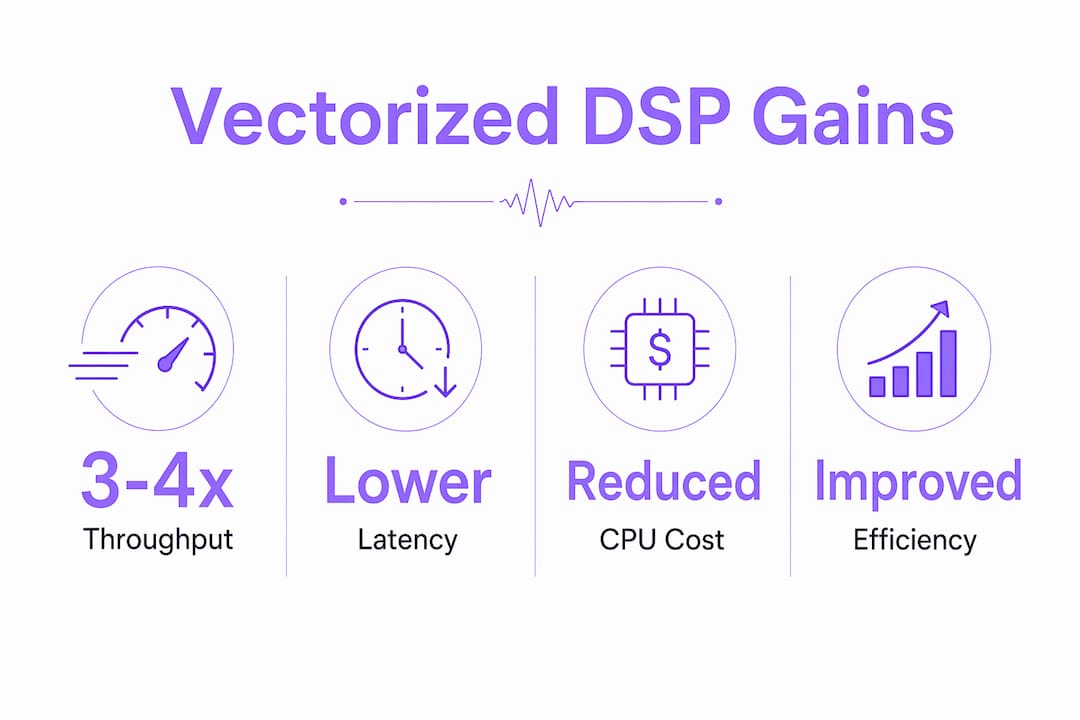
The table below shows where vectorized DSP delivers the most measurable gains compared to scalar processing:
| DSP Task | Scalar CPU Cost | Vectorized Gain |
|---|---|---|
| FFT butterfly operations | High, sequential | 3–4x throughput improvement |
| FIR filter convolution | Moderate, loop-heavy | Significant reduction in loop iterations |
| Gain and mixing operations | Low per sample, high volume | Up to 8x fewer loop iterations |
| Parallel audio stream mixing | Scales poorly with track count | Near-linear scaling with SIMD lanes |
Modern DAWs and plugins predominantly use floating-point arithmetic with vectorized processing to maintain low latency and high precision. Floating-point SIMD is now the professional standard because it handles the dynamic range of audio signals without the quantization artifacts that fixed-point arithmetic introduces at high sample rates.
Which DSP algorithms and audio tasks benefit most from vectorization?
Not every algorithm benefits equally from vectorization. The algorithms that gain the most share one trait: they apply the same operation repeatedly across large arrays of data.
- FFT butterfly operations: The FFT is the most vectorization-friendly algorithm in audio DSP. Each butterfly stage applies identical multiply-add operations to pairs of complex numbers. SIMD maps directly onto this structure, which is why FFT implementations see the largest throughput gains.
- FIR filters: Finite Impulse Response filters compute a weighted sum of past samples. That sum is a dot product, and dot products are textbook SIMD operations. A 512-tap FIR filter runs dramatically faster when each multiply-accumulate step processes four or eight samples at once.
- IIR filters: Infinite Impulse Response filters are harder to vectorize because each output sample depends on the previous one. Structural refactoring using parallel filter forms or polyphase decomposition is required before SIMD can help.
- Mixing and gain staging: Summing multiple audio streams is embarrassingly parallel. Each output sample is the sum of N independent input samples. SIMD handles this with no data dependencies at all.
- Spectral processing: Pitch shifting, time stretching, and convolution reverb all operate in the frequency domain after an FFT. The vectorized FFT feeds directly into vectorized spectral manipulation.
Transitioning to vectorized DSP often requires deep algorithmic refactoring using vector math and tensor product formulations. Legacy algorithms written as sequential scalar loops cannot simply be recompiled and expect SIMD gains. The data flow itself must be restructured so that independent operations align across the vector lanes.
How to implement vectorized DSP processing: compilers, intrinsics, and best practices
Modern C++ compilers including GCC, Clang, and MSVC include auto-vectorization passes that can convert simple scalar loops into SIMD instructions automatically. Auto-vectorization works well for straightforward operations like gain scaling or sample-by-sample addition. It fails reliably on anything with data dependencies, complex branching, or non-contiguous memory access.
For performance-critical paths, manual intrinsics are the answer. ARM NEON intrinsics are C-level functions that map directly to SIMD instructions, giving you full control without writing raw assembly. A typical NEON gain operation uses vld1q_f32 to load four floats, vmulq_f32 to multiply them by a gain vector, and vst1q_f32 to store the results. The compiler handles register allocation while you control the instruction selection.
The practical steps for a vectorized DSP pipeline are:
- Profile first. Identify the scalar loops consuming the most CPU time using a profiler like Instruments on macOS or Perfetto on Android. Only vectorize the bottlenecks.
- Align your memory. Effective vectorized DSP code requires cache-line-aligned memory and lock-free data structures like single-producer single-consumer (SPSC) ring buffers. Misaligned loads stall the CPU and erase your SIMD gains.
- Write scalar reference code first. A correct scalar implementation gives you a ground-truth output to validate your SIMD version against. Audio bugs from incorrect SIMD lane ordering are notoriously hard to hear at low amplitude.
- Apply intrinsics to the inner loop. Replace the scalar multiply-accumulate with NEON intrinsics. Keep the loop structure identical so the compiler can still optimize surrounding code.
- Benchmark with realistic buffer sizes. Test at 64, 128, 256, and 512 samples. SIMD overhead at very small buffer sizes can outweigh gains, so know your crossover point.
High-level languages and modern compilers increasingly handle complex DSP vectorization, reducing the need for tedious assembly coding. Hand-written assembly is now rarely justified. The exception is a handful of inner loops where you need precise control over instruction scheduling on a specific microarchitecture.
Pro Tip: Use __attribute__((aligned(16))) in C/C++ to declare audio buffers with 16-byte alignment. This single annotation eliminates misaligned load penalties and often triggers auto-vectorization in loops the compiler would otherwise skip.
What are the practical implications of vectorized DSP for audio engineers?
The technical gains from vectorized processing translate into concrete production benefits that audio engineers and producers experience every session.
- Lower buffer sizes without dropouts. Vectorized plugins complete their processing blocks faster, letting you run your DAW at 64 or 32 samples without glitches. That means monitoring latency under 3ms, which is indistinguishable from hardware monitoring for most engineers.
- More plugins per session. A 3–4x reduction in CPU cost per plugin means you can run three to four times as many instances before hitting your CPU ceiling. A mix that required freezing tracks on scalar hardware runs in real time with vectorized plugins.
- Consistent performance on mobile and embedded hardware. ARM NEON is standard on every modern iOS and Android device. Vectorized DSP is what makes professional-grade audio apps viable on phones and tablets without burning the battery.
- Better system stability. Vectorized code finishes processing in fewer clock cycles, which reduces the probability of the audio thread missing its deadline. Fewer missed deadlines mean fewer glitches and xruns.
Data parallelism through SIMD vectorization provides a distinct advantage over multicore threading by speeding up individual processing tasks rather than just multitasking. Threading adds latency through synchronization overhead. SIMD adds throughput within a single thread, which is exactly what a real-time audio callback needs. For a deeper look at how these gains connect to low-latency audio thread programming, the relationship between SIMD and thread scheduling is worth understanding in detail. The future of this technology is also expanding into neural processing, where vectorized DSP in neural audio is enabling real-time AI-driven effects at production quality.
Key Takeaways
Vectorized DSP processing delivers 3–4x real-world throughput gains on critical audio kernels by applying SIMD instructions across multiple samples simultaneously, making low-latency, plugin-dense production sessions achievable on modern hardware.
| Point | Details |
|---|---|
| SIMD processes multiple samples at once | ARM NEON 128-bit registers handle eight 16-bit audio samples per instruction, cutting loop iterations dramatically. |
| FFT and FIR filters gain the most | These algorithms map directly onto SIMD lane operations, delivering the largest measurable throughput improvements. |
| Memory alignment is non-negotiable | Cache-line-aligned buffers and SPSC ring buffers prevent CPU stalls that erase SIMD performance gains. |
| Auto-vectorization has real limits | Compilers vectorize simple loops reliably but require manual intrinsics for complex DSP kernels like FFT butterflies. |
| SIMD beats threading for latency | Data parallelism speeds up individual tasks within one thread, avoiding the synchronization overhead that threading adds. |
Why vectorized DSP changed how I think about audio plugin design
I spent years treating CPU optimization as a final polish step, something you did after the algorithm was "done." Vectorized DSP broke that habit completely. Once I saw a convolution reverb drop from 38% CPU to 9% after a NEON rewrite, I stopped thinking of SIMD as an advanced topic and started treating it as a baseline requirement.
The part that surprised me most was how much the algorithm itself had to change. You cannot bolt SIMD onto a scalar design. IIR filters, in particular, forced me to rethink data flow from scratch using parallel filter forms I had never needed before. That refactoring work is where most engineers give up, and I understand why. It is genuinely hard. But the payoff is a plugin that runs on a phone with the same quality as a desktop workstation.
The compiler story has also shifted significantly. Five years ago, auto-vectorization was unreliable enough that I wrote intrinsics for almost everything. Now, with modern Clang and GCC, I write clean C++ first and only drop to intrinsics when the profiler tells me the compiler missed something. That workflow is faster and produces more maintainable code. The DSP algorithm design principles that support this approach are worth studying before you write a single line of SIMD.
My advice to any audio engineer starting with vectorization: profile before you optimize, align your memory before you write a single intrinsic, and always validate SIMD output against a scalar reference. The bugs you miss in vectorized code are the ones that only appear at specific sample rates or buffer sizes, and they will cost you more time than the optimization saved.
— Kai
Vector-dsp: built on the DSP principles that matter
Audio engineers who have worked through the complexity of vectorized processing know what it costs to get it right. Vector-dsp builds its plugin architecture on exactly these principles, applying SIMD-optimized DSP kernels, floating-point precision, and real-time-safe memory management from the ground up.

Every Vector-dsp tool targets the VST3, AU, and AAX formats with low-latency performance as a hard constraint, not an afterthought. The goal is professional-grade audio processing that runs efficiently whether you are on a high-end workstation or a mobile production setup. If you want to see how these principles translate into production-ready tools, explore Vector-dsp's audio plugins and see what intentional DSP design actually sounds like.
FAQ
What is vectorized DSP processing?
Vectorized DSP processing applies a single instruction to multiple audio data samples simultaneously using SIMD hardware. ARM NEON SIMD, for example, processes eight 16-bit samples per instruction with a 128-bit register.
How much faster is SIMD vectorization than scalar DSP?
Hand-written ARM NEON intrinsics on FFT butterfly kernels deliver consistent 3–4x throughput gains over scalar C++ code. Simpler operations like gain scaling can reduce loop iterations by up to 8x.
Which audio algorithms benefit most from vectorization?
FFT operations and FIR filters benefit most because they apply identical operations across large arrays of independent data. IIR filters require structural refactoring before SIMD can help.
Do I need to write assembly code for vectorized DSP?
Modern compilers handle auto-vectorization for simple loops reliably. For critical DSP kernels, ARM NEON intrinsics in C/C++ deliver near-assembly performance without the maintenance cost of raw assembly.
Why does memory alignment matter for vectorized DSP?
Misaligned memory loads stall the CPU and cancel out SIMD throughput gains. Cache-line-aligned buffers and lock-free SPSC ring buffers are required for stable, glitch-free vectorized audio processing.