Best Reddit.com Alternatives in 2026: Find Your New Home
Best Reddit.com Alternatives in 2026: Find Your New Home

The best reddit.com alternatives right now are Lemmy for federated subreddit-style communities, Mastodon for privacy-first decentralized discussion, Discord for real-time niche servers, Hacker News for high-signal tech talk, and Bluesky for modern ad-free social feeds. Each one wins on a different axis, so the right pick depends entirely on what you actually used Reddit for.
TL;DR:
- Want Reddit's exact format without a corporate owner? Start with Lemmy.
- Need live voice chat and tight community bonds? Set up a Discord server.
- Privacy matters most? Pick a Mastodon instance with a published moderation policy.
Table of Contents
- How do the top reddit.com alternatives compare at a glance?
- Is Lemmy really the closest thing to Reddit?
- Why do privacy-focused users prefer Mastodon?
- What makes Bluesky different from other decentralized platforms?
- How do kbin and Saidit compare for simpler community hosting?
- When does Discord beat every other Reddit alternative?
- Are Hacker News and Stack Exchange still worth it for technical discussion?
- What about Quora, Tildes, Slashdot, and 4chan?
- How do you choose the right Reddit alternative for your needs?
- Where do Reddit communities go, and how do you follow them?
- How we evaluated these reddit.com alternatives
- Can you use Reddit tools and APIs to ease the transition?
- What legal and content policy issues affect community migration?
- Key Takeaways
- Why moderation and discovery matter more than UI
- Useful sources and reading to explore each alternative
- Vector-dsp builds tools for the communities that care about sound
How do the top reddit.com alternatives compare at a glance?
| Platform | Best for | Moderation model | Federated? | Privacy/anonymity | Content focus | Discovery | Mobile apps | Activity level | Cost |
|---|---|---|---|---|---|---|---|---|---|
| Lemmy | Reddit-style communities | Instance rules (volunteer admins) | Yes (ActivityPub) | Pseudonymous | Links, communities | Fragmented | Yes | Growing | Free |
| kbin / Mbin | Hybrid microblog + link mag | Instance rules | Yes (ActivityPub) | Pseudonymous | Links + short posts | Fragmented | Limited | Small | Free |
| Mastodon | Privacy-first conversation | Instance rules | Yes (ActivityPub) | Pseudonymous; no tracking | Microblogging | Fragmented | Yes (Tusky, etc.) | Large | Free |
| Bluesky | Modern social feed | Centralized + composable | Partial (AT Protocol) | Account portability | Short posts, trends | Algorithmic feed | Yes | Growing fast | Free |
| Discord | Real-time niche groups | Server owner/mod team | No | Username-based | Chat, voice, events | Invite/link-based | Yes | Very large | Free / Nitro |
| Hacker News | Tech and startup news | Centralized (YC team) | No | Pseudonymous | Tech links, discussion | Single feed | Unofficial | Established | Free |
| Stack Exchange | Expert technical Q&A | Centralized + community | No | Pseudonymous | Q&A | Excellent (Google) | Yes | Very large | Free |
| Quora | Long-form expert answers | Centralized | No | Real name encouraged | Q&A, opinion | Algorithmic | Yes | Very large | Free / Plus |
| Tildes | Curated low-noise discussion | Community-voted | No | Pseudonymous | Links, discussion | Single feed | None | Small, invite | Free |
| Saidit | Permissive link aggregation | Community-run | No | Pseudonymous | Links, communities | Single feed | None | Small | Free |
| 4chan | Anonymous imageboard | Minimal | No | Fully anonymous | Images, threads | Board-based | Unofficial | Large | Free |
| Phorom | Classic forum, modern UX | Admin/mod team | No | Pseudonymous | Forum threads | Forum search | Limited | Small | Free |
| Librear | Curated topical pages | Community-moderated | No | Pseudonymous | Links, community pages | Upvote discovery | Limited | Small | Free |
| Beehaw | Friendly federated community | Instance rules (strict) | Yes (ActivityPub) | Pseudonymous | General discussion | Fragmented | Via Lemmy apps | Small | Free |
| Slashdot | Legacy tech news | Centralized | No | Pseudonymous | Tech news | Single feed | Limited | Declining | Free |
| Hive / Steemit | Blockchain-based posting | Stake-weighted | No | Pseudonymous | Crypto, blogging | Feed-based | Yes | Niche | Crypto tipping |
| Threads | Short-form social posts | Centralized (Meta) | Partial (ActivityPub) | Real name encouraged | Short posts | Algorithmic | Yes | Very large | Free |
| — | Meme and image humor | Centralized | No | Pseudonymous | Memes, images | Feed-based | Yes | Large | Free |
Is Lemmy really the closest thing to Reddit?
Yes. Lemmy's federated, open-source architecture mirrors Reddit's community structure more closely than any other alternative. You get upvotes, downvotes, community feeds that look and feel like subreddits, and a link-aggregation format that will feel immediately familiar. The difference is that no single company owns it. Lemmy runs across independently operated instances, each with its own rules, admins, and culture, all connected through the ActivityPub protocol.
Pros:
- Subreddit-style communities with familiar voting and comment threads
- Open-source codebase; no corporate ownership or API monetization risk
- Cross-instance federation means you can follow communities on other servers
- Free to use; many instances accept donations to cover hosting
Cons:
- Choosing an instance is a real learning curve for new users
- Discovery is fragmented; a community on one instance may not appear on another
- Moderation quality varies widely depending on volunteer admin availability
- Smaller overall user base than Reddit, so some niche topics have thin activity
The discovery problem is the one most people underestimate. Federated platforms require you to pick an instance first, and what you see depends heavily on which instance you join. Beehaw, for example, federates selectively to keep its feed calm, which means you will miss communities visible from other servers.
Pro Tip: Use the instance picker at join-lemmy.org to filter by topic focus, size, and registration policy before committing. Joining a general-purpose instance like lemmy.world gives you the widest federation reach.
For anyone building or migrating an open-source audio community, Lemmy's structure maps well to the kind of technical discussion threads you find in open-source audio tool communities.
Why do privacy-focused users prefer Mastodon?
Mastodon excels for users who want identity-managed, tracked-free conversation across servers. It is not a Reddit clone. Think of it as Twitter/X rebuilt without the algorithm, the ads, or the central authority. Each server (called an instance) runs its own rules, and you can move your account between servers without losing your followers, thanks to ActivityPub.
Pros:
- No central algorithm pushing engagement-bait content
- Strong instance-level moderation; many servers have detailed, published policies
- No ads, no data harvesting at the platform level
- Account migration tools let you move servers without starting from zero
Cons:
- Not structured around communities or subreddits; discovery is person-to-person
- The federated timeline can feel chaotic without careful curation
- No equivalent to Reddit's upvote-ranked community feed
- Some instances go offline without warning if admins burn out
Mastodon works best as a replacement for the conversational, social layer of Reddit, not the link-aggregation or Q&A layer. If you spent most of your Reddit time in comment threads talking to people rather than browsing community feeds, Mastodon fits that behavior well.
What makes Bluesky different from other decentralized platforms?
Bluesky offers a modern feed design and decentralization priorities that suit social-discussion users who value trending topics and an ad-free experience. Built on the AT Protocol rather than ActivityPub, it takes a different approach to portability: your identity and data are tied to a handle you control, not to a specific server. That means switching providers does not cost you your account history.
Pros:
- No ads and no algorithmic manipulation of the default feed
- Account portability is a genuine technical feature, not a marketing claim
- Trending topics and custom feeds give it a discovery edge over Mastodon
- Fast-growing user base, especially among journalists and tech communities
Cons:
- Not structured around subreddit-style communities; discovery is feed-based
- Moderation is still maturing; content policy enforcement is inconsistent
- Smaller community depth than Reddit for niche topics
- AT Protocol federation is partial; full decentralization is still in progress
Where Bluesky diverges most from Reddit is navigation. Reddit is community-first: you subscribe to r/something and browse that feed. Bluesky is person-and-topic-first: you follow accounts and subscribe to custom feeds built by other users. That shift suits people who want a curated stream of conversation, not a structured community board.
How do kbin and Saidit compare for simpler community hosting?
kbin and Saidit are lightweight, community-first link-aggregation options for users who want simpler moderation and smaller, more manageable communities. Neither has Lemmy's instance count or user base, but both serve specific needs well.
kbin / Mbin blends a microblogging format with link magazines (their term for communities). It federates via ActivityPub, so you can follow Lemmy communities from a kbin account and vice versa. The hybrid format is genuinely different from Reddit: posts can be short-form social updates or traditional link submissions, which makes it feel like a cross between Mastodon and Reddit. The Mbin fork has become the more actively maintained branch as of 2026.
Saidit takes a different approach entirely. It is centralized, community-run, and deliberately permissive. Moderation is lighter than most federated alternatives, which appeals to users frustrated by heavy-handed subreddit moderation. The trade-off is that lighter moderation cuts both ways: you get fewer removals of legitimate posts, but also fewer guardrails against low-quality content.
Pros (both):
- Smaller communities mean less noise and more direct interaction
- No corporate ownership or monetization pressure
- kbin's federation means access to the broader Fediverse
Cons (both):
- Much smaller user bases than Reddit or even Lemmy
- Limited mobile app support compared to mainstream platforms
- Saidit's permissive moderation creates quality inconsistency
When does Discord beat every other Reddit alternative?
Discord is the right choice when you need real-time chat, voice, events, and bots for a tight-knit community. It is not a Reddit replacement in the structural sense: there are no upvotes, no community feeds, and no link aggregation. What it does offer is a live communication layer that no other platform on this list matches.
Pros:
- Voice and video channels built in; no third-party tool needed
- Bot ecosystem (MEE6, Carl-bot, etc.) handles moderation, welcomes, and events automatically
- Threads and forum channels added in recent years give it some asynchronous depth
- Free tier is generous; most communities never need Nitro
Cons:
- Search is poor; older conversations are effectively lost
- No public indexing; Google cannot find your Discord discussions
- New members need an invite link; organic discovery is nearly impossible
- Not suited for asynchronous, reference-style discussion
The subreddit types that migrate well to Discord are gaming communities, live hobby groups (watch parties, trading, crafting), and any community that already relied on the daily discussion thread format. Communities built around long-form guides, wikis, or searchable Q&A do not migrate well. Their value lives in the archive, and Discord has no real archive.
Music production communities, for instance, often split: Discord handles the live feedback and collaboration sessions, while a forum or Lemmy instance holds the reference threads. That split is worth planning for before you migrate.
Are Hacker News and Stack Exchange still worth it for technical discussion?
For high-signal tech discussion and structured Q&A, yes, both remain top choices. Hacker News and Stack Exchange serve different but complementary needs, and neither has a real competitor for their specific niche.
Hacker News (Y Combinator) aggregates tech and startup news with a comment culture that actively discourages low-effort posts. The moderation is centralized and consistent, which keeps signal high. The trade-off is narrow scope: off-topic posts get flagged fast, and the community skews heavily toward software engineering and startup culture. If your subreddit was r/programming, r/startups, or r/MachineLearning, Hacker News absorbs much of that use case.
Stack Exchange is the right destination when you need a definitive answer, not a discussion. Its reputation system rewards correct, well-sourced answers and buries speculation. The strict scope rules frustrate some users, but they are also why a Stack Overflow answer from 2014 is still accurate and findable. For communities migrating from technical subreddits where the best posts were essentially Q&A threads, Stack Exchange is a natural fit.
Pros (both):
- High information density; low tolerance for noise
- Established, stable platforms with years of indexed content
- Free to use
Cons (both):
- Narrow topical scope; off-topic content is removed quickly
- Hacker News has no community structure; it is a single feed
- Stack Exchange's strict rules can feel hostile to newcomers
For audio engineers and DSP developers, the future of DSP technology is exactly the kind of topic that generates high-quality Hacker News threads and Stack Exchange questions worth bookmarking.
What about Quora, Tildes, Slashdot, and 4chan?
These four platforms each serve a narrow, specific use case. None is a general Reddit replacement, but each still uniquely owns its niche.
Quora is best for long-form expert answers on broad topics. The platform encourages real-name profiles and followable topics, which produces more accountable, if sometimes self-promotional, responses. Quora's own community discusses Reddit alternatives in detail, which tells you something about its audience overlap. It works well for opinion-heavy topics where you want multiple expert perspectives rather than community consensus.
Tildes is invite-only and deliberately small. It trades scale for quality, using community voting on discussion norms rather than algorithmic amplification. If you want a curated, low-noise environment and are willing to wait for an invite, Tildes delivers a reading experience closer to early Reddit than anything else on this list.
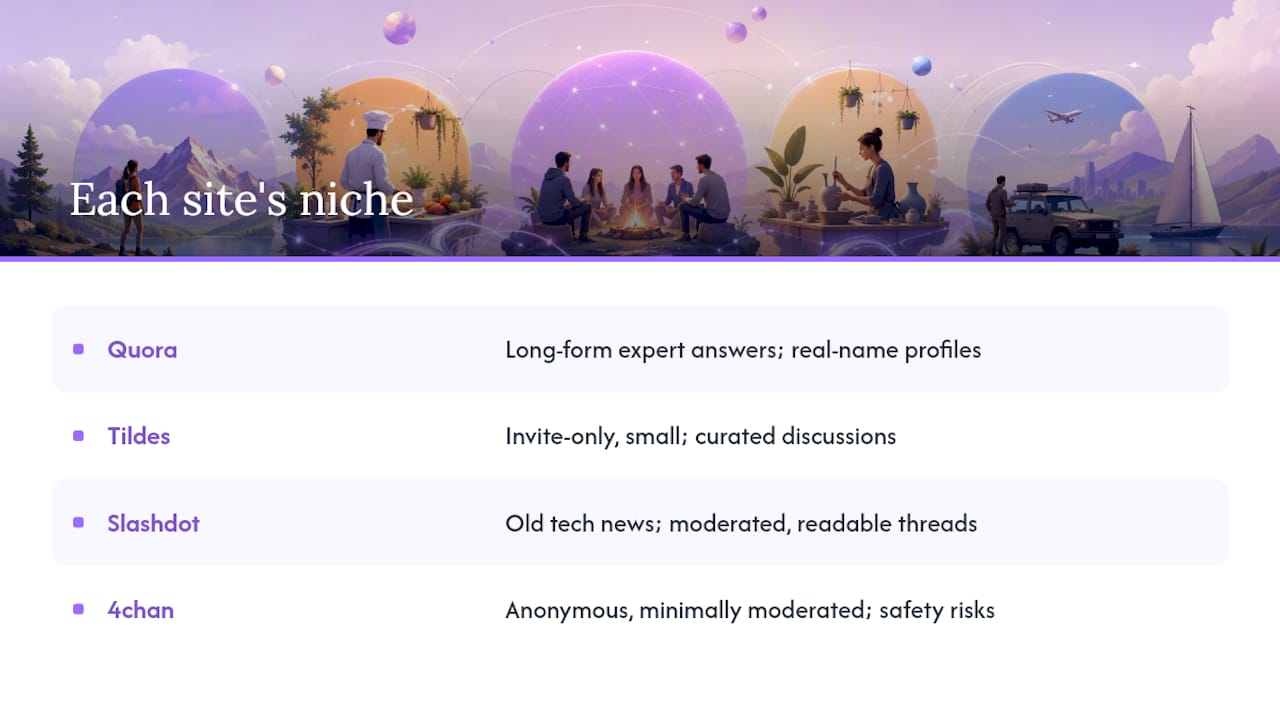
Slashdot is the original tech news aggregator, predating Reddit by years. Its community is smaller and older than it once was, but the comment moderation system (meta-moderation, karma filtering) still produces readable threads on technology topics. Think of it as a slower, more deliberate Hacker News with a longer institutional memory.
4chan requires a direct safety note: it is fully anonymous, minimally moderated, and hosts content that ranges from niche hobbyist communities to genuinely harmful material depending on the board. Some boards (e.g., /g/ for technology, /mu/ for music) have active, knowledgeable communities. Most boards carry significant safety risks, particularly for younger users.
On 4chan: The anonymity model produces both its most valuable content (unfiltered expert opinion with no reputation to protect) and its worst (harassment, illegal content on unmoderated boards). Never treat it as a general-purpose Reddit replacement. If you use it, stick to specific boards with established community norms and understand that content is ephemeral — threads expire and are not archived by default.
How do you choose the right Reddit alternative for your needs?
Pick by your primary motivation for leaving Reddit, not by feature lists. The alternatives that succeed do so by optimizing for one goal: privacy, curated discussion, real-time chat, or expert Q&A. Trying to find one platform that does all of them leads to disappointment.
Questions to ask before you commit:
- Do you need real-time chat and voice? If yes, Discord is the answer. Everything else is asynchronous.
- Is searchability and archival value critical? Stack Exchange and Hacker News are indexed by Google. Federated platforms and Discord are not.
- Do you want account portability? Bluesky (AT Protocol) and Mastodon (ActivityPub) both support it. Centralized platforms do not.
- How much moderation do you want? Tildes and Stack Exchange are strict. Saidit and 4chan are permissive. Lemmy varies by instance.
- Does your community need to be discoverable by strangers? Centralized platforms (Reddit, Quora, Stack Exchange) are publicly indexed. Discord and many federated instances are not.
- Are you migrating an existing community or starting fresh? Migrating requires admin cooperation, an archive strategy, and a realistic member-retention expectation.
Red flags to watch for:
- Single-admin instances with no stated backup or continuity plan (common on smaller Lemmy and Mastodon servers)
- Platforms with no search or archive function if your content has reference value
- Paywalls that gate basic participation without clear community benefit
- Instances that defederate frequently, which fragments your audience without warning
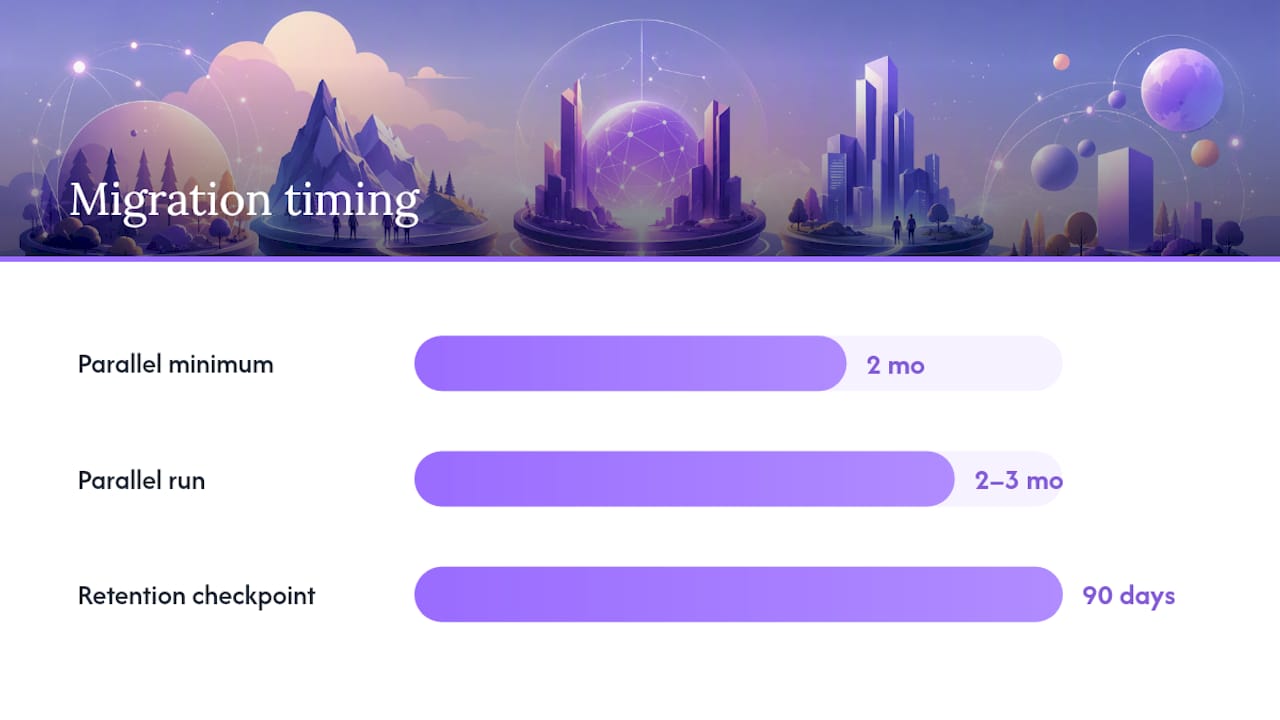
On costs and timelines: Most alternatives are free to join. Running your own instance costs roughly $5–20/month for a small server on a VPS, depending on traffic. Migrating a community realistically takes two to six months to reach stable activity on a new platform; expect to retain 20–40% of your original member count in the first three months.
Where do Reddit communities go, and how do you follow them?
Communities typically migrate to a mix of federated instances, Discord servers, and specialized sites. The fastest way to find where a specific subreddit moved is sub.rehab, a community directory that catalogs migration targets and tracks where communities landed after subreddit changes or Reddit policy shifts.
Migration checklist:
- Contact the mod team — Find the subreddit's moderators on their new platform before the migration announcement disappears.
- Use invite flows — For Discord and Tildes, generate invite links and pin them in the subreddit sidebar before migration.
Community-maintained GitHub lists (such as the GeorgeSG/sub.rehab repository) supplement the sub.rehab directory with additional mirrors and alternative instances worth checking.
| Migration resource | What it covers | Best used for |
|---|---|---|
| sub.rehab | Subreddit-to-platform migration directory | Finding where a specific community moved |
| GeorgeSG/sub.rehab (GitHub) | Community-curated alternative lists | Supplemental instance and mirror discovery |
| Platform instance lists (join-lemmy.org) | Active Lemmy instances by topic | Choosing the right federated home |
| Discord server directories (Disboard) | Public Discord servers by topic | Finding existing Discord communities |
Member retention after migration is almost always lower than organizers expect. A realistic target is 30% of active members within the first 90 days, with growth resuming only after the new platform reaches critical mass for that topic. Running parallel communities for the first two to three months consistently produces better long-term retention than a hard cutover.
How we evaluated these reddit.com alternatives
Platforms were evaluated on nine criteria matching the comparison table dimensions: moderation model, federation status, privacy and anonymity options, content focus, discovery and searchability, mobile app availability, activity level, cost, and migration feasibility.
Evaluation approach:
- Activity checks: Community size and post frequency were assessed using platform-native feeds, third-party roundups including Beebom's 2026 roundup and We360.ai's analysis, and direct browsing of each platform.
- Federation status: Verified against platform documentation and, for Lemmy, the open-source codebase on GitHub.
- Migration feasibility: Evaluated based on documented migration tools, invite flows, and community directory listings including sub.rehab.
Research was conducted in early 2026. Platform activity levels and federation policies change; verify current instance status before committing to a migration.
Can you use Reddit tools and APIs to ease the transition?
Partially. Reddit's API changes in 2023 broke most third-party apps and tools, which accelerated the migration wave in the first place. That said, several compatibility bridges exist.
For Lemmy, the API is open and documented, and several Reddit-to-Lemmy redirect tools exist as browser extensions that automatically reroute reddit.com URLs to their Lemmy equivalents. The Lemmy community maintains a list of these tools on join-lemmy.org.
For Mastodon and Bluesky, no direct Reddit API bridge exists, but cross-posting bots (built on platforms like n8n or Zapier) can mirror Reddit posts to a Mastodon or Bluesky account during a transition period, keeping both communities fed while members migrate.
Discord integrates with Reddit via bots like PRAW-based custom bots or services like Zapier, which can auto-post new Reddit threads to a Discord channel. This is a common transition strategy: keep the subreddit alive as a read-only feed while building the active community on Discord.
For communities that relied on Reddit's wiki feature, migrating to a dedicated wiki tool (Notion, Confluence, or a self-hosted MediaWiki instance) before the platform migration preserves reference content that would otherwise be lost.
What legal and content policy issues affect community migration?
Content policies vary significantly across these platforms, and some differences have real legal implications for US-based community operators.
DMCA compliance: Reddit, Discord, Stack Exchange, and Quora all have established DMCA takedown processes. Federated platforms like Lemmy and Mastodon place DMCA responsibility on individual instance operators. If you run your own instance, you are the operator of record and must handle takedown requests yourself.
User data and CCPA: California's Consumer Privacy Act applies to platforms that collect personal data from California residents above certain thresholds. Large centralized platforms (Discord, Quora, Bluesky) have compliance infrastructure. Self-hosted Lemmy or Mastodon instances operated by individuals may not, which creates legal exposure for instance operators who collect user data.
Content moderation liability: Section 230 of the Communications Decency Act protects US-based platforms from liability for user-generated content in most cases. This protection extends to federated instance operators who are US-based, but the legal landscape around Section 230 continues to evolve. Non-US instances operate under their own jurisdictions.
Age verification and COPPA: Platforms that knowingly collect data from users under 13 must comply with COPPA. Anonymous platforms like 4chan have no age verification, which is a legal and ethical risk for any community that might attract minors.
This is general information, not legal advice. Confirm current content policy and legal obligations with a qualified attorney before operating a community platform.
Key Takeaways
The single most important decision when leaving Reddit is matching your platform to your primary motivation: format parity, privacy, real-time engagement, or expert Q&A.
| Point | Details |
|---|---|
| Match platform to motivation | Choose Lemmy for Reddit's format, Mastodon for privacy, Discord for real-time chat, Stack Exchange for expert Q&A. |
| Federation fragments discovery | Federated platforms give you autonomy but require active effort to find and follow communities across instances. |
| Migration takes months | Expect two to six months for a community to stabilize on a new platform; retain parallel presence during the transition. |
| Check sub.rehab first | Before migrating, search sub.rehab to see if your community already has an established home elsewhere. |
| Vector-dsp for audio communities | Audio producers and DSP engineers will find relevant technical discussion on Hacker News and Stack Exchange; Vector-dsp covers DSP-specific topics directly. |
Why moderation and discovery matter more than UI
The platforms that fail communities are almost never the ones with the worst interface. They are the ones where moderation burned out or discovery collapsed.
Federation is the clearest example. Lemmy and Mastodon give communities genuine autonomy, but that autonomy comes with a real operational cost: volunteer admins who handle hosting, backups, moderation queues, and instance continuity. When a single-admin instance goes offline, the community disappears with it. No UI improvement fixes that structural fragility.
Discovery is the quieter problem. A Reddit community with 50,000 members is findable by anyone who searches the topic on Google. The same community rebuilt on a Lemmy instance is invisible to that search. Members who do not already know where to look will never find it. That is not a feature gap you can patch with a better mobile app; it is a fundamental architectural difference between federated and centralized platforms.
The practical implication: before you evaluate any alternative on its feature set, ask two questions. Who is running the moderation, and what happens if they stop? How will new members find the community in six months? The platforms that answer both questions well, whether through institutional stability (Stack Exchange, Discord) or through strong community directories and cross-promotion, are the ones worth building on.
Useful sources and reading to explore each alternative
- 12 Best Reddit Alternatives You Should Try in 2026 | Beebom
- 12 Best Reddit Alternatives in 2026-We360.ai
- sub.rehab · Find your next diving spot
- Snakk — Communities Worth Talking In
- join-lemmy.org
- LemmyNet/lemmy · GitHub
- Phorom
- Librear | Discover. Discuss. Share.
Vector-dsp builds tools for the communities that care about sound
Most of the platforms above are where audio producers and DSP engineers talk about their craft. Vector-dsp is where the tools they discuss actually get built. If you are a music producer or sound engineer who found this article while looking for a better community home, the technical discussions worth having about real-time DSP, low-latency processing, and plugin architecture are exactly what Vector-dsp covers.
ToneLab, Vector-dsp's flagship plugin, brings multi-lane parallel effects architecture with per-lane EQ targeting to VST3, AU, and AAX formats, running at real-time low latency across Windows and macOS DAWs. It is the kind of tool that generates the Hacker News threads and Stack Exchange questions worth bookmarking.
Try ToneLab and see whether precision DSP design changes how you work.