EQ Before Compression: Four Question Flow, Mix Recipes for Engineers
EQ Before Compression: Four Question Flow, Mix Recipes for Engineers
There is no universal rule for whether EQ belongs before or after your compressor. Use EQ before compression when a frequency (rumble, sibilance, mic thump) is unfairly triggering the compressor and needs to be tamed first. Compress first when you need predictable, full-spectrum gain reduction and plan to shape final tone afterward. Detector-side (sidechain) EQ offers a third path when you want to change how the compressor reacts without touching the audible signal at all.
TL;DR:
- Corrective EQ should be applied before compression to prevent problematic frequencies from triggering unpredictable gain reduction.
- Creative EQ, such as boosting presence or warmth, is best placed after compression once the dynamics are controlled and tonal balance is clear.
- Sidechain EQ offers a way to modify how a compressor responds without altering the audible signal, useful for controlling low-frequency pumping or resonances.
- The decision on EQ and compression order depends on whether you are fixing an active problem or shaping the sound character; most engineers default to fixing first, then shaping.
- A flexible approach combines corrective and creative moves, often using advanced multi-lane plugins to manage complex processing within a single signal chain.
Table of Contents
- How Pre-EQ Changes What the Compressor Actually Hears
- Corrective EQ vs Creative EQ: Vocals, Snare, Bass, and the Mix Bus
- A Four-Question Decision Flow For Choosing Order Mid-Session
- Sidechain EQ: Changing the Compressor's Reaction Without Touching the Tone
- What Sound On Sound, Berklee, and Sweetwater Agree On
- Quick Recipes to Start From Tonight
- Why Engineers Overcomplicate This More Than They Should
- Get Chains Like This Running Without the Guesswork
- Sources
How Pre-EQ Changes What the Compressor Actually Hears
A compressor doesn't respond to what you hear. It responds to whatever signal hits its detector circuit, and that detector reads level, not musicality. Insert an EQ before the compressor, and you're not decorating the sound. You're rewriting the instructions the compressor follows.
Boost a frequency before the signal reaches the compressor, and you raise how often that band crosses the threshold. Cut a frequency, and you lower it. This is why a bass guitar with a boomy 80 Hz peak can make a compressor chatter unpredictably. That low-end energy keeps tripping gain reduction even when the rest of the performance is sitting at a reasonable level.
Attack and release settings compound the effect. A boosted band with a fast attack triggers gain reduction almost instantly, which can suck the life out of transients you actually wanted to keep. A boosted band with a slow release keeps the compressor working longer after the peak has already passed, dragging down material that has nothing to do with the original problem. Sound On Sound frames this directly: cutting problem frequencies before compression stops them from dominating the detector's decision-making, while leaving the tonal shaping for later.
Here's the mechanism in short form:
- Pre-EQ boosts increase how often and how hard a band triggers gain reduction.
- Pre-EQ cuts reduce a band's influence on the detector, calming erratic compression.
- Attack time determines how fast the compressor reacts to that altered signal.
- Release time determines how long the altered reaction lingers after the peak.
A quick statistic to frame this: there's no published percentage for "how much" pre-EQ shifts gain reduction, because it depends entirely on the boost or cut applied and the compressor's ratio. But the qualitative pattern is consistent across engineering references. Sweetwater notes that EQ placed before a compressor changes how the compressor responds to that spectral content, while EQ placed after gives more predictable, repeatable tonal results. That predictability is exactly what you sacrifice, and exactly what you gain, depending on where you put the filter.
Corrective EQ vs Creative EQ: Vocals, Snare, Bass, and the Mix Bus
The cleanest way to think about ordering isn't "before or after." It's "corrective or creative." Berklee Online draws this line clearly: fix problems before the compressor, shape character after it. That single distinction resolves most of the confusion engineers run into.
- Vocals. Cut low-frequency mic thump and rumble below 100 Hz before compression, since that energy can trigger the compressor even when it's inaudible in the mix. Tame harsh sibilance with a narrow pre-compression dip if it's aggravating gain reduction on "s" and "t" sounds. Save the flattering moves, a presence boost around 3 to 5 kHz or warmth around 200 Hz, for after compression, once the dynamics are settled and you can hear the true tonal balance.
- Snare and drums. Resonant ringing or boxy buildup around 400 to 800 Hz should come out before the compressor, or it will pump the whole hit unevenly. Interestingly, some engineers deliberately boost high frequencies before compression on drums specifically to control transient slap when the attack time is fixed and can't be adjusted further, a trick worth knowing rather than fighting.
- Bass. Clean up flabby low end and unwanted harmonics below 60 Hz before the compressor so the detector isn't chasing sub-frequency energy that never makes it through smaller speakers anyway. Once the low end is tight, use post-compression EQ to dial in the tonal presence that cuts through a mix on real playback systems.
- Mix bus. For glue compression, most engineers avoid heavy pre-compression EQ on the bus itself and instead fix problems at the track level, letting the bus compressor react to a signal that's already balanced. Post-bus EQ then handles final brightness or width adjustments without undoing the glue you just built.
Pro Tip: If you're not sure whether a boost belongs before or after your compressor, ask whether it's fixing a problem or adding flattery. Fixes go first. Flattery goes last.
A Four-Question Decision Flow For Choosing Order Mid-Session
Run through these before you touch a knob:
- Is there a technical issue actively triggering the compressor? Rumble, plosives, resonant ringing, or a stray frequency spike. If yes, EQ before compression to remove it.
- Are you chasing a specific compressor character that should react to the full spectrum? Glue compression, bus cohesion, or a vintage-style clamp. If yes, compress first and shape tone afterward.
- Will adding EQ after compression undo the compressor's work? A big post-compression boost can push a band back over the level the compressor just tamed. If so, go back and re-evaluate your threshold and ratio rather than layering more EQ on top.
- Still not sure? Apply subtle corrective EQ first, compress conservatively, then finish with broader tonal EQ after. This order works as a safe default for most sources.
A few practical notes to keep nearby while you work through that flow:
- Automation can sometimes replace heavy compression entirely, an approach Splice recommends alongside subtractive EQ as the first move in any mix.
- Revisit your compressor settings every time you add or remove a significant EQ move, since the two are never fully independent.
- Document which order you used per track. Six months from now, you won't remember why the snare chain looks the way it does.
For a deeper breakdown of chain order beyond just EQ and compression, Vector-dsp's guide to plugin order mixing walks through a similar four-question framework applied to a full signal chain.
Sidechain EQ: Changing the Compressor's Reaction Without Touching the Tone
Detector, or sidechain, EQ is a different tool entirely. Instead of filtering the audio that reaches your speakers, you filter only the copy of the signal the compressor's detector listens to. The audible path stays untouched. Only the compressor's decision-making changes.
Common recipes include a high-pass filter on the detector to stop low-frequency pumping, and narrow cuts targeting a specific resonance that keeps causing erratic gain reduction. Hugh Robjohns at Sound On Sound describes this as frequency-conscious compression: you get the tonal benefits of leaving the audio path untouched while still controlling exactly what triggers the squeeze.
- Reach for detector EQ when insert-based pre-EQ would audibly thin out a sound you want to keep intact.
- Use a gentle high-pass around 80 to 100 Hz on the detector for bass and kick to stop sub-frequency pumping.
- Use a narrow, moderate cut at the exact resonant frequency when one note or hit keeps triggering harder than the rest.
Pro Tip: If your compressor doesn't offer a dedicated sidechain EQ, some plugins let you split the signal into a parallel lane, filter that lane, and use it purely as the detector feed while your main path stays clean.
What Sound On Sound, Berklee, and Sweetwater Agree On
Three of the most cited references in mixing education land on the same conclusion, and it's rare for that much agreement to exist on a topic engineers argue about constantly.
There is no absolute rule governing EQ and compression order. The choice comes down to intent: remove problems before the compressor, shape character after it. Corrective work belongs first; creative work belongs last.
- Sound On Sound frames the choice as corrective versus creative, not a fixed law of mixing.
- Berklee Online teaches both orders explicitly and pushes students to test each on real material rather than memorize a rule.
- Sweetwater notes that pre-EQ changes compressor behavior while post-EQ keeps that behavior predictable, a trade-off rather than a right-or-wrong answer.
Some modern plugin architectures reflect this same thinking. Multi-lane parallel processing with per-lane EQ targeting can let you route a cleaning EQ ahead of a compression stage on one lane while running a separate creative EQ after dynamics on another, all inside a single low-latency signal path instead of stacking multiple standalone plugins.
Quick Recipes to Start From Tonight
- Vocal: Pre-EQ high-pass around 80 to 100 Hz, gentle de-ess if needed, then compress with a 3:1 ratio, medium attack (10 to 20 ms), fast release. Add presence and warmth after.
- Snare: Cut boxiness near 400 to 500 Hz pre-compression, then use a medium attack to preserve some crack before gain reduction kicks in.
- Bass: Clean sub-60 Hz mud pre-compression, then compress at a moderate ratio and finish with tonal EQ for definition.
- Bus glue: Fix at the track level, compress the bus with a slow attack, and reach for parallel compression if you want density without losing all transient life. Blend the parallel path in at roughly 20 to 30% for a start.
Why Engineers Overcomplicate This More Than They Should
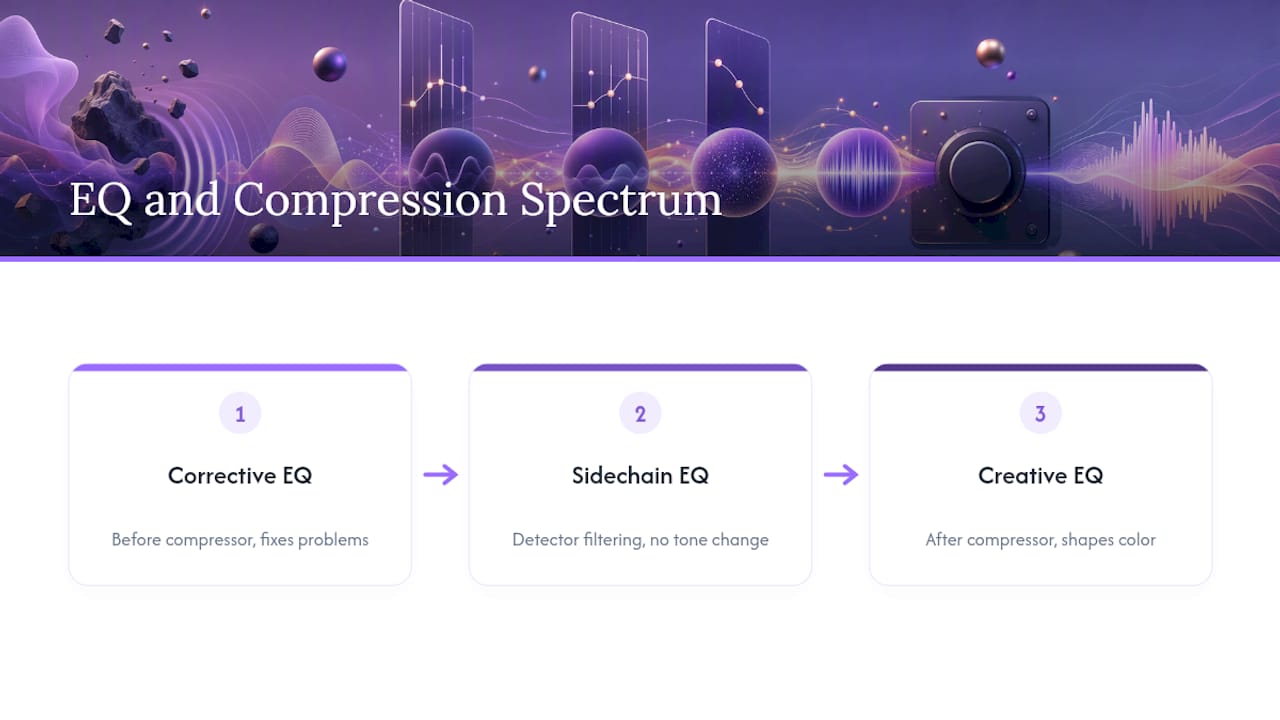
Most of the confusion around EQ and compression order comes from treating it as a technical rule instead of a question about intent. It isn't. The mechanics are simple once you separate "fixing a problem" from "shaping a color." What the conventional advice gets wrong is presenting this as a binary choice, EQ first or compress first, when the more useful mental model is a spectrum: corrective moves at the front of the chain, creative moves at the back, and sidechain EQ available whenever you need to change compressor behavior without touching the tone at all.
Where I'd push back on common practice is the habit of defaulting to compress-first out of convenience rather than judgment. It's often faster, sure. But a compressor reacting to an untamed resonance is fighting a fire it shouldn't have to fight, and no amount of post-EQ fully undoes that. The reader's priority should be diagnosing the source material first: is something misbehaving, or does it just need color? That single question, asked before touching any plugin, resolves most of the ordering debate that forums treat as a religious argument.
What's genuinely underrated is sidechain EQ. Engineers reach for insert EQ far more often than detector filtering, even when detector filtering solves the exact problem with less collateral damage to the tone.
— Kai
Get Chains Like This Running Without the Guesswork
Building a chain where corrective EQ, compression, and creative tonal shaping all coexist usually means stacking three or four plugins and hoping the signal routing behaves as expected. Some plugins use a multi-lane parallel architecture with per-lane EQ targeting, so you can clean a problem frequency on one lane, compress it, and reshape tone on another lane, all inside one low-latency plugin instead of a chain of separate ones.

That routing flexibility matters most on exactly the sources covered above: a vocal that needs a de-essed lane and a warmth lane, a snare that needs transient control on one path and body on another, a bass that needs sub-cleaning without losing tonal weight. Some plugins run in VST3, AU, and AAX across Windows and macOS, with a free demo available before you commit to a license. If you want to try building one of these chains yourself, check out audio plugin sites and download demos to hear them against your own sessions.
Sources
- Q. Should EQ first or compress first? — Sound On Sound
- EQ Before or After Compression? — Berklee Online Take Note
- EQ Before or After Compression? — Sweetwater